

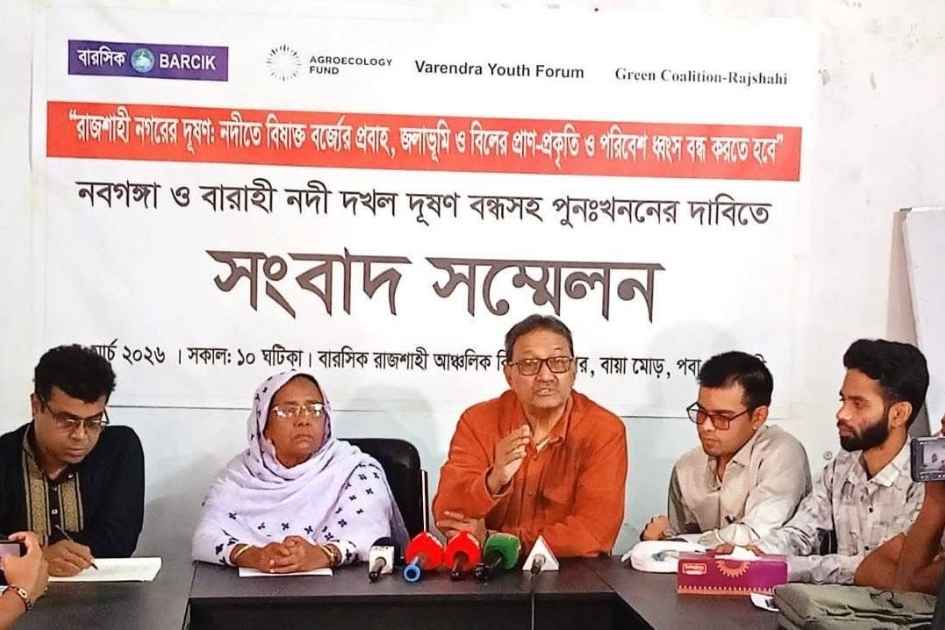



Civil society groups warn untreated urban waste in Rajshahi is contaminating rivers and wetlands, harming biodiversity, public health, fisheries, and agriculture, and urge urgent government action to prevent wider ecological disaster.
Environmental groups in Rajshahi, a major city in northwestern Bangladesh, warned on Sunday that untreated urban waste is severely polluting rivers and wetlands connected to the Padma River system, raising serious concerns about public health, agriculture and regional food security.
The warning came during a press conference held Sunday morning at the BARCIK Rajshahi Resource Center, jointly organized by Green Coalition, Barendra Youth Forum and BARCIK. Speakers included Mahbub Siddiqui, convener of Green Coalition Rajshahi district; Rahima Khatun, convener of Paba upazila; Shahidul Islam, regional coordinator of BARCIK in the Barendra region; and Atikur Rahman Atik, president of Barendra Youth Forum.
According to the organizers, unplanned urban expansion and inadequate management of solid and liquid waste have led to widespread pollution, encroachment and ecological degradation in rivers and water bodies surrounding the city.
Environmental monitoring by the groups found that large volumes of untreated wastewater flow daily through drains and canals into several rivers originating from the Padma, including the Swarmangala, Barahi, Naboganga and Barnoi rivers. Once known for their natural flow and biodiversity, these rivers are now turning dark, polluted and foul-smelling.
Sediment buildup, plastic waste and toxic discharge have disrupted natural water flow, while fish populations and aquatic life have declined sharply. Local fishers say their livelihoods are increasingly threatened as fish catches continue to fall and river ecosystems deteriorate.
“This is no longer just an environmental issue. It is a public health and food security crisis,” said Atikur Rahman Atik, president of Barendra Youth Forum, during the press conference.
The pollution is also spreading into nearby low-lying wetlands, including Sapmara Beel, Bokmari Beel, Bhugoroil Beel, Paikorer Beel and Borobaria Beel, which support agriculture, fisheries and biodiversity across thousands of hectares.
Activists say contaminated water is causing long-term waterlogging, reducing fish production and seeping into farmland.
As a result, crop yields and safe food production are increasingly at risk. There are also concerns that polluted water could eventually reach Chalan Beel, one of Bangladesh’s largest inland wetland ecosystems, potentially threatening the wider regional environment.
Speakers at the event warned that communities living near the polluted rivers and wetlands are already experiencing health problems. Residents have reported cases of skin diseases, waterborne illnesses and respiratory discomfort linked to foul odors from contaminated water bodies.
Children, women and elderly residents are considered particularly vulnerable, while low-income farmers and fishers are bearing the direct economic impacts of environmental degradation.
Environmental advocates emphasized that the crisis is not only about pollution but also about environmental justice and the safety of future generations.
At the press conference, organizers urged authorities to take several urgent steps. They called for immediate action to remove encroachment and pollution from the Swarmangala, Barahi and Naboganga rivers and to ensure proper management of liquid and solid waste in Rajshahi city.
They also demanded the installation and effective operation of modern sewage treatment plants and the enforcement of mandatory effluent treatment plants in industries, hospitals and commercial facilities with strict monitoring.
The groups further called for an independent investigation committee to identify sources of pollution and encroachment and to publicly release its findings, along with comprehensive testing of water and soil quality in affected rivers and wetlands. They emphasized the need for a coordinated restoration master plan involving local communities, youth groups, environmental organizations and experts.
Environmental groups urged relevant government authorities, including the Ministry of Environment, Forest and Climate Change, Bangladesh, the Department of Environment, Bangladesh and the Bangladesh Water Development Board, to take immediate and coordinated action to prevent further ecological damage.
Activists warned that without swift government intervention, the pollution crisis could escalate into a broader environmental and public health emergency affecting ecosystems, livelihoods and food systems across the region.




