

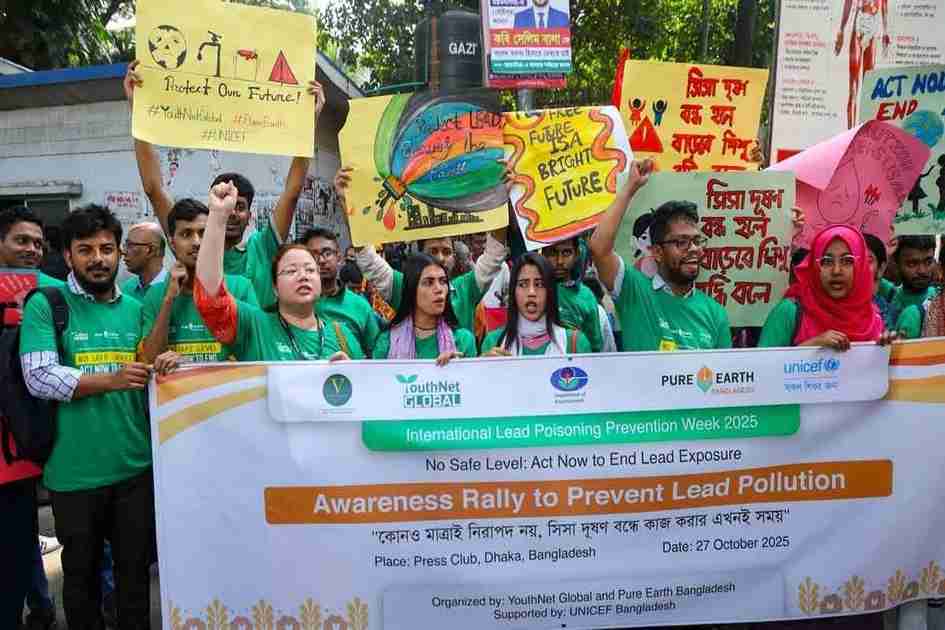



Bangladeshi youth are confronting a silent public health emergency, exposing toxic lead pollution from batteries, shutting illegal factories, and pushing policy change to protect children, workers, and communities nationwide today.
In Bangladesh, millions of children live every day under an invisible threat. Lead, a heavy metal that slowly accumulates in the body, is poisoning the next generation. More than 36 million children, nearly 60 percent of all children in the country, carry dangerously high levels of lead in their blood. The consequences are devastating and irreversible, including permanent brain damage, learning difficulties, behavioural disorders, cardiovascular disease, pregnancy complications and premature death. Economists estimate the annual cost to Bangladesh’s economy at six to nine percent of GDP through lost productivity, healthcare expenses and long-term cognitive harm.
The sources of lead exposure are deeply embedded in everyday life. Electric rickshaws fill the streets of Dhaka and other cities, powered by lead-acid batteries that leak toxic substances when they degrade, fail or are discarded. Solar home systems, installed in more than four million households and credited with expanding electricity access to over 20 million people, depend on similar batteries. Nearly half of these systems are now defunct due to battery failure, poor maintenance or prolonged inactivity. In both cases, spent batteries are often dumped or recycled informally. Informal recycling and smelting operations process these batteries near schools, residential areas, agricultural land and forests, releasing toxic dust into air, soil and water. Children play nearby, often unaware that every breath, touch and mouthful of food can carry lifelong consequences.
Bangladesh’s streets hum with battery-powered rickshaws, widely celebrated as an affordable and low-carbon transport solution. There are now more than six million nationwide, including up to 1.2 million in Dhaka alone. Each rickshaw relies on lead-acid batteries that last barely one to one and a half years before being replaced. This creates a constant and growing stream of hazardous waste. Solar home systems tell a similar story. Over 4.1 million were installed over the past two decades, yet nearly 47 percent are no longer functional. Many of their batteries end up in informal workshops where lead is smelted without safety equipment, environmental clearance or waste controls.
Thousands of such operations operate close to schools, homes and forests. Toxic dust settles into soil and water, quietly poisoning entire communities. The burden falls most heavily on children and workers, particularly those living in low-income and marginalised areas. What appears to be a technical problem of waste management is in reality a profound crisis of public health, child rights, environmental justice and accountability.
Amid this crisis, YouthNet Global has emerged as a force for change. The organisation has trained hundreds of youth leaders across the country to understand, document and act against lead pollution. Through the SolveLeadPollution campaign, YouthNet Global mobilised communities across all 64 districts of Bangladesh. From schools to marketplaces, youth volunteers educated peers, neighbours and families about lead exposure and its impacts. More than 1.5 million people were reached through awareness programmes, digital platforms and national and international media. Students became messengers, raising concerns about unsafe workshops and questioning hazardous practices in their neighbourhoods. Rallies, human chains and community meetings brought national attention to what was once an invisible crisis, while extensive media coverage amplified the urgency of the issue.
By educating youth leaders on Bangladesh’s toxic battery recycling problem, YouthNet Global transformed awareness into action. Youth documented polluters, alerted authorities, influenced policymakers and forced accountability through sustained public pressure. According to Pure Earth Bangladesh, more than one thousand abandoned toxic lead sites continue to poison children every day, underscoring the urgency of youth-led monitoring and enforcement.
In Narayanganj, the impact of this movement became vividly clear. Fariha, a young climate activist, noticed persistent coughing and nausea among students at a madrasa located next to an informal battery recycling facility. She documented the toxic lead oxide fumes and alerted local authorities. With support from YouthNet Global and Pure Earth Bangladesh, the factory was shut down, eliminating daily exposure for hundreds of children. Her action demonstrated how individual youth leadership, when supported by strong networks and institutions, can produce life-saving outcomes.
Fulbaria in Narsingdi district offers another powerful and painful lesson. For more than a decade, residents lived under the shadow of a Chinese-owned battery recycling factory. Toxic dust contaminated farmland, ponds and the air. Crops failed, children fell ill and workers laboured in hazardous conditions without protective equipment or healthcare. YouthNet Global worked alongside residents to document the damage, organise community action and bring the struggle to courts and national media. Rakib Hasan, a young environmental defender, emerged as a local leader, mobilising workers and residents to demand justice. The Supreme Court eventually ordered the permanent closure of the factory. Yet the aftermath revealed deeper systemic challenges. Workers were left without livelihoods, soil and water remained contaminated and the long-term health impacts persisted. Fulbaria showed that addressing lead pollution requires not only enforcement but also remediation, worker protection and a just transition.

Government authorities have acknowledged the critical role of youth in driving this transformation. “The Department of Environment has been conducting regular enforcement drives across the country to curb lead pollution, including monitoring and compliance actions against illegal and unsafe practices,” said Md Ziaul Haque, Additional Director General of the Department of Environment. “YouthNet Global is actively supporting local-level monitoring and reporting, helping communities hold polluters accountable.”
The impact of youth-led action is already measurable and significant. Nearly fifty illegal lead smelting and recycling facilities have been shut down across multiple districts. Additional illegal sites have been demolished following youth documentation and mobile courts have imposed fines and jail sentences on polluters. Youth advocacy contributed directly to the development and approval of Bangladesh’s first National Action Plan on Lead Pollution. Lead poisoning is now formally recognised by authorities as a public health emergency rather than a marginal environmental issue.
“YouthNet Global’s efforts to raise mass awareness, mobilise communities and drive evidence-based advocacy have been extraordinary,” said Syeda Rizwana Hasan, Adviser with ministerial rank for Environment, Forest and Climate Change, Water Resources and Information and Broadcasting. “Their work has ensured that lead pollution is no longer ignored.”
Bangladesh’s experience demonstrates that young people, when educated, organised and empowered, can confront even the most hidden environmental health threats. They are documenting polluters, alerting authorities, shaping enforcement decisions and influencing national policy. They are transforming silent crises into urgent public priorities.
Looking ahead, YouthNet Global plans to expand youth monitoring networks, launch a digital platform for anonymous reporting of illegal lead operations, strengthen district-level monitoring committees and advocate for the formal classification of lead as a toxic substance. Over the coming years, the organisation envisions nationwide surveys of blood and environmental lead levels, closure of unsafe factories, school-based prevention programmes and a transition to sustainable, non-toxic energy storage technologies that protect both communities and workers. At the global level, YouthNet Global will advocate for regional cooperation and international action, including a dedicated resolution at the United Nations Environment Assembly.
The fight against lead pollution is not only about reducing toxic exposure. It is about transforming systems, ensuring environmental justice, protecting vulnerable communities and securing a just transition to safer and more sustainable technologies. With sustained youth-led advocacy, public engagement and cross-sectoral collaboration, Bangladesh can achieve a lead-free environment, a fairer society and a healthier future for generations to come.
There is no safe level of lead. The stakes could not be higher. But in the hands of Bangladesh’s youth, hope, courage and collective action are already changing the course of history.




