

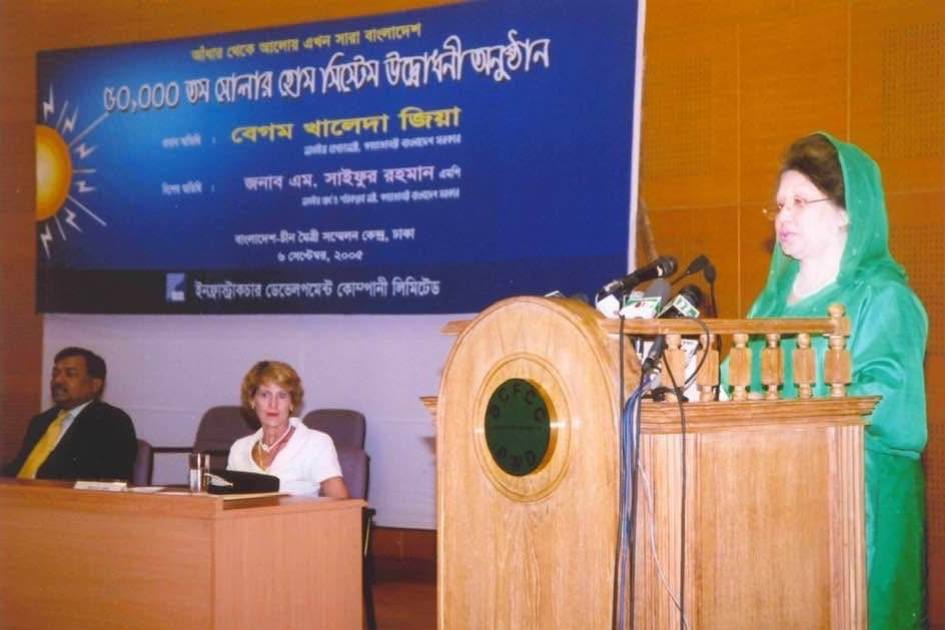



Bangladesh became a global solar leader as Khaleda Zia backed solar homes, rural electrification and girls’ education, delivering clean energy to millions and shaping inclusive, climate-friendly development nationwide and beyond.
Bangladesh has emerged as a global leader in off-grid solar electrification, providing clean electricity to millions through its pioneering Solar Home System (SHS) programme. Former Prime Minister Begum Khaleda Zia played a key role in the early promotion of renewable energy, linking rural development, women’s education and climate-friendly solutions.
In 2005, Khaleda Zia officially inaugurated the 50,000th solar home system via a satellite link from Dhaka to a remote household in Feni district, marking a major milestone in the government-led initiative. According to Muhammad Fauzul Kabir Khan, former Adviser to the Caretaker Government on Power, Energy, Mineral Resources, Road Transport, Bridges and Railways, the milestone also included interactions with local communities, highlighting the programme’s focus on improving rural livelihoods and education for girls.
Through a satellite connection, she spoke with a schoolgirl from the household who expressed excitement at receiving solar electricity. Khaleda Zia asked the girl what she would serve if she visited, to which the girl replied with local delicacies including polao, lobsters, rice cakes and buffalo yogurt. Khaleda Zia thanked the girl for the invitation, encouraged her to focus on her studies and advised her parents not to marry her off at a young age.
Khan noted that Khaleda Zia’s warmth and approachability were evident throughout the interaction. Her vision of development focused on economic reform, rural electrification and empowering women through education, policies that have left a lasting impact on Bangladesh’s journey toward inclusive growth and sustainable development.
Launched in January 2003 by the Infrastructure Development Company Limited (IDCOL), with support from the World Bank and the Global Environment Facility (GEF), the SHS programme provides affordable solar electricity to households without access to the grid. Over the years, it has installed more than six million systems, supplying clean electricity to an estimated 18 to 24 million people who previously relied on kerosene lamps. This has significantly reduced indoor air pollution and greenhouse gas emissions while enabling local businesses and improving educational opportunities.
A 2021 World Bank report noted that Bangladesh’s SHS programme had cut millions of tonnes of CO₂ equivalent, offering a globally recognized model for scaling renewable energy in rural areas. Bangladesh’s approach combines government leadership, innovative financing through IDCOL, partnerships with NGOs and private sector providers and micro-loans for households, providing a blueprint for low-carbon, inclusive growth.
By linking rural electrification with sustainable energy solutions, Bangladesh continues to shape global renewable energy strategies. The nation is expanding solar initiatives to schools, hospitals and rooftops, ensuring that clean energy contributes to climate resilience, sustainable development and an improved quality of life for its citizens.




