

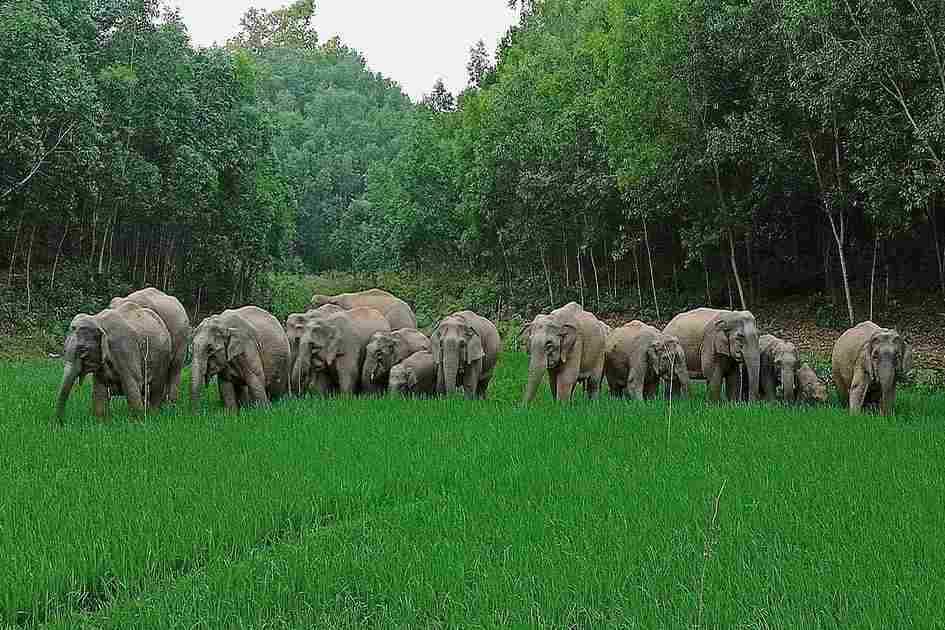



Farmers in Sherpur’s hill areas are harvesting paddy early as hungry elephants raid fields, exposing growing human-wildlife conflict and urgent need for sustainable, long-term solutions to protect both livelihoods and wildlife.
Residents of the hilly border areas in three upazilas of Sherpur have spent more than three decades battling wild elephants, as hungry herds driven by food shortages in the forest raid ripening paddy fields and force farmers to harvest their crops early to save what they can.
With repeated attempts to protect their fields failing, many farmers are now cutting half-ripe paddy and bringing it home before the usual harvest time, fearing that elephants will destroy everything if they wait any longer.
Agriculture officials have promised compensation for crops damaged in elephant attacks, while the local member of parliament has called for the prime minister and the forest minister to intervene to find a lasting solution to the conflict between humans and elephants.
People living in the Garo Hills along the Sherpur border say daily encounters with wild elephants have become part of life as they struggle to maintain their presence in the hills. With too little food available in the forest, the large animals are descending on cropland in search of food and devouring nearly mature paddy.
As the harvest season approaches each year, herds of elephants move into farmland in the hilly areas of Sreebardi, Jhenaigati and Nalitabari upazilas, destroying ripe paddy fields. Farmers say they have tried to drive them away by lighting fires and beating drums, but the attacks continue.
The recent rise in elephant raids has pushed farmers to cut paddy while it is still partly green. Because half-ripe paddy yields less than fully matured crops, they are also suffering financial losses. Local farmers are demanding urgent measures to ensure enough food for elephants inside the forest so that crops grown through hard labour can be protected.
Elias Sangma, a farmer from the Christian Para village in the Balijuri area of Sreebardi upazila, said elephant herds arrive every year when the paddy begins to ripen.
“This year I cultivated paddy with borrowed money,” he said. “If the elephants eat the crop, I will be ruined, so I am cutting the half-ripe paddy and taking it home.”
Romizul Islam, a farmer from the hilly village of Nakshi in Jhenaigati, said a herd of around 35 to 40 wild elephants entered the village a few days ago and destroyed the half-ripe paddy of many residents by eating it and trampling it underfoot.
“That is why we are harvesting the paddy before it ripens fully out of fear of the elephants,” he said. “If they attack again, even this much will not be saved.”
Mahmudul Hasan Akand, agriculture officer of Sreebardi upazila, said crops are damaged by elephant attacks every year in the hilly areas.
“The government provides compensation to farmers whose crops are destroyed in attacks by wild elephants,” he said. “This year we are preparing a list of farmers whose fields have been damaged. After proper verification, compensation will be given to the genuine victims.”
Forest officials said shrubs suitable as elephant food have already been planted in the forest to discourage the animals from entering human settlements and to ensure they find enough food in the wild. But Sumon Mia, ranger of the Balijuri Range under the Mymensingh forest division, said the amount of such planting remains insufficient.
He said a much larger plantation of elephant-friendly trees and shrubs could significantly reduce attacks on villages and cropland.
Mohammad Mahmudul Haque Rubel, the BNP lawmaker for Sherpur-3, which covers Sreebardi and Jhenaigati, said the government must move quickly to resolve the human-elephant conflict permanently.
According to forest department data, about 100 elephants live in the Sreebardi, Jhenaigati and Nalitabari areas of Sherpur, divided into three separate groups.




