

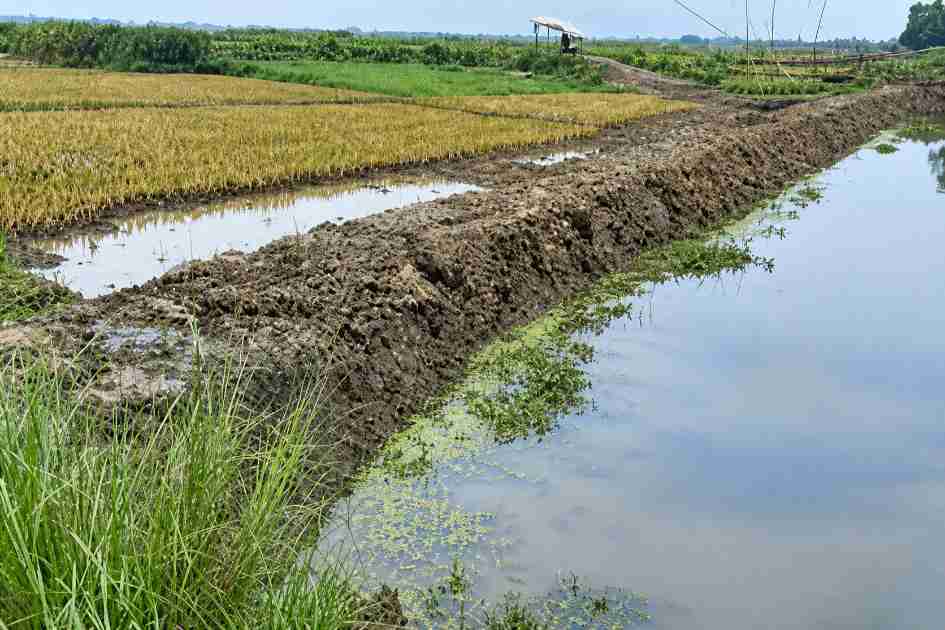



Rising Atrai River water and continuous rain are flooding Chalan Beel fields, putting thousands of hectares of Boro paddy at risk as farmers and authorities scramble to contain the damage.
Fresh inflows from the Atrai River have started entering Chalan Beel through five canals in Natore’s Singra upazila after two days of continuous rain, raising fears that nearly 26,000 hectares of standing Boro paddy could be submerged if the water is not brought under control quickly.
The warning has come from the Singra upozila agriculture office itself, as local authorities and farmers work around the clock to hold back the rising water.
According to the office of the Singra upazila agriculture officer, continuous rain has been falling in the Chalan Beel area of Singra for two days since Thursday night. As a result, paddy fields in relatively low-lying areas have already started going under water.
But the main concern now is the Atrai River. Water flowing down from upstream in northern India has started entering Chalan Beel through five canals in Singra: Jormollika, Sardanagar-Hulhulia, Katuabari, Rakhalgachha and the municipal crematorium ghat canal.
With the support of the administration, local farmers are trying to block the canal mouths with earthen embankments. But there are fears that the barriers may collapse if the river level continues to rise and the rain persists. If that happens, large parts of Chalan Beel could go under water within a short time, submerging vast stretches of paddy.
This year, Boro has been cultivated on 36,610 hectares of land in Singra. Harvesting has already begun and, according to the agriculture department, 30 percent of the crop has been cut so far. But nearly 26,000 hectares of paddy are still standing in the fields and farmers need another 15 to 20 days to complete the harvest.
Local people said water from the Atrai River started entering Jormollika field through the area beneath the Jormollika bridge on the Singra-Atrai road from Friday night. After receiving the news, farmers stayed awake through the night and used earth-cutting equipment to build a soil embankment under the bridge. Because of that barrier, the water level has risen further. If the water breaks through, paddy on 250 to 300 hectares of land in the area could go under.
Water from the Atrai River had already begun entering the main part of Chalan Beel through the Sardanagar-Hulhulia canal from Thursday night. After being informed, the upazila officer and the agriculture officer rushed to the spot yesterday. With their financial support, local residents built an earthen barrier to stop the flow. But local farmers said there is a risk that the embankment could give way at any time.
The area facing the greatest danger is Katuabari and the North Domdoma Jolarbata sluice gate area. A section of the sluice gate is broken, allowing water from the Atrai River to enter the beel. Local residents are trying to hold back the flow with sandbags.
River water has also started entering the beel through the mouths of the Rakhalgachha canal and the municipal crematorium ghat canal.
Singra upazila agriculture officer Khandakar Farid confirmed the risks, saying that two-thirds of the paddy produced in the beel remains unharvested. In this situation, early rainwater from upstream and the past two days of local rainfall have become a major cause for concern.
Farmers are being advised to harvest their paddy quickly. But many are still not using harvesters. The reluctance comes because paddy cut by machine fetches a comparatively lower price, making many farmers unwilling to use them.
Field-level agriculture staff are giving farmers the mobile phone numbers of harvester owners to help them get in touch directly. It is hoped that from today, Saturday, farmers will begin using harvesters to cut the crop. At the same time, all possible administrative support is being provided to build earthen embankments and control the water.




