

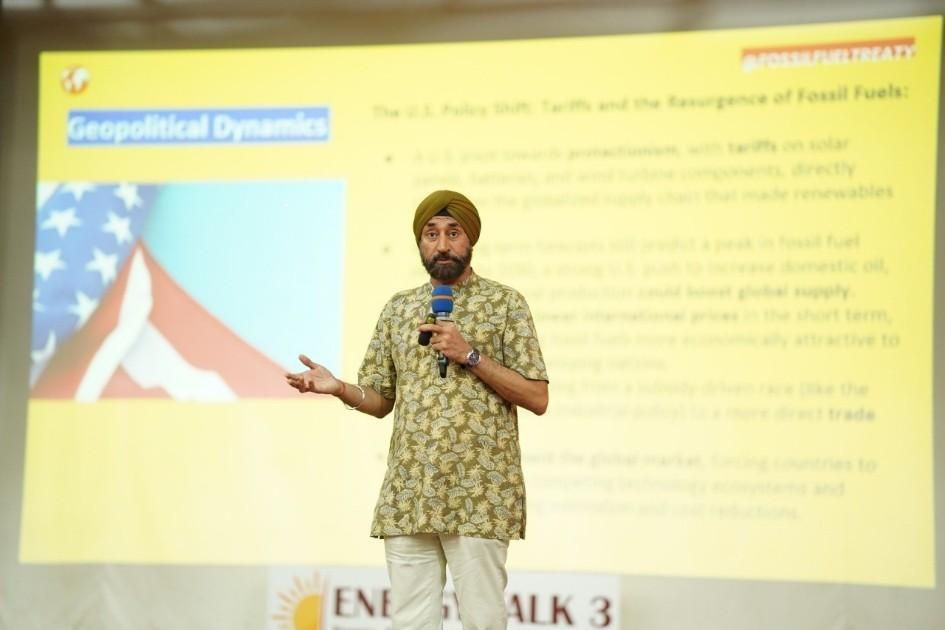



Climate activist Harjeet Singh was arrested in Uttar Pradesh a day after an ED search, sparking concern among rights groups that regulatory actions are narrowing civic space in India.
The arrest of renowned climate activist Harjeet Singh by India’s Uttar Pradesh excise department on Tuesday for keeping “excess” liquor at home has renewed debate over civic space and the use of regulatory laws against independent voices.
The arrest, confirmed by Sanjay Singh, assistant excise commissioner of Ghaziabad, came a day after the Enforcement Directorate (ED) searched Singh in a foreign exchange violation case related to the alleged misuse of around Rs 6 crore received from abroad and narrative-building on behalf of foreign influencer groups, officials said. The ED probe focuses on climate advocacy narratives in India, particularly relating to the Fossil Fuel Non-Proliferation Treaty (FF-NPT), a proposed international agreement aimed at phasing out fossil fuel production globally.
The arrest came a day after the ED conducted searches at Singh’s residence and at the premises of his company, Satat Sampada Pvt. Ltd. (SSPL), in Delhi and Ghaziabad under the provisions of the Foreign Exchange Management Act (FEMA). Authorities noted that the excise case is legally distinct from the FEMA investigation, though the timing of the two actions has drawn public attention.
The agency also said Singh’s foreign travel is under scrutiny. His participation in the Breathe Pakistan Summit in February 2025 and his visit to Bangladesh in December 2025 are being examined for funding sources and the nature of meetings held. The ED alleged that during his Bangladesh visit, Singh delivered a lecture at the Climate Justice Assembly held at Sher-e-Bangla Agricultural University in Dhaka and met individuals described by the agency as unrelated to the stated purpose of the trip, coinciding with protests characterised by the ED as anti-India.
More climate activists are on the radar of the Enforcement Directorate, which searched properties linked to Singh in a funding probe triggered by intelligence received during the UN climate summit COP30 in Brazil. Officials, speaking on condition of anonymity, said the intelligence suggested certain climate activists were jeopardising India’s position on issues such as the use of fossil fuels.
As part of the same operation, the ED also searched the residence of Sanjay Vashisht, director of Climate Action Network South Asia (CANSA). No charges have been proven in either case and authorities say investigations remain ongoing.
According to the ED, SSPL received foreign remittances worth approximately Rs 6 to 6.5 crore between 2021 and 2025, reportedly routed as consultancy charges and agro-product sales from international entities including Climate Action Network (CAN) and Stand.Earth. These organisations, the agency claimed, had themselves received funding from donors under India’s Prior Reference Category, such as Rockefeller Philanthropy Advisors, which requires prior approval from the Ministry of Home Affairs before transferring funds to Indian entities.
The ED alleged that cross-verification of filings indicated the funds were intended to advance FF-NPT advocacy in India rather than for genuine consultancy work. SSPL reportedly turned profitable after 2021 following these inflows and the ED further alleged that Singh and co-shareholder Jyoti Awasthi diverted portions of the funds for personal use.
Indian authorities maintain that all actions are being carried out strictly according to the law. No charges have yet been proven in either the ED investigation or the excise case, which remain ongoing.
The developments have sparked concern among civil society organisations and environmental activists, who warn that repeated use of financial and regulatory laws against independent civil society groups risks shrinking democratic space and silencing critical voices in climate advocacy. Social media campaigns calling for Singh’s release, using slogans such as “Free Harjeet Now,” have gained momentum.
The latest action comes amid a wider pattern of regulatory scrutiny affecting civil society organisations in India, particularly those engaged in human rights and environmental advocacy. Over the past decade, several international NGOs have been forced to scale back or shut down operations. Amnesty International closed its India office in 2020 after its bank accounts were frozen. Greenpeace India has faced licence suspensions, while the Ford Foundation was placed under enhanced scrutiny over its funding activities.
In September 2022, the Income Tax Department conducted surveys on Oxfam India and other organisations over alleged Foreign Contribution Regulation Act violations. In April 2023, the Central Bureau of Investigation filed an FIR against Oxfam India alleging further violations, which the organisation has denied.
India has experienced a significant contraction of civic space, with thousands of NGOs reportedly losing access to foreign funding after FCRA licences were revoked or suspended. Analysts say smaller grassroots organisations dependent on sub-grants have been particularly affected, leading many groups to shift away from advocacy toward service-oriented or technical work linked to the Sustainable Development Goals.
Rights groups warn that constraining civil society risks weakening democratic oversight and undermining India’s credibility on climate leadership at a time when inclusive engagement is seen as essential to addressing the climate crisis. The CIVICUS Monitor has downgraded India’s civic space rating from obstructed to repressed, citing legal and administrative barriers faced by independent organisations.
Commenting on the broader implications, Sohanur Rahman, executive coordinator of YouthNet Global, said the developments highlight a growing tension between climate action and civic freedoms.
“Climate justice cannot be separated from democratic space,” Rahman said. “When environmental advocacy is treated with suspicion and control, it risks silencing the very voices that are working to protect communities, ecosystems and long-term national interests. A healthy democracy needs room for independent civil society to question, engage and contribute constructively.”




