




Bangladesh is seeking closer employer involvement in technical education as green industries create demand for skills in sustainability, workplace safety and emerging industrial sectors.
Dhaka seeks stronger industry-TVET partnerships to prepare workforce for a sustainable industrial future.
As Bangladesh moves towards a greener and more technology-driven industrial economy, the country needs a workforce equipped with green skills, environmental awareness and industrial safety knowledge, said Mohammad Navid Safiullah, Additional Secretary of the Ministry of Environment, Forest and Climate Change.
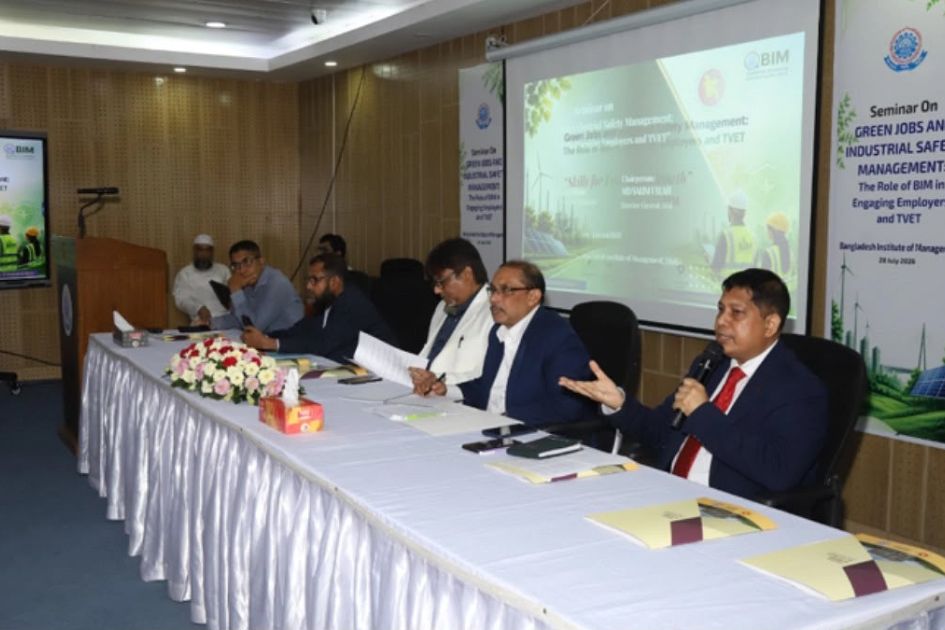
He made the remarks at a seminar titled “Green Jobs and Industrial Safety Management: The Role of BIM in Engaging Employers and TVET”, organised by the Bangladesh Institute of Management (BIM) at its Sobhanbag campus in Dhaka on Monday.
The seminar brought together policymakers, industry leaders, technical education administrators, employers, academics and development partners to discuss how Technical and Vocational Education and Training (TVET) graduates can be better prepared for the changing demands of the labour market.
Safiullah said Bangladesh’s transition towards a green economy requires closer collaboration among government, industries and educational institutions. He added that sustainable industrial growth will depend on developing workers with the skills needed for emerging sectors.
Skills gap remains a key challenge
Speakers said that although Bangladesh has made significant progress in expanding technical education, industries continue to face shortages of skilled workers due to a mismatch between training outcomes and workplace requirements.
They stressed the need to modernise TVET curricula, expand apprenticeship and internship opportunities, increase industry participation in skills development and strengthen collaboration between employers and educational institutions.
With a large young workforce entering the labour market every year, Bangladesh faces the challenge of ensuring that technical education keeps pace with rapid changes in global industries.
Green transition creating new employment opportunities
The seminar highlighted that the global transition towards environmentally sustainable production and the growing adoption of Environmental, Social and Governance (ESG) standards are creating new employment opportunities in renewable energy, sustainable manufacturing, environmental management, waste management, energy efficiency and industrial safety.
Speakers said industries worldwide increasingly require workers equipped with sustainability knowledge, green skills and occupational safety competencies, which could significantly improve the domestic and international employment prospects of Bangladeshi technical graduates.
BIM reaffirmed its commitment to continuing research, policy dialogue, professional training and stakeholder engagement to support green industrial development, industrial safety management and improved employment opportunities for technical education graduates in Bangladesh.
Government calls for industry-led skills development
Abdur Nasar Khan, Secretary of the Ministry of Industries, attended the programme as the chief guest and said sustainable industrial development depends largely on creating a technically skilled workforce capable of meeting the needs of modern industries.
“Green skills, industrial safety and industry-oriented technical education are becoming increasingly important for Bangladesh’s economic transformation,” he said, calling for stronger partnerships among government agencies, industries, TVET institutions and BIM.
Abul Khair Md Akkas Ali, Director General (Additional Secretary) of the Directorate of Technical Education under the Ministry of Education, emphasised the importance of aligning TVET programmes with evolving industrial demands through greater industry participation in curriculum development, practical training and competency assessment.
He appreciated BIM’s initiative and reaffirmed the Directorate’s commitment to working with stakeholders to improve the employability of technical education graduates.
Engineer Md Ruhul Amin, Chairman of the Bangladesh Technical Education Board (BTEB), highlighted the need to modernise TVET curricula and increase industry involvement in apprenticeship programmes, certification and competency development.
BIM to strengthen employer-TVET collaboration
The seminar was chaired by Md Salim Ullah, Director General of BIM, who reaffirmed the institution’s role in connecting industries with technical education providers.
“BIM aims to become a strategic bridge between employers and technical education institutions by promoting industry-driven skills development,” he said.
He highlighted BIM’s ongoing efforts to enhance the career readiness of TVET graduates through professional training, industry engagement and policy dialogue.
Delivering the keynote presentation, Dr Mohammad Nazmi Newaz, Senior Management Counsellor and Head of the General Management Division at BIM, discussed the changing nature of industrial management, the rise of green employment opportunities and the growing importance of workplace safety.
He also presented BIM’s proposed initiatives to develop specialised career pathways in industrial safety management and other emerging occupational sectors for TVET graduates.
Representatives from government agencies, industry associations, private sector organisations, development partners and technical education institutions participated in the discussion and shared recommendations on strengthening industry-TVET collaboration.
The seminar concluded that Bangladesh’s success in green industrial transformation will depend not only on investment in technology but also on developing a workforce equipped with the right skills, safety knowledge and adaptability for the jobs of tomorrow.




