

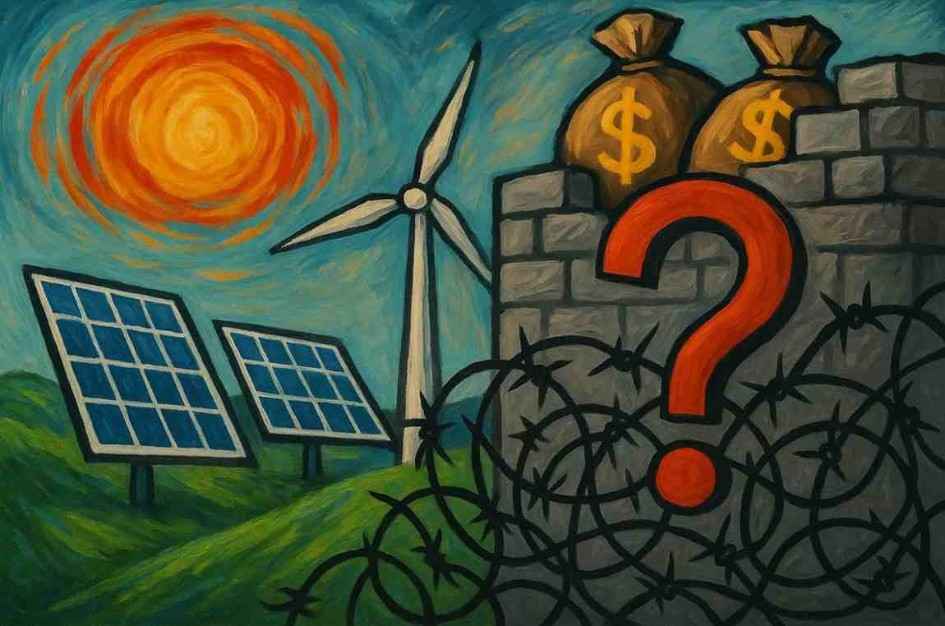



Bangladesh’s renewable energy ambitions face major financing barriers. Banks favor short-term efficiency projects over long-tenor renewables, citing risks and collateral demands. Policies exist but poor implementation, gender gaps, and fund shortages slow progress, leaving clean energy goals uncertain despite urgent national targets.
When 35-year-old Sohel Rana [not his real name] walked into a Dhaka bank in 2022, he carried high hopes for a rooftop solar project at a Narayanganj shoe factory. Electricity costs were rising, and supply remained unstable, making the project vital for cost control and smooth operations.
“We are a foreign company and came here to do business smoothly,” he recalls. “I submitted all the required documents, but the bank delayed approval for about one year.”
By the time the loan was sanctioned, the panels had already been installed—financed by the company’s own capital. Even leasing companies offered little relief. IDCOL, the state-backed financier of renewable energy projects, also failed to provide timely support.
Rana’s frustration reflects a deeper problem: across Bangladesh, small- and medium-scale renewable energy developers continue to face formidable financing barriers, despite the country’s ambitious clean energy targets.
“As we have foreign investment, many local investors who express interest in launching such projects still leave their green goals unimplemented. This affects the country’s renewable energy targets, leaving them uncertain,” Rana adds.
Rana’s struggle is emblematic of broader systemic challenges in Bangladesh’s renewable energy financing landscape, where national goals often clash with ground realities.
Energy efficiency dominates, renewables lag behind
Bangladesh has committed to achieving a 100% reduction in emissions by 2050, in alignment with the Paris Agreement of 2015. Renewable energy’s share in the country’s green finance portfolio has remained flat at around 6%–7% in recent years.
Instead, energy and resource efficiency dominate, receiving more than four times the financing of renewables, according to both Bangladesh Bank and BIBM survey data.
Between 2021 and 2023, only 3%–7% of green finance from banks and financial institutions went to renewable energy. By June 2024, renewables accounted for just 6.66% of green finance and 1.05% of sustainable finance, according to the Bangladesh Bank data.
As of March 2025, renewable energy projects had received Tk 54.84 billion, or just 6.7% of the Tk 820.56 billion total green finance portfolio, the BB survey data said.
As revealed in the recent survey data, except for solar home systems and net metering rooftop solar systems, the percentage share of renewable energy finance to total finance is insignificant.
The amount of financing is significantly higher for men in both urban and rural areas than for women from 2021 to 2024.
The survey also said roofs are a great resource for generating highly cost-competitive solar energy. The solar home system has the largest contribution to green finance, followed by integrated cow-rearing biogas plants, solar irrigation pumping systems, and biogas plants.
In contrast, financing for energy and resource efficiency reached Tk 225.37 billion—27.5% of the total. This imbalance stands in sharp contrast to Bangladesh’s national ambitions: 30% renewable energy by 2030 and 40% by 2041 under the Mujib Climate Prosperity Plan (MCPP).
Experts acknowledge that both energy efficiency and renewables are pillars of the energy transition. But banks find efficiency projects more attractive, as they typically require shorter loan tenors of five years or less and carry faster payback periods. Renewables, with longer repayment horizons, are often sidelined.
“While the central bank allows financial institutions to provide loans to renewable energy projects for more than five years, financial institutions consider this risky,” said Shafiqul Alam, lead energy analyst at the Institute for Energy Economics and Financial Analysis (IEEFA).
“As there are different energy-efficient technologies based on production processes in different industries, the demand for energy efficiency financing is higher than renewable energy financing,” he opined.
Alam stated, “Apart from rooftop solar projects, small-scale renewable energy projects, such as biogas and biomass, are normally based in rural areas, for which financial institutions have limited information on the credit profiles of rural borrowers.
“This often deters rural borrowers from accessing the green funds for projects like biogas and biomass. Financial institutions also feel that they do not receive high-quality project proposals for loans to renewable energy projects.”
A credit risk guarantee scheme may help address the perceived risks of renewable energy projects and encourage financial institutions to provide loans to them, according to Alam.
Risk aversion and collateral demands
High collateral requirements often deter industries from applying for green loans. Similar credit guarantee schemes in countries like India and Kenya have successfully unlocked financing for small-scale solar and community energy projects. Experts say Bangladesh could adapt such models to ease collateral burdens and accelerate renewable investment.
“Community-level projects are considered even riskier due to lack of information,” Alam says. He suggests that credit risk guarantee schemes and annual renewable energy finance targets for banks could help mitigate risks and encourage more investment.
A.S.M. Munir, company secretary of the Bangladesh Sustainable and Renewable Energy Association (BSREA), argues that the problem lies in financing culture. “Sustainable finance includes different categories, with renewable energy being just one of them. Banks often prefer other products they view as cleaner energy options,” he says. “To my knowledge, none of the BSREA members or renewable energy entrepreneurs have been able to obtain loans through Bangladesh Bank’s financing schemes.”
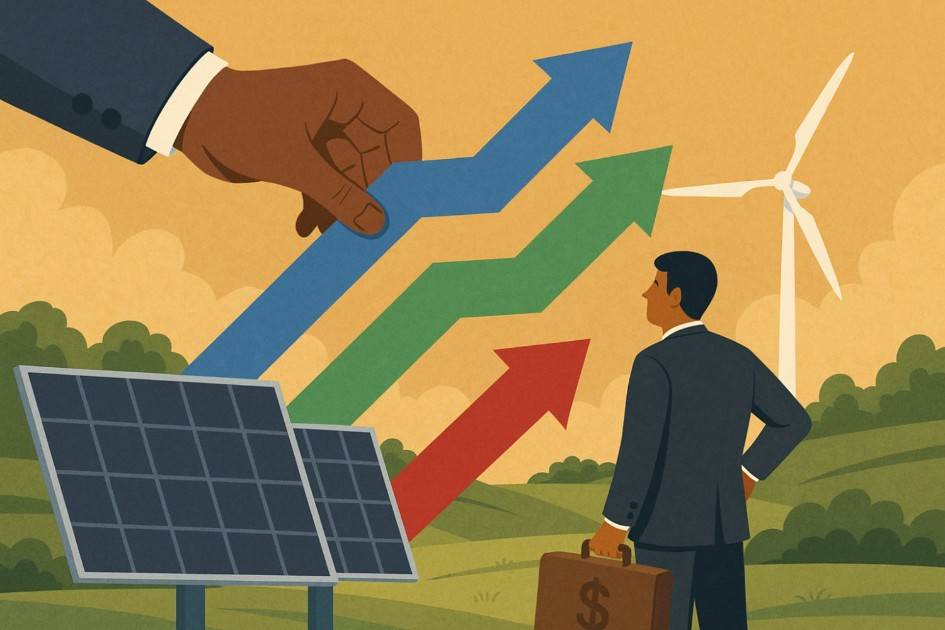
Munir adds that while commercial banks are not outright unwilling to lend, the low profit margins in renewable energy discourage them. IDCOL’s financing facilities, he says, are technically available, “but the high collateral requirements and other obstacles frequently make these loans inaccessible for many borrowers.”
Engineer Naznin Akther, Managing Director of GSOLARIC Bangladesh Ltd and Director of SOLARIC Limited, echoed similar concerns.
She said as many as 300 solar businesses, ranging from small to large, are grappling with huge challenges in securing loans – mostly for their rooftop solar projects – from commercial banks.
“A significant number of entrepreneurs, both small and large, could not obtain loans from private banks due to issues with equity and collateral,” Naznin said.
She also noted that while some entrepreneurs without prior business experience manage to get loans and generate returns – which is understandable – many genuine entrepreneurs with years of experience struggle to secure financing.
“This is often due to restrictive commercial bank policies or the banks’ limited capacity to properly evaluate and engage with solar businesses,” she added.
Naznin emphasized that the lack of accessible financing is slowing down the growth of renewable energy in Bangladesh. “If banks adopt more flexible and informed lending policies, rooftop solar projects could expand much faster, contributing to the country’s clean energy goals,” she said.
Policy progress, but poor implementation
Bangladesh has introduced multiple policies over the years to accelerate renewables. The 2008 Renewable Energy Policy offered incentives, and the creation of the Sustainable and Renewable Energy Development Authority (SREDA) in 2012 marked a key step.
More recently, Bangladesh Bank launched refinancing programs, a Green Transformation Fund, and environmental risk management guidelines, culminating in a Sustainable Finance Policy in 2020 and the upcoming Green Credit Guarantee Scheme. Yet, progress remains slow on the ground.
“Banks are still risk-averse and lack capacity to assess renewable energy projects,” says a SREDA official. “Many don’t even know how to evaluate the technical and commercial viability of solar or biogas projects.”
Khondkar Morshed Millat, faculty member at Bangladesh Institute of Bank Management (BIBM) and former director, Sustainable Finance Department of Bangladesh Bank, underscored the urgent need for a national structured database of technical service providers and potential entrepreneurs to ease loan access for CMSMEs.
“Without a structured and centralized database, banks struggle to properly assess and support CMSMEs,” Millat said. “Such a system would streamline financing and create greater confidence among lenders.”
He pointed out that at present, only 15–16 banks are actively financing CMSMEs, while most others remain absent. “Many banks either lack the institutional capacity to serve this segment, or their boards are simply reluctant to get involved,” he explained.
Md Shamsuddoha, chief executive of the Centre for Participatory Research and Development (CPRD), underscored the oversight gap, saying, “There should be a distinct category in financing, which we call sustainability financing.
“Every project must be scrutinized carefully to see whether it truly aligns with the definition of sustainability provided by the regulator. In my view, there is poor monitoring and supervision by regulators on whether the projects undertaken by entrepreneurs genuinely qualify as sustainability financing.”
“The capacity of private bank officials to identify the proper definition of green and sustainability financing is still very poor. They need comprehensive training to build their expertise in this area,” Shamsuddoha added.
He also stresses monitoring, “Without such oversight and institutional capacity, many projects risk being labeled as ‘sustainable’ without meeting true criteria, undermining the credibility of green financing initiatives in the country.”
Calling for coordinated efforts, Millat emphasized the role of government agencies and regulators. “SREDA, the Power Development Board, Bangladesh Bank, the Department of Environment, and other relevant stakeholders must work together if Bangladesh is to achieve its ambitious renewable energy targets,” he said.
Capacity building, according to him, is crucial. “SREDA should take the lead in launching training and capacity-building initiatives, not only for entrepreneurs but also for banks,” he suggested.
“Both sides need to understand the risks, opportunities, and mechanisms of renewable financing.” Millat emphasized A-to-Z capacity building for A-to-Z concerns.
Millat also highlighted the excessive bureaucratic hurdles entrepreneurs face. “At present, 15 to 20 different permissions are needed just to start a business,” he said. “How can we expect entrepreneurs – especially women – to take interest in such a system?”
Institutional and infrastructure barriers
Policy inconsistencies and coordination failures further complicate financing.
The Mujib Climate Prosperity Plan envisions 40 percent renewable energy by 2041, but the Integrated Energy and Power Master Plan (IEPMP) 2023 forecasts only 8.8 percent under a broader “clean energy” label, which still prioritizes fossil fuels.
“This disconnect sends mixed signals to financiers: should they trust the 40% ambition or the modest 8.8% target?” notes one private banker.
Land scarcity adds to another hurdle.
A 1MW ground-mounted solar plant requires around 2.5 acres, making acquisition costly and legally complex in densely populated Bangladesh. These barriers discourage both investors and lenders from supporting utility-scale solar and wind projects.
Small-scale focus, big-picture problem
Most renewable financing in Bangladesh has supported small projects such as solar home systems, rooftop solar, irrigation, and biogas plants—often backed by IDCOL. While safe and relatively low risk, these projects alone are insufficient to meet national goals.
Large-scale ventures, such as utility-scale solar or wind farms, struggle to secure capital domestically, pushing them to depend on international finance, foreign direct investment, and multilateral development banks.
Alam notes: “For utility-scale projects, Bangladesh Bank’s green funds are inadequate due to the volume required. International finance, FDI, and multilateral development bank funding are more suitable for large projects.”
Gender disparities add another layer: from 2021 to 2024, men received significantly more renewable financing than women, with few gender-smart initiatives in place to close the gap.
BB green refinancing schemes see slow progress
Over the past decade, Bangladesh Bank (BB) has expanded its portfolio of green financing initiatives, introducing multiple refinancing schemes to encourage industries to adopt sustainable technologies and practices.
These initiatives aim to promote renewable energy, resource efficiency, and eco-friendly modernization across various sectors, reflecting the country’s increasing focus on green industrial transformation.
The tenor under the Tk10 billion refinancing scheme is within 3 to 10 years, with a debt-equity ratio of 70:30. The required debt limit from participating financial institutions (PFIs) is open for the project as demanded.
“The 70:30 debt-equity ratio is simply unrealistic for most small entrepreneurs,” Naznin said. “It means they must invest 30% of the project cost from their own pocket, which CMSMEs often cannot afford.
As a result, many of them are excluded from accessing loans under this refinancing scheme,” said Engineer Naznin, who is also a woman entrepreneur and director of Bangladesh Solar and Renewable Energy Association (BSREA).
For women entrepreneurs, the challenge is even greater, as they usually have less access to collateral and family-owned assets. As a result, many are excluded from accessing loans under this refinancing scheme, she pointed out.
“The open-ended debt requirement from participating financial institutions (PFIs) often creates an additional barrier, making it difficult for smaller businesses to access the loans they need,” Naznin stated.
On renewable energy financing, Millat was critical of the narrow focus of banks and financial institutions.
“Most banks are only interested in rooftop solar projects because Bangladesh Bank is not encouraging banks for low-cost funding under its refinancing schemes due to huge land scarcity, which means the overall contribution to renewable finance is insignificant,” he noted.
Millat attributed the lack of interest in larger solar projects to land scarcity. “The shortage of suitable land is one of the chief reasons banks are unwilling to finance utility-scale solar projects.”
Quality import substitutions is a crucial factor in one way, and high import duties on raw materials of renewable energy products are another big concern.
Millat also linked financing challenges to gender inequality in entrepreneurship. “We have failed to empower women entrepreneurs under the current financing structure,” he said.
“Women often lag behind in securing loans, as they are forced to rely on their husband’s funds or family resources. The system is not designed to support them independently.”
“No collateral is required up to BDT 5 lakh for both male and female entrepreneurs, and collateral-free loans are allowed up to BDT 25 lakh for women. Again, there is a huge advantage of collateral-free and personal guarantee-free loans under the credit guarantee scheme, subject to eligibility criteria issued by the Credit Guarantee Department of Bangladesh Bank,” he said.
But these facilities are not widely known among CMSME groups, and banks are not actively informing entrepreneurs about them. Some banks hesitate to use credit guarantee facilities because the approval process at Bangladesh Bank can be time-consuming, according to him.
He added that the Bangladesh Bank’s approval process for issuing credit guarantees should be expedited.
Millat highlighted a huge gap between policy and practice, ultimately affecting CMSME groups. “So access to finance is a challenge, but the biggest challenge is the information gap,” he said.
He argued that existing bottlenecks in financing undermine broader development goals, especially women’s economic inclusion.
“If women cannot access financing, how can we expect them to grow as independent business leaders?” Millat asked.
Large allocations, slow implementation
Despite the significant funds allocated to these schemes, the actual disbursement of loans remains slow. This indicates both opportunities and challenges in aligning financial mechanisms with Bangladesh’s sustainability goals.
An official from the Bangladesh Bank, speaking anonymously to Climate Watch, revealed that there are currently 40 clients who have applied for loans worth Tk 8.0 billion under different refinancing schemes offered by the central bank through various banks and financial institutions.
Fund shortage and expansion plans
The official acknowledged that the central bank is struggling to meet the demand for loans due to a shortage of funds. “We are facing difficulties in providing loans and are considering expanding our fund offerings to overcome this crisis,” the official stated.
This highlights the critical need for enhanced financial resources and strategies to ensure the success of BB’s green financing initiatives and their alignment with the country’s sustainability ambitions.
Refinance scheme for environment-friendly products
BB first introduced a revolving refinance scheme in 2009 with an initial allocation of Tk 2 billion. The goal was to support solar energy, biogas plants, and effluent treatment plants (ETPs), areas that were struggling to attract conventional financing. Over time, the scheme evolved significantly.
The fund size was increased to Tk 4 billion, and later to Tk 10 billion in 2023. Coverage was expanded to 70 green products under 11 categories. Since inception, a cumulative Tk 14.82 billion has been disbursed from the scheme up to March 31, 2025.
This expansion reflects rising industry demand for environmentally friendly technologies, though disbursement levels indicate there is still room for stronger uptake.
Green Transformation Fund
Launched in January 2016, the Green Transformation Fund (GTF) began with USD 200 million to help the export-oriented textile and leather sectors import eco-friendly machinery and raw materials. The central bank halted disbursements for foreign currency loans in 2020.
However, in December 2022, Bangladesh Bank also rolled out a local-currency refinance scheme under the GTF worth Tk 50 billion. By March 31, 2025, Tk 18 billion had been disbursed to 63 clients through 20 banks, including Tk 1.18 billion in the January–March 2025 quarter alone.
Technology development and upgradation fund
Another significant initiative is the Tk10 billion Technology Development and Upgradation Fund, created under the Export Policy 2021–2024.
The fund supports modernization and technological upgrades across 35 industrial sectors under 11 initiatives, channeled through 29 banks and 9 finance companies.
By March 31, 2025, total disbursements had reached Tk 9.83 billion. During January–March 2025 alone, Tk 0.63 billion was disbursed across seven projects, reflecting continued interest in industrial modernization.
Shariah-based refinancing schemes
A Shariah-based refinancing scheme worth Tk 1.25 billion was introduced to encourage the adoption of green products. However, the funds have already been discontinued due to a lack of popularity.
Banks finance green projects, but carbon impact needs monitoring
Bangladesh Bank’s Sustainable Finance Policy requires quarterly reporting of green and sustainable loans. But most disclosures focus on volumes rather than verified carbon reductions.
International standards such as the Partnership for Carbon Accounting Financials (PCAF) and ISSB’s climate disclosure rules push banks to quantify financed emissions—something Bangladesh has yet to adopt.
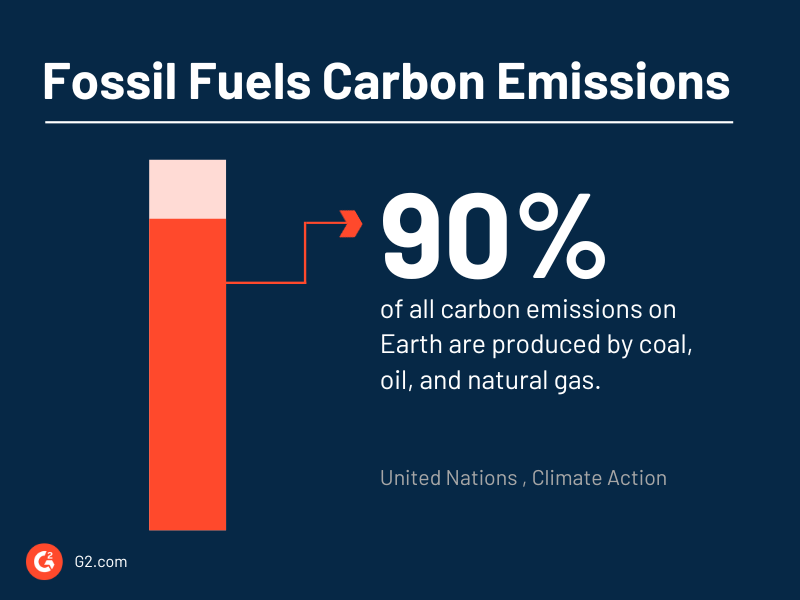
“Many banks are financing energy-efficient technologies across various industries, such as apparel, to reduce carbon emissions. However, there should be a robust monitoring mechanism to track whether these projects actually achieve lower carbon outputs, and the results should be systematically documented,” Shamsuddoha said.
Signs of hope, but risks of missed opportunities
There are bright spots. A 2024 NBR circular reinstated 10-year tax exemptions for private renewable projects. The Power Division is pushing for 500–2,000 MW of private solar plants.
International financiers such as ADB, EIB, IFC, and Germany continue to pledge support. Success stories like the Muktagacha Solartech Energy project (20 MW), financed by ADB and a local bank, show what is possible.
Yet for every success, there are dozens of stories like Rana’s—marked by delays, high collateral demands, and risk aversion.
Until such barriers are systematically addressed, Bangladesh’s clean energy transition risks remaining stuck in pilot projects, far from the scale needed to achieve its ambitious goals.




