




The article argues that Nepal’s flood disaster exposes a slow, underfunded loss-and-damage system, raising questions over grants, debt relief and responsibility for vulnerable countries including Bangladesh.
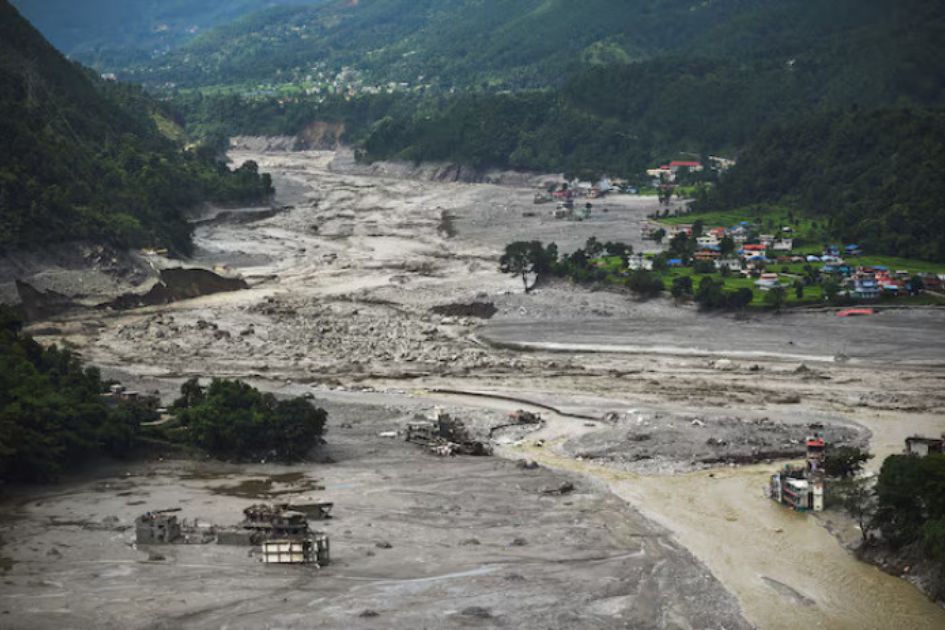
Zero point zero five percent. That was Nepal’s share of the world’s annual CO2 emissions in 2024, according to Our World in Data; its share of cumulative historical emissions since 1751 is just 0.01 percent. Yet after a section of mountain near Langtang Lirung peak collapsed on August 26, the resulting flood of mud, stone and ice surged down the Trishuli and Lhende Khola rivers for about a hundred kilometers. It tore through settlements including Betrawati Bazaar in Rasuwa and Devighat in Nuwakot. As of September 12, according to the Kathmandu Post, Nepal’s National Disaster Risk Reduction and Management Authority had recovered 1,386 bodies, with 5,130 people still unaccounted for. As of September 6, Chinese state news agency Xinhua had reported 43 dead and 519 missing in Tibet, according to Al Jazeera. Nepali authorities have estimated the economic cost at between $4 billion and $7 billion. The country that has contributed almost nothing to this crisis of global warming is now paying the heaviest price. There is no room to view this incident as merely an isolated natural disaster. It is essentially a reflection of the utter failure of global climate politics and an unequal global structure.
Many criticize the tendency to broadly label every natural disaster directly as the sole consequence of climate change as a hasty move. Drawing the line between how much global climate change is responsible and how much local geological structure is involved behind a specific geographical event is not always scientifically easy. If these cautions are ignored, the discussion will sound one-sided and indirectly hand arguments over to the opposition. But even accepting that scientific caution, the foundation of the main argument does not weaken. No matter where the share of responsibility lies, the risk of damage is always distributed completely unequally.
Researchers say the slope above Langtang Lirung had been destabilizing for years, as permafrost at high altitude thawed and the terrain grew progressively less stable, a pattern scientists link to warming in mountain regions generally. Earlier disasters in the region, including the 2021 landslide-dam flood on the Melamchi River in Sindhupalchok district, which killed at least 21 people amid heavy monsoon rain and rapid snowmelt, had already signaled the Himalayas’ growing instability. On July 8, 2025, a glacial lake outburst flood struck the same Rasuwa district, when a supraglacial lake roughly 36 kilometers north of the Nepal-China border burst and sent a surge down the Lhende stream, sweeping away the Miteri Pul border bridge and leaving 20 people missing, according to Nepal’s Department of Hydrology and Meteorology and the ICIMOD.
The question is therefore not why it happened but what happens next. Right here the gap between the promises made by the developed world and harsh reality is most nakedly exposed. Nepal had already submitted three separate proposals to the Fund for Responding to Loss and Damage (FRLD), the UN’s dedicated climate loss-and-damage mechanism, earlier this year, before the August disaster. On September 9, the fund confirmed $20 million for Nepal under that earlier request. A separate emergency appeal filed after the flood, on September 1, is still awaiting a decision. Digging into the fund’s numbers reveals a system that, in practice, cannot deliver what it promises: it holds $822 million in total pledges, but only around $350 million of that is currently earmarked for disbursement. Under this same initial funding window, nearly 180 project proposals have been submitted from different parts of the world, with combined financial demand already crossing $2.8 billion.
Under the fund’s initial modalities, individual country requests currently range from five to twenty million dollars, a startup-phase ceiling rather than a permanent rule. Even the twenty million dollars Nepal has now secured is well under one percent of the estimated four to seven billion dollars in damage. The Asian Development Bank approved a separate $5 million emergency grant on August 28, but standing amid the ruins, even that remains largely symbolic against that scale of loss.
The problem is not limited to the inadequacy of the monetary amount as there is also an issue with the extremely slow pace of the process. Nepal’s post-flood emergency appeal now awaits the fund’s next board meeting in December, in Manila, but a scheduled meeting is no guarantee of when, or whether, money will actually reach Nepal. The flood struck in the very gap between the fund’s ordinary cycle and its next decision point, exposing how ill-suited the system is to sudden disasters. Climate disasters will not strike according to the schedule of the Loss and Damage Fund board meetings. But our international financing system remains stuck in that old, slow and bureaucratic project approval mold.
From here emerges the much-discussed debate of loan versus grant, which is essentially the moral centerpiece of this entire climate discussion. The fund’s own startup money is structured as grants, not loans. But if Nepal has to turn to the broader climate finance system, including multilateral development banks, to cover the rest of its reconstruction, a country already burdened by foreign debt risks deepening its revenue deficit. Climate finance, at least for loss and damage, should not be conditional lending but grant-based compensation for historical emissions and ongoing injustice.
We see the same picture looking at Bangladesh. Bangladesh is also a low-emitting yet highly vulnerable country on the same list. Our coastline is constantly eroding, and coastal sea levels are rising at 3.8 to 5.8 millimeters a year, nearly double the global average. This regional rate reflects both global sea-level rise and local land subsidence, driven partly by groundwater extraction and reduced sediment deposition, so climate change is not the sole factor, though it remains the primary driver of the long-term trend. More than a million people could eventually be displaced if this trend continues, according to a Department of Environment-funded study that used satellite altimetry data to track the change. When our turn for ultimate destruction comes in a major disaster, we too will have to face the exact same slow-paced fund, the same gap between pledged and disbursement-ready funds, and the same loan versus grant debate.
The path to resolving this crisis is crystal clear, with a deficit existing only in goodwill. First, climate finance for loss and damage and disaster recovery, as distinct from broader mitigation and adaptation finance, must be converted into a grant-based model. Second, we must close this gap between promise and delivery in the Loss and Damage Fund and immediately empower it with adequate capital. At the same time, an automated process must be created to respond quickly in emergency situations. Third, a significant portion of the foreign debt of climate-vulnerable countries needs to be waived immediately so they can create fiscal space in their own budgets for disaster management. This responsibility should fall primarily on bilateral creditors among developed nations and on multilateral lenders such as the World Bank, the IMF and regional development banks like the ADB, which hold the bulk of these countries’ outstanding climate-related debt.
The Author is an environmental writer, organiser, columnist and student of disaster science and management at Begum Rokeya University.




