


Every year, the UN Climate Change Conference known as COP brings together governments, youth delegates, Indigenous peoples, activists and experts from across the world to negotiate the future of the planet. Decisions taken here gradually shape global climate policy. This year, my journey to COP30 began far away from the Amazon rainforest on the fragile coast of Satkhira of Bangladesh.
Growing up on the frontline of climate change
Satkhira, my home, is where children grow up learning how to survive before they learn how to dream. Here the sea is slowly swallowing the land; saltwater creeps into ponds, soil, and even the wind. Our mothers walk miles for a pitcher of clean water. Our children wade through knee-deep mud to reach school. Pregnant mothers and elderly fathers often travel river routes at midnight for medical care.
Cyclones, salinity, floods, and drought are not disasters, they are seasons of life. Fields fail, cattle starve, and households are forced to migrate. This is the reality I inherited, and this is where my climate activism began.
Since 2017, through our youth-led organisation Greenman, we have worked to raise awareness about climate impacts in Satkhira. This year, as a Youth Fellow of ICCCAD, I was selected along with my colleague Rehan to attend COP30. It became my first-ever international representation, and a life-changing one.
The struggle before the journey
Before the conference even began, the challenges started. Our e-visas were repeatedly rejected without explanation. Only after an in-person interview at the Brazilian embassy did we finally receive our visas just two days before our flight. After nearly two days of travel, we arrived in Belém, the Amazonian city hosting COP30.
A divided world inside two zones
COP is divided into two zones:
- The Blue Zone, where official negotiations take place on NDCs, adaptation finance, the Loss and Damage Fund, and other critical issues.
- The Green Zone, open to the public, showcasing innovations, cultural exhibitions, and civil society events.
We arrived early enough to explore the Green Zone. Indigenous communities displayed handcrafted items made from forest materials. Pavilions from different countries hosted discussions and exhibitions. The enthusiasm from local Brazilians was palpable crowds lined up every day to enter.
A COP of hope, confusion and crisis
Belém’s residents told us that the city had transformed roads repaired, new infrastructure built. Yet many seasoned COP participants felt this was one of the least flamboyant COPs in recent years. And the summit became controversial within days:
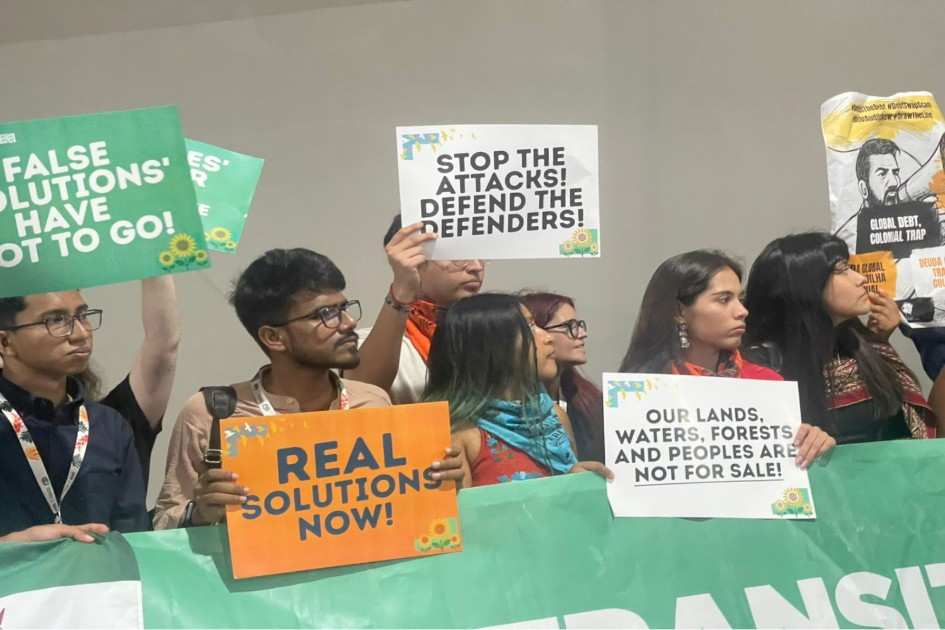
On Day 2, Indigenous groups attempted to enter the venue forcefully, protesting decades of land grabbing, extractive industries, and climate injustice.
Their frustrations were understandable and their slogan was unforgettable: “We cannot eat money.”
But the most frightening moment came on the afternoon of December 20. I was speaking as a panelist at the Just Transition Pavilion when sudden chaos erupted.
We heard shouting. People ran toward us. A fire had broken out just a few pavilions away.
Tents collapsed as people tried to escape. Many became stuck behind metal barricades. Some climbed over using ladders. Firefighters soon cut open the barriers, but the fear lingered. For many of us, COP30 suddenly became the COP on fire.
Finding my voice at the global stage
At ICCCAD’s COP30 Youth Fireside event, I spoke about the struggles of coastal communities and the power of youth leadership. Standing before global climate leaders, I faltered for a moment—perhaps overwhelmed by the scale of the platform. But with encouragement from the audience, youth participants, and ICCCAD officials, I regained confidence.
After the session, several attendees asked to learn more about Satkhira. I invited those working on coastal resilience to visit our region. Bangladesh’s Adviser on Fisheries and Livestock, Farida Akhter, attended the event as chief guest. We briefly discussed the challenges and potential of livestock rearing in coastal areas an issue she promised to follow up on.
Lessons from the global climate community
I visited several country pavilions and spoke with representatives to understand how different nations respond to climate change. Their strategies varied widely shaped by geography, economy and political realities. Many pavilions showcased their cultural heritage alongside climate innovation.
Bangladesh’s pavilion was placed right at the entrance. It reminded me how powerfully we could tell our story not only of loss and vulnerability but also of resilience, culture, and natural beauty. Our tourism, heritage, and community strength deserve a place in global conversations.
Speaking at the youth policy lab on Just Transition
One of my most meaningful moments was speaking at the “Youth-Led Pathways for a Just Transition” policy lab, hosted by the Government of Bangladesh, ILO and YouthNet Global. I highlighted the short-term and long-term migration patterns in the coast and stressed that:
A transition must be just not only technologically, but socially and economically—so people can move with dignity, safety and real livelihood options.
Nature-based solutions in the Sundarbans and the river systems can transform the coast, but only if justice and equity guide the transition.
Inside the negotiations: hopes and limitations
I joined several open meetings on adaptation and loss and damage. I observed how negotiators defend positions, respond to criticism, and fight over commas and phrases that shape global policy.
COP30 was branded as the “implementation COP.” Brazil’s President Lula called it “the COP of truth.” But how much truth did it deliver?
The Belém Package, COP30’s final outcome document, contains 29 decisions, including:
- A call to triple global adaptation finance by 2035 (not mandatory)
- Voluntary indicators for the Global Goal on Adaptation (GGA)
- A framework for Just Transition mechanisms
- 122 countries submitting new or updated NDCs
Yet the biggest gap remains fossil fuels. Everyone talks about the urgency of keeping 1.5°C alive, but no binding roadmap for phasing out fossil fuels emerged from Belém.
A journey of lessons and responsibility
COP30 ended in fire, frustration, hope and hard decisions. But for me, it was a classroom larger than any I have known. Every moment taught me something about leadership, justice, negotiation, and resilience.
As I return to my coastal home, I carry with me the Amazon’s lessons. The world is changing fast. And so must we.
The world is my school; I remain its student, learning, unlearning and striving to serve my people.
Disclaimer: The views and opinions expressed in this article are those of the author and do not necessarily reflect the opinions and views of The Climate Watch




