

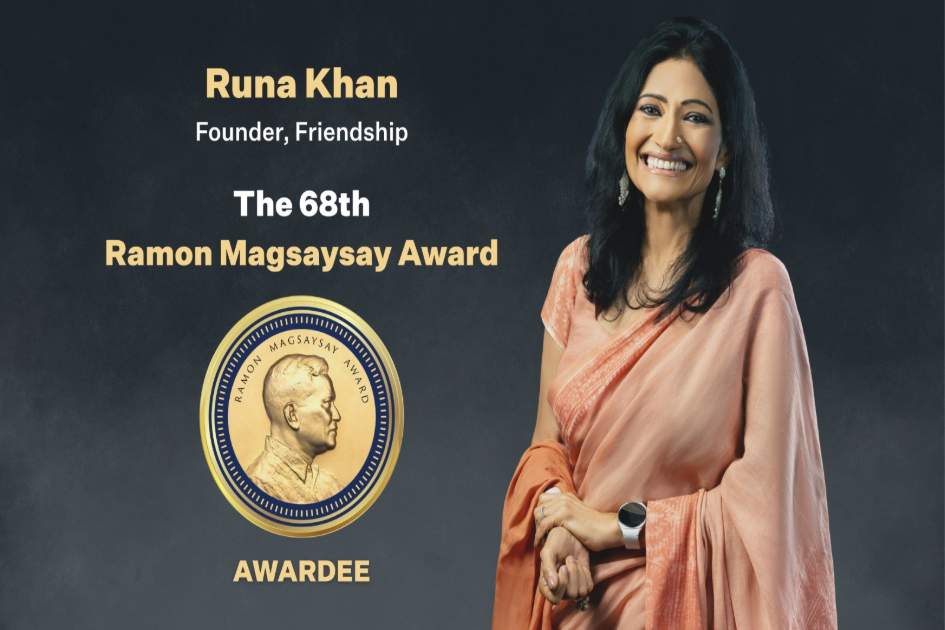



Runa Khan among the recipients of the 68th Ramon Magsaysay Award on 31 August for her ‘Greatness of Spirit’ and leadership in developing Friendship’s ‘integrated, holistic development solutions’.
Runa Khan, founder of Bangladesh-based social purpose organisation Friendship, has been named a recipient of the 2026 Ramon Magsaysay Award, recognising more than two decades of work building locally led development solutions for marginalised communities.
The Ramon Magsaysay Award, widely regarded as “Asia’s Nobel Prize”, recognises “greatness of spirit” and “transformative leadership in Asia”.
Khan is the 14th recipient of the award from Bangladesh. The formal award ceremony will be held on November 15 in Manila, Philippines.
“It is with great happiness and profound humility that I accept the Ramon Magsaysay Award,” Khan said after the announcement.
“There is no leader who walks alone, so it is an honour for me to receive this on behalf of the unaddressed communities, who allow us to walk beside them; and on behalf of my Friendship family whose tireless devotion makes this work possible every day.”
She added: “I thank also those who have trusted and walked this almost impossible path with me for 25 long years, just believing. My children whose patience and understanding awes me.
“This recognition is a wonderful responsibility, and I offer my deepest gratitude to the Ramon Magsaysay Award Foundation for their trust and for honouring the enduring faith and power of humanity.”
Khan’s work began in Bangladesh’s remote riverine communities, where Friendship initially operated a single floating hospital.
The initiative has since developed into an integrated social purpose organisation serving 7.5 million people annually across healthcare, education, climate action, sustainable economic development, inclusive citizenship and cultural preservation.
Friendship’s approach is based on designing development systems around the realities of the communities they are intended to serve, rather than expecting people to adapt to systems that cannot reach them.
The organisation recruits and trains local people and works with communities to shape programmes around their needs.
It also takes an inclusive approach involving women and people with disabilities while linking healthcare, education, livelihoods, rights and climate resilience.
The award recognises Khan’s efforts to develop a model rooted in a deep understanding of and respect for local communities and the interconnected challenges facing people in remote areas.
In its official citation, the Ramon Magsaysay Award Foundation recognised Khan for “her profound empathy for the poorest of the poor in her country, and her courage, vision, and tenacity in building and leading Friendship to accomplish her mission.”
“In her hands, privilege became not an entitlement, but a responsibility; not a family legacy to protect, but a gift to be shared so that others, too, might have the chance to live with hope, opportunity, and dignity,” the citation said.
Five years after founding Friendship in Bangladesh, Khan took the initiative to establish Friendship in Luxembourg in 2006, followed by the Netherlands in 2007, the United Kingdom in 2010, France in 2015 and Belgium in 2018.
Her aim was to work as closely as possible with donors and partners, bypassing long chains of intermediaries in international aid while preserving local ownership.
The international entities have supported Friendship Bangladesh throughout its development over the past 24 years, backed by a network of public and private supporters.
The Ramon Magsaysay Awards were first presented in 1958 in memory of Ramon Magsaysay, the seventh president of the Philippines.
Over 68 years, the award has been bestowed on 328 individuals and 28 organisations whose service has offered solutions to some of the most challenging problems of human development in 24 countries across Asia and beyond.
Previous recipients linked to Bangladesh include Grameen founder Muhammad Yunus and BRAC founder Fazle Hasan Abed.
Other prominent recipients include Mother Teresa, the Dalai Lama and Japanese filmmaker Akira Kurosawa.
Muhammad Yunus and Mother Teresa later received the Nobel Peace Prize.
Mother Teresa travelled to Bangladesh in the 1990s and blessed the river barge that would later become Friendship’s first hospital ship.




