




Train operations along the newly built Chattogram–Cox’s Bazar railway line are facing increasing danger as wild elephant herds repeatedly cross the tracks inside the Chunati Wildlife Sanctuary, a globally recognized habitat for Asian elephants. Frequent sightings and near-collisions, particularly at night, have alarmed train crews, passengers and environmentalists.
Experts warn that unplanned hill cutting across a 12-kilometer stretch of the Lohagara–Harbang section has severely disrupted traditional elephant corridors, forcing the animals to use the railway tracks to move between forest patches putting both elephants and passengers at growing risk.
Repeated encounters raise alarm
On September 16, the Saikat Express, traveling from Cox’s Bazar to Chattogram, encountered a herd of elephants on the tracks within the sanctuary around 9:30 p.m. The driver repeatedly blew the whistle and applied the brakes to prevent a collision. Because the train was already running at a reduced speed of 20 km/h across the 4 km danger zone, the herd eventually moved off the tracks.
This was not an isolated incident. On July 23, another Saikat Express driver spotted a lone elephant directly on the track. Swift action and slow driving helped avert another potential disaster.
Not all encounters have ended safely, however. On October 13 last year, a wild elephant was struck by the Eid Special–10 train, sustaining severe injuries. Despite receiving veterinary treatment, the animal died two days later.
Train crews and passengers report that herds are now frequently sighted, especially during nighttime runs, raising fears of a major accident at any moment.
A fragile habitat under threat
Established in 1986, the Chunati Wildlife Sanctuary is Bangladesh’s first protected area for elephants and a vital corridor connecting Bangladesh and Myanmar within the broader Asian Elephant Range. It is home to several resident and migratory herds that depend on unbroken forest connectivity.
Researchers have long warned that linear infrastructure projects such as roads, railways, and power lines through forested landscapes fragment habitats and intensify human-elephant conflicts. In the past decade alone, over 150 elephants have died across Bangladesh due to train and vehicle collisions, electrocution, and habitat loss.
Project threatens broader biodiversity
The environmental impact extends far beyond elephants. A biodiversity survey conducted by Norris L. Dodd, a U.S.-based research organization, along with Bangladeshi partners, found that construction of the Chattogram–Cox’s Bazar railway may endanger 234 wildlife species. Among them, 61 species are already listed as threatened by the IUCN, including five reptiles, five birds, and five mammals.
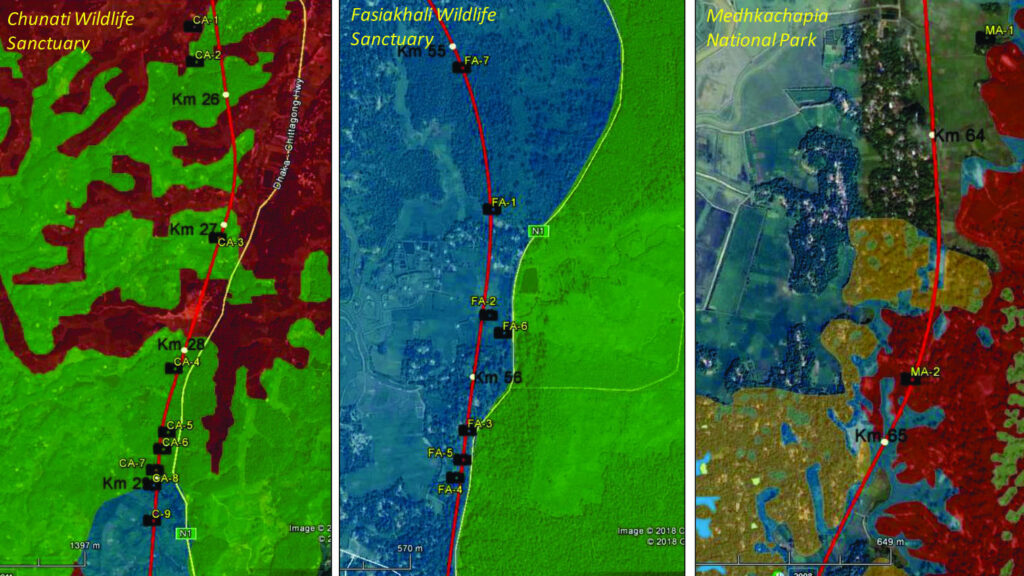
The survey, using camera traps in Chunati, Fasiakhali, and Medhakachapia forests, recorded 234 species in Chunati alone, including 168 groups of six mammal species. In Fasiakhali, 66 species and four mammal groups were identified.
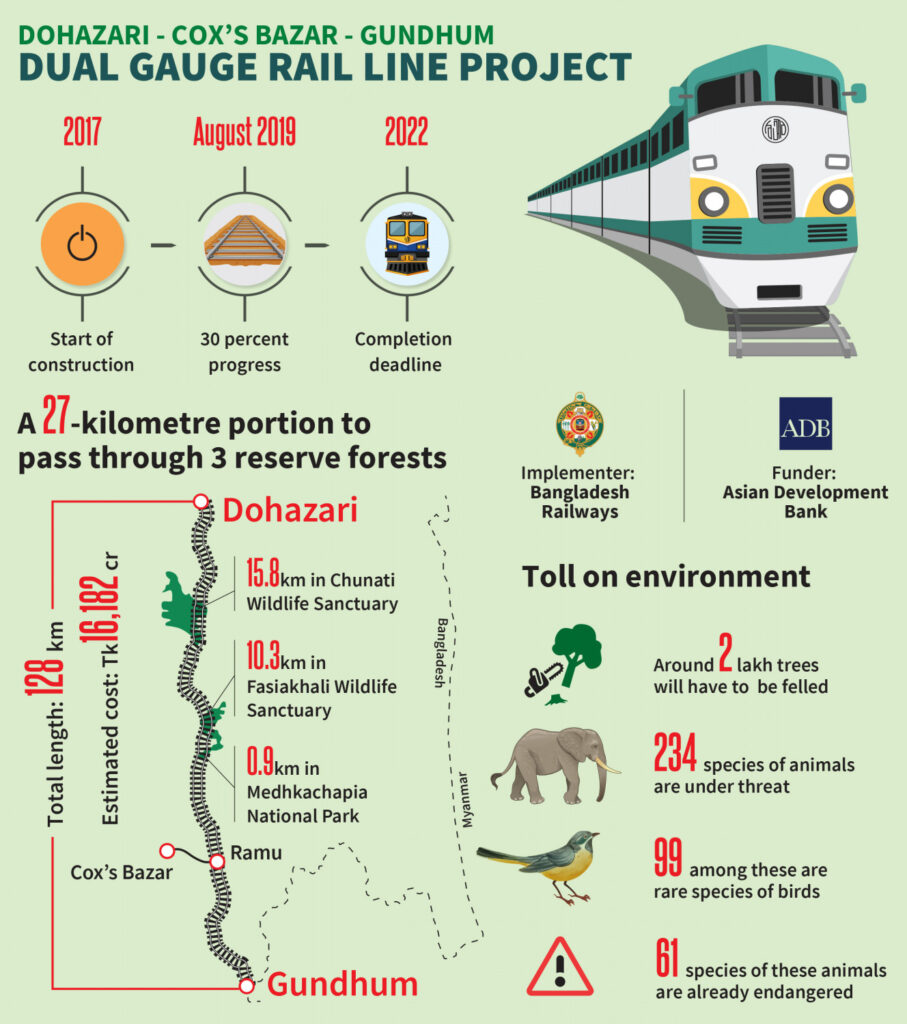
The railway route passes through 27 kilometers of forest areas—15.8 km in Chunati, 10.3 km in Fasiakhali, and 0.9 km in Medhakachapia. Construction will require the felling of approximately 200,000 trees, with plans to replant 700,000 trees later. However, environmentalists caution that replantation cannot compensate for immediate habitat loss and fragmentation.
“The railway authority claims they will build underpasses, but recurring wildlife deaths show these facilities are poorly designed and ineffective,” said Dr. Mohammad Kamal Hossain, forestry expert and ecologist.
Experts blame unplanned construction
Environmentalists attribute the crisis to ecologically insensitive planning and construction. Within the 12 km stretch of the Chunati Sanctuary, massive hill cutting has drastically altered the terrain, blocking natural elephant movement.
Although the Department of Environment (DoE) authorized 11.92 km of hill cutting for the 101 km Dohazari–Cox’s Bazar project, investigations reveal excessive excavation. In Chunati Union, contractors allegedly cut around 20 hills, removing approximately 22 million cubic feet of soil far exceeding approved limits.
While several underpasses were included in the project design to facilitate animal crossings, experts say these are too narrow, lacking vegetation, and unsuitable for large herds. Consequently, elephants avoid these structures and continue following their traditional migration routes, which now intersect the railway.
“The so-called wildlife underpasses fail to replicate natural corridors,”
added Dr. Hossain. “Without vegetation cover and adequate width, elephants do not feel safe. The design overlooks basic ecological behavior.”
Development vs. Biodiversity
Inaugurated as a major infrastructure initiative to boost tourism and regional connectivity, the Chattogram–Cox’s Bazar railway has drawn sharp criticism for ignoring wildlife corridors and failing to implement safeguards outlined in its Environmental Impact Assessment (EIA).
With Bangladesh’s elephant population now estimated at fewer than 300, mostly confined to fragmented forest patches, conservationists warn that poor planning could push the species closer to extinction.
“Development cannot come at the cost of extinction,” said Shamsuddin Illius, environmental journalist and Bureau Chief-Chittagong at The Business Standard.
“Protecting elephant corridors is not just an ecological duty, it is a moral obligation.”
An urgent call for Wildlife-friendly engineering
The growing tension between infrastructure expansion and wildlife survival in Bangladesh underscores the urgent need for nature-based planning and wildlife-sensitive engineering. Experts emphasize that properly designed underpasses, enforced train speed limits, and real-time wildlife monitoring are essential to prevent further tragedies.
Without immediate action, the country’s last wild elephants symbols of Bangladesh’s rich biodiversity may become casualties of development.




