

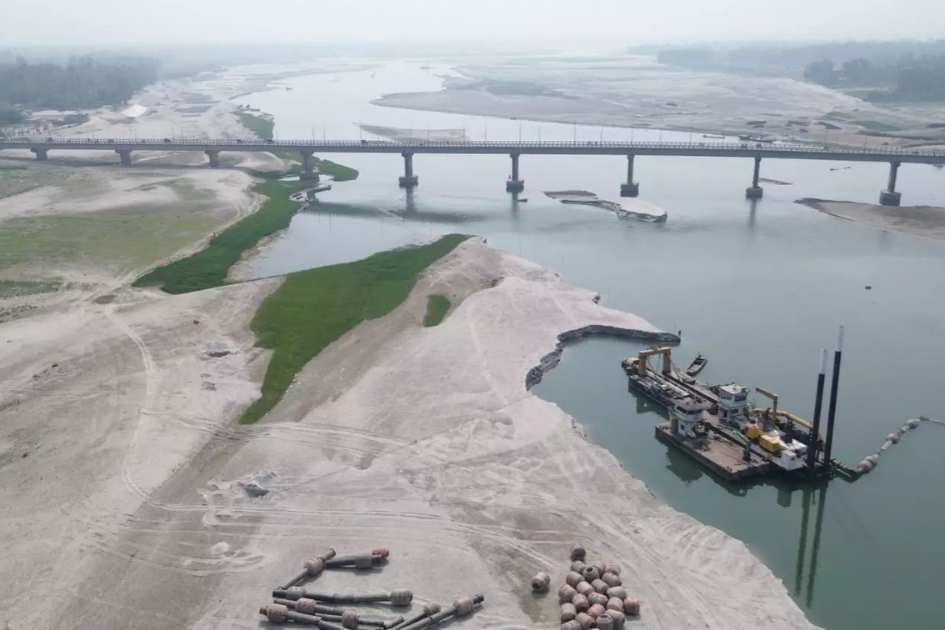



Large-scale dredging of the Dharla River in Kurigram is reducing erosion, restoring navigation and improving drainage, offering relief and renewed security to thousands of riverside residents across northern Bangladesh today.
Once infamous for relentless erosion and disrupted navigation, the Dharla River in northern Bangladesh is gradually regaining its vitality thanks to a large-scale dredging project. The initiative aims to stabilise the riverbed, restore navigability and provide relief to riverside communities long threatened by shifting currents.
For decades, families along the Dharla lived under constant fear as the river’s changing course devoured homes and farmland. Now, with dredging underway along a key 25-kilometre stretch from Pateshwari in Bhogdanga union to Kaliganj in Begumganj union, locals report calmer waters and faster drainage during the monsoon.
The project not only restores navigability but also strengthens local infrastructure, mitigates erosion and provides a renewed sense of security for thousands who have lived under the Dharla’s unpredictable flow.
Originating in India’s Cooch Behar district, the transboundary Dharla flows into Bangladesh through Patgram and Lalmonirhat, passing through Fulbari, Sadar and Ulipur upazilas in Kurigram. The 60-kilometre river, averaging 1.2 kilometres in width, eventually merges with the Brahmaputra at Buraburi.
The Bangladesh Inland Water Transport Authority launched the “Improvement and Restoration of Navigability of the Old Brahmaputra, Dharla, Tulsai and Punarbhaba Rivers” project to address severe sedimentation and riverbank erosion. Dredging began on December 14, 2023 and will continue until June 30, 2027 at a cost of approximately 30 million US dollars, or Tk 263.21 crore.
BIWTA Executive Engineer Samir Chandra Pal said dredging reaches up to 8.5 feet below the water surface to ensure smooth navigation. Around 16 million cubic metres of sediment are targeted for removal, with 10.3 million cubic metres already cleared, marking 65 percent progress.
The dredged soil is being repurposed to reinforce flood embankments, fill low-lying lands, stabilise erosion-prone areas and create a proposed 30-acre DC Park near the Dharla Bridge. Some dredged sand has also generated revenue for the government.
Residents are already feeling the impact. Abdul Quddus of Jagmohon Char recalled sleepless nights during monsoons fearing that his home would collapse into the river. “Now the river is calmer and water drains quickly,” he said. Farmer Rafiqul Islam noted that land previously lost to erosion has been restored, improving local agriculture. Shefali Begum said faster water drainage has eased flooding near her home.
Experts warn, however, that the Dharla has a sedimentation tendency of nearly 97 percent, meaning regular dredging will be necessary to maintain long-term navigability. The Institute of Water Modelling oversees project design, digital surveys and supervision, while local committees monitor dredging and sediment management.
Local officials emphasise the need to extend dredging along the river’s full 60-kilometre stretch for lasting benefits. BIWTA Additional Chief Engineer Saidur Rahman said, “The positive impact is already visible. Continuing dredging along the entire river is crucial for the safety and livelihoods of riverside communities.”




