

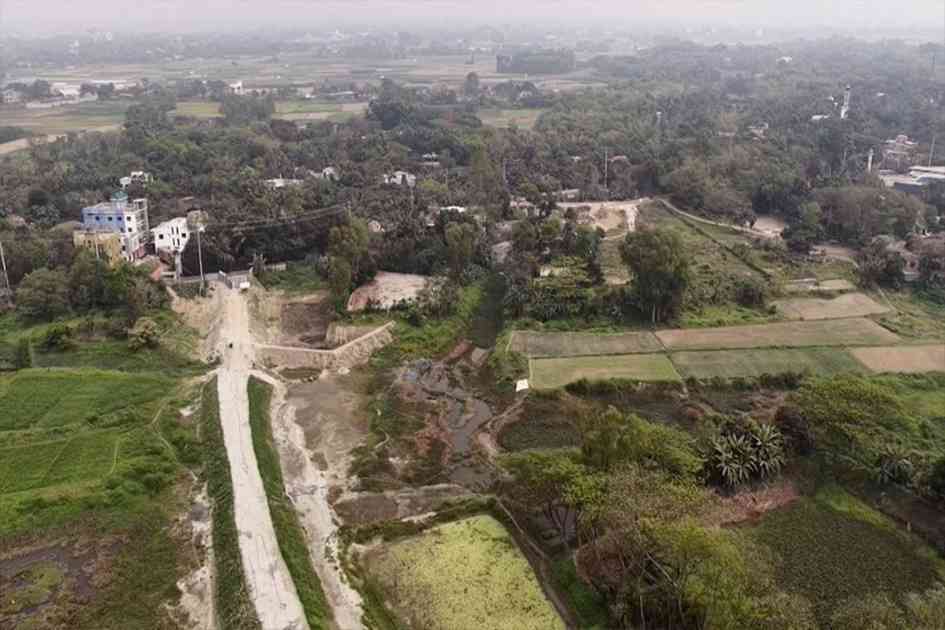



Once a lifeline in Keraniganj, Dhaka’s Shingh River has nearly disappeared due to encroachment and urban expansion, raising alarm over lost ecosystems, livelihoods and failures in river governance.
Once a vital artery for commerce, transport and daily life, the Shingh River has all but disappeared in Dhaka’s Keraniganj area. Today only narrow drainage channels or empty beds mark its former path. While government records still recognize its existence, locating it on the ground is nearly impossible.
As the world observes the International Day of Action for Rivers, the Shingh River stands as a warning that without vigilance urbanization, political negligence and encroachment can erase history, ecology and livelihoods alike. Restoring the river is not just an environmental issue; it is also a social and economic imperative.
Elder residents vividly recall the river in its prime. Abdul Karim, 72, a local resident, said, “Boats used to ply here carrying goods. This river was the lifeline for our community.” Fatema Begum, 68, another resident, added, “People used to sail across this river. It was life for us.”
The river’s name itself tells a story. Local resident Jasim Uddin, 55, explained, “The river was big. Its waves roared like a lion. That’s why it was called the Shingh River.”
Official surveys once recorded the river as spanning 17 kilometres and more than 120 feet in width. Today locals say large portions have vanished, filled in or converted into roads, fields and private properties. Rafiqul Islam, a farmer, said, “If the river survives people and farmers survive. But it’s slowly disappearing.”
Government land records confirm the decline. Surveyors Delwar Hossain and Afzal Hossain said much of the riverbed has been absorbed into private ownership or paved over. “One side of the river has become a concrete road. Other parts are now private land,” they said. Only small segments remain as officially recognized channels. In some areas even the river mouth is blocked, with madrasas, roads and other structures standing where water once flowed.
Conflicting official maps add to the confusion. Documents from the National River Protection Commission show the Shingh River originating from the old Buriganga and flowing into the Dhaleshwari. Surveyors, however, trace its source to Bhandarkhola and say it meets the Dhaleshwari further south. The original mouth has been obstructed, reflecting unchecked urban development and weak enforcement of environmental protection.
In one striking case a madrasa filled sand across the riverbed and built a road over about seven acres. Authorities later intervened. Keraniganj Assistant Commissioner (Land) Jannatul Mawa said, “They had no permission to change the river’s course. We have stopped the work. If necessary we will reclaim the land for the river.”
Despite dredging efforts in the past the river has not been revived. Sohanur Rahman, Executive Coordinator of YouthNet Global, said, “Unchecked encroachment and inaction have slowly erased this vital lifeline. Losing the Shingh River threatens livelihoods, water management and food security. Authorities and communities must act urgently to restore it and strengthen river basin management.”




