

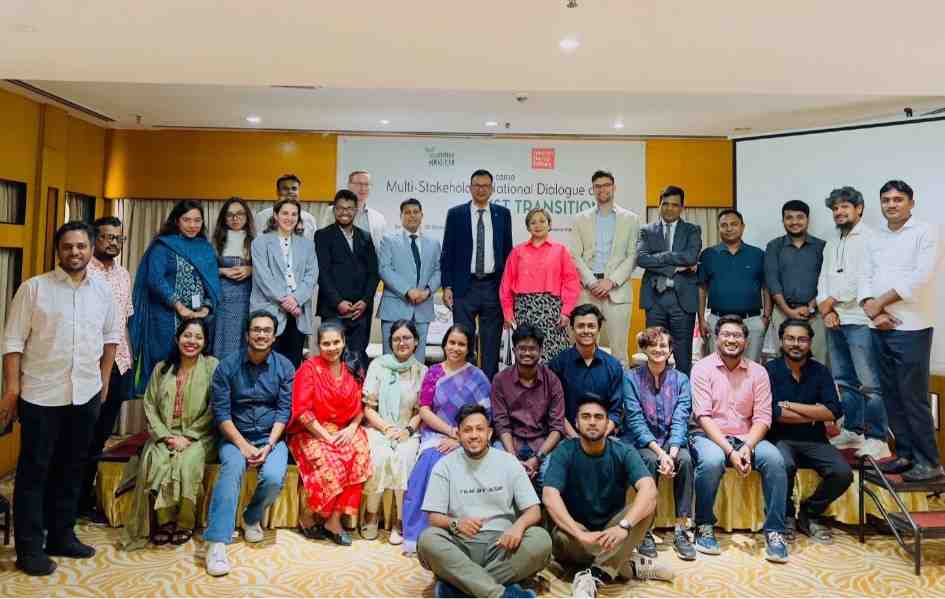

Experts, policymakers, trade unionists and youth leaders have underscored the urgency of developing a National Just Transition Policy Framework to ensure Bangladesh’s shift to a low-carbon economy is fair, inclusive and equitable.
Speakers collectively emphasised that achieving a just transition requires job security, reduced skill gaps, and the inclusion of workers, youth, and vulnerable groups at the heart of climate action. They echoed the call for a comprehensive national framework—an essential step to ensure Bangladesh’s climate and labour transitions leave no one behind as the country prepares for the UN Climate Summit COP30 in Belém, Brazil.
The call came during a national multi-stakeholder dialogue titled “Road to COP30: Shaping Bangladesh’s Just Transition,” held in Dhaka on Monday. Participants highlighted the need for green skills development, vocational training, and livelihood opportunities to prepare workers for the changing world of work.
Jointly organised by YouthNet Global and Friedrich-Ebert-Stiftung (FES) Bangladesh, the event brought together government officials, labour leaders, development partners, youth activists, and climate experts to formulate recommendations for equitable climate action.
Bangladesh has already made history by integrating just transition principles into its updated Nationally Determined Contributions (NDC 3.0)—becoming the first country in Asia to dedicate a full chapter to this concept. The move reflects the nation’s leadership in linking climate ambition with social justice, decent work, and sustainable enterprise.
Farmers’ resilience at the heart of Just Transition
Mohammad Navid Safiullah, Additional Secretary and Head of the Climate Change Wing at the Ministry of Environment, Forest and Climate Change, and Guest of Honour at the event, shared field experiences from Khulna and Rajshahi, highlighting the resilience and innovation of Bangladeshi farmers facing climate adversity.
“During a visit to Dacope upazila in Khulna, a farmer told me saline water had destroyed his crops. But after learning to grow salt-tolerant rice and vegetables, he regained hope,” he said. “Similarly, in Rajshahi’s Godagari upazila, a farmer revived his land with solar-powered irrigation. These examples show that innovation and support can turn challenges into opportunities—which is what a just transition is all about.”
He stressed that a just transition must be fair and inclusive, ensuring that workers and communities gain new skills, access green jobs, and receive social protection. Safiullah added that the ministry is advancing these efforts through the NDC Implementation Framework, National Adaptation Plan, and partnerships with other ministries, the private sector, and development partners. He also called for local-level adaptation measures and the mainstreaming of just transition principles into all national policy frameworks.
Financing a fair and inclusive transition
On the issue of climate finance, AKM Sohel, Additional Secretary and Head of the UN Wing at the Ministry of Finance’s Economic Relations Division (ERD), said that finance, policy, and governance must align to enable a just and inclusive transition.
“For Bangladesh to achieve a just and inclusive climate transition, finance, policy, and governance must work hand in hand,” he said. “We must also champion climate finance justice at COP30 through new grants, concessional loans, and innovative financing—while easing the debt burdens of climate-vulnerable countries.”
He revealed that the ERD is preparing a climate finance strategy to support just transition initiatives and mobilise investment for low-carbon growth.
Youth at the centre of change
Sohanur Rahman, Executive Coordinator of YouthNet Global, delivered the keynote presentation titled “NDC 3.0 to COP30: Bangladesh’s Roadmap on Just Transition.” He emphasised fairness, accountability, and intergenerational equity, stressing that youth and workers are key agents of change in achieving an equitable transition.
He also discussed the proposed Belém Action Mechanism (BAM)—a global framework under the UNFCCC—to help countries achieve a just transition through coordination and shared learning.
Rahman highlighted Y-Just: Building Sustainable and Equitable Futures in Bangladesh, a youth-led initiative jointly implemented by YouthNet Global and FES Bangladesh. The initiative seeks to strengthen the voice and leadership of young people in advancing a just, inclusive, and sustainable transition across the country.

Y-Just connects youth, workers, civil society, and policymakers to promote equitable climate action that safeguards livelihoods, upholds gender justice, and ensures that no one is left behind in the shift toward green and resilient economies. Through nationwide dialogues, research, advocacy, and community-driven campaigns, the initiative bridges local realities with national climate policy—empowering young people to play a meaningful role in shaping Bangladesh’s just transition agenda ahead of COP30 and beyond.
International voices on inclusion and partnership
The concluding session featured remarks from Jannis Hussain, First Secretary and Deputy Head of Development Cooperation at the Embassy of Germany, and Nayoka Martinez Bäckström, First Secretary (Environment and Climate) and Deputy Head of Cooperation at the Embassy of Sweden.
Jannis praised the dynamic participation of young people in the dialogue and urged that trade unions and marginalised communities directly benefit from quality transition outcomes. Nayoka emphasised a cross-sectoral approach and stronger coordination through the Bangladesh Climate Development Partnership (BCDP), assuring that civil society voices will be meaningfully included in future processes.
Dr Felix Gerdes, Resident Representative of FES Bangladesh, commended the inclusive nature of the dialogue and encouraged continued collaboration among government, youth, labour unions, and development partners to operationalise Bangladesh’s just transition vision.
Pathways beyond COP30
A panel discussion titled “Shaping Bangladesh’s Just Transition: NDC 3.0 Priorities and Strategic Pathways Beyond COP30”—moderated by Farah Anzum, Bangladesh Lead for Climate and Energy—focused on green jobs, social protection, and inclusive climate action.
AKM Ashraf Uddin of the Bangladesh Labour Foundation stressed the importance of job security, reducing skill gaps, tackling informalisation, and creating decent employment for youth. He referenced the Dhaka Declaration and a proposed COP30 Charter on labour rights as guiding tools for action.
Dr Mohammad Emran Hasan from Oxfam highlighted issues of climate colonialism, technology transfer, and fair climate finance, calling for evidence-based advocacy to reform existing systems.
Valentina Spinedi from UNICEF Bangladesh urged centring the most vulnerable—especially girls and children—in national climate action plans and investments that could attract Green Climate Fund (GCF) support.
Dr Shah Abdul Saadi, Deputy Secretary at the Ministry of Finance, called for a whole-of-government approach and stronger international commitments to climate finance, noting that achieving a just transition requires a paradigm shift toward equitable, inclusive, and low-carbon development models guided by fairness and access for all.
Moderator Farah Anzum concluded that building trust and collaboration among all actors is fundamental for achieving a fair climate transition in Bangladesh.




