

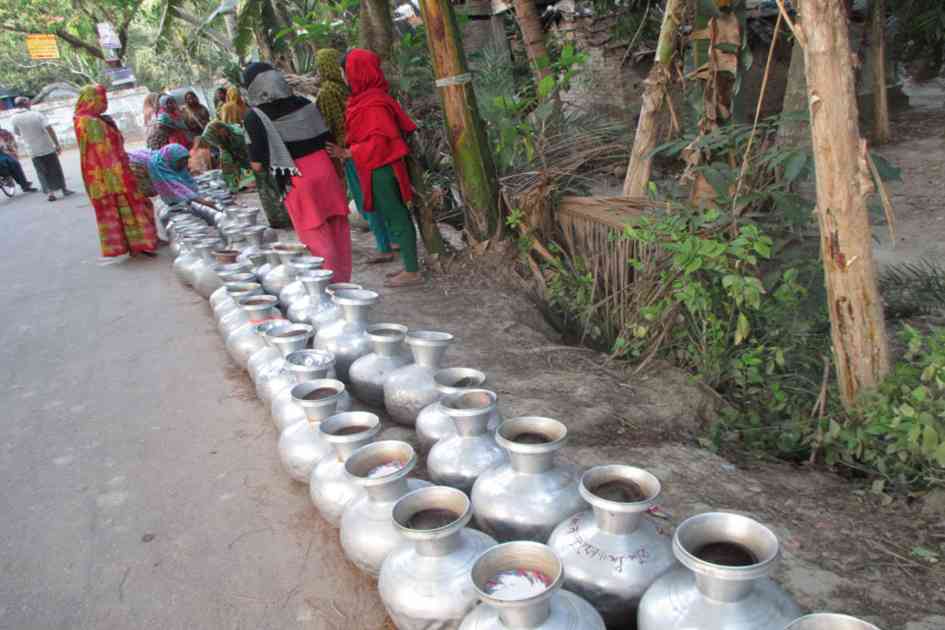

Climate-driven salinity is contaminating water in coastal Bangladesh, endangering health, livelihoods and rights, as communities demand political action following a landmark court ruling amid worsening cyclones, neglect and elections.
Climate change is increasingly shaping daily life in Bangladesh’s coastal southwest, where rising water salinity is triggering a serious public health emergency and an escalating crisis in access to safe drinking water. Despite the scale of the problem, residents say the issue remains largely ignored in political parties’ election manifestos ahead of the upcoming national polls.
The issue gained renewed urgency after a High Court verdict on January 2, 2026, recognised access to safe water as a fundamental right of Bangladeshi citizens. However, residents of Morrelganj and Sharankhola say the ruling has yet to translate into meaningful action on the ground.
Activist groups say communities are no longer seeking promises but action. As climate risks escalate along Bangladesh’s coast, ensuring access to safe drinking water is no longer just a development issue. It has become a test of political accountability, climate justice and governance.
According to officials, some areas of Bagerhat district now record water salinity levels exceeding 2,000 milligrams per litre, far above the permissible limit of 1,000 milligrams per litre for drinking water.
Jayanta Mallick, Executive Engineer at the Department of Public Health Engineering in Bagerhat, said that Morrelganj, Mongla, Sharankhola and Kochua upazilas are highly affected by saline water.
Communities in the Morrelganj and Sharankhola sub-districts of Bagerhat are among the worst affected, as climate-driven salinity intrusion, where seawater enters freshwater sources, intensifies due to frequent cyclones, tidal surges and river erosion. Both surface water and groundwater have become increasingly unsafe for consumption.
Field observations show that agricultural land, ponds, canals and rivers across the district have become heavily contaminated with saltwater, damaging livelihoods, food security and local ecosystems.
The water crisis is also undermining essential public services. Many schools in affected areas lack access to safe drinking water, contributing to waterborne illnesses among students. Health centres are struggling to maintain hygiene standards, increasing health risks for patients. Women and children remain the most affected, often walking long distances each day to collect potable water.
Similar conditions persist across neighbouring coastal districts. “We have been facing a drinking water crisis for years due to salinity in water. For a long time, there was no tube well in our village and we had to rely on pond water for drinking and cooking,” said Monowara, wife of Sohil Uddin Khan, from Uttar Madinabad village in Koyra upazila of Khulna.
In Paigachha upazila, businessman Khan Jahan Ali from Garaikhali village said fresh water has become increasingly scarce. “Saline water is everywhere. At the same time, water sanitation and hygiene related problems are serious here due to a lack of awareness,” he said.
In Morrelganj’s Sannasi village, residents said constant saltwater intrusion caused by tidal surges, cyclones and river erosion is severely damaging cropland and threatening access to safe water, healthcare and employment.
“The excessive saline water is harming people’s housing, health and the local economy. As a result, poverty is increasing,” said local women leader Jannatul Habibah.
Local youth leaders say the crisis has reached an alarming level. For residents of Sharankhola and Morrelganj, even a single glass of clean water has become a rare luxury. During the last summer season, climate activists from YouthNet Global distributed safe drinking water in parts of Morrelganj using personal funds, highlighting the stark reality of the crisis.
Abdullah Al Shihab Emon, District Coordinator of YouthNet Global in Bagerhat, said the water shortage has become a daily survival challenge for coastal families. “Safe drinking water is no longer easily available in many villages of Morrelganj and Sharankhola. Women and children are spending hours every day just to collect drinkable water, while waterborne diseases are rising silently,” he said.
Despite the worsening situation, communities say access to safe drinking water has received little to no attention in the election manifestos of major political parties. While campaign documents focus heavily on infrastructure development, residents argue that clean water, essential for life, health and dignity, remains sidelined.
Government officials acknowledge the challenge. SM Shamim Ahmed, Superintending Engineer, Additional Charge, Khulna Circle of the Department of Public Health Engineering, said that in some areas even tube well water can no longer provide fresh water due to excessive salinity. He said the government is working to address the crisis by installing new tube wells and expanding rainwater harvesting facilities in vulnerable coastal zones.
Water experts warn that without long-term, climate-resilient planning, the situation will deteriorate further. Prof AKM Saiful Islam, former director of the Institute of Water and Flood Management at BUET, said climate change is a major driver of the crisis and emphasised the need for a fair and sustainable water management system.
Calling for water justice and political accountability, Sohanur Rahman, Executive Coordinator of YouthNet Global, said the continued neglect of safe water reflects a deeper governance failure. “Access to safe drinking water is a constitutional right, not a development




