

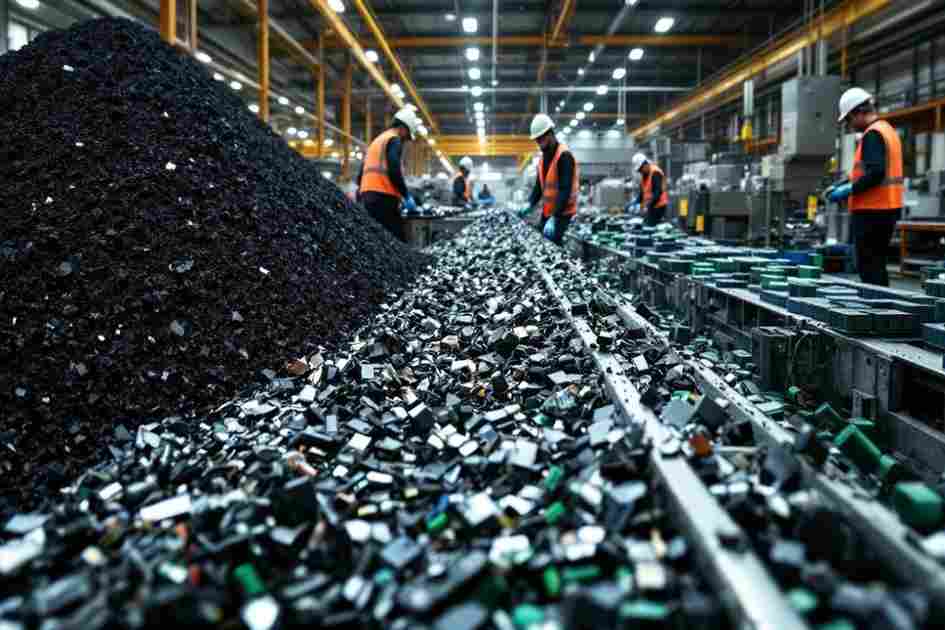



China prepares for a sharp rise in retired EV batteries, tightening recycling rules to recover lithium and other critical minerals amid global debates over sustainable mining and just transition policies.
China is preparing for a massive wave of spent electric vehicle (EV) batteries, boosting recycling efforts as the world’s largest EV market seeks to reduce reliance on imported critical minerals.
“Unlike conventional cars, EVs are more like fast-moving consumer goods,” said Mo Ke, founder and chief analyst at Tianjin-based RealLi Research. “Digital systems in EVs become outdated quickly, so drivers typically change vehicles after five to six years.”
Last year, EV sales in China surpassed 16 million units. Roughly 10 percent of all vehicles on the road were electric and more than half of new cars sold carried green EV plates.
To address the growing volume of end-of-life batteries, China is introducing stricter recycling regulations in 2026. The new rules will track, collect and repurpose retired lithium-ion batteries, promoting material recovery while cutting dependence on imported lithium, cobalt and nickel. Retired EV batteries in China are projected to reach 1.04 million tonnes in 2025 and could surge to 3.5 million tonnes by 2030.
China’s focus on recycling, combined with ongoing global debates over critical minerals, highlights the intersection of climate policy, industrial strategy and sustainable technology. As the EV revolution accelerates, countries and companies face growing pressure to balance growth, resource security and environmental responsibility.
In Tianjin, startups like Tianjin Battery Technology are turning discarded batteries into valuable resources. The company disassembles battery packs to recover lithium, copper and aluminum, achieving more than 90 percent lithium recovery. Some components are reused for second-hand vehicle repairs. “We work to fully extract value from retired batteries and leave no potential untapped,” said Ma Youwei, the firm’s equipment manager.
China’s battery recycling sector is embracing advanced technology. Shenzhen-listed GEM uses intelligent dismantling systems and high-precision lithium extraction, achieving similar recovery rates. It now operates more than 140 recycling sites domestically and overseas, partnering with more than 750 vehicle and battery manufacturers worldwide.
Global expansion is underway. CATL, the world’s largest battery producer, plans a recycling plant in Hungary by 2026. Gotion High-tech, Envision Greenwise and Huayou Recycling are entering European markets through strategic partnerships, reflecting growing demand for sustainable battery solutions.
The surge in recycling comes as China and Russia opposed including critical minerals in the COP30 Just Transition Work Programme in Belem, citing economic and geopolitical concerns. Their resistance preserves flexibility in mining operations, avoids binding environmental, social and governance obligations and maintains influence in global supply chains.
Countries advocating stricter environmental, social and governance measures, including the EU, UK, Australia, Colombia and the African Group, pushed for sustainable mining to limit environmental damage and human rights risks. Despite their efforts, the final draft removed mentions of critical minerals, leaving mining largely under voluntary frameworks.
Experts warn that excluding enforceable environmental, social and governance measures could slow progress toward net-zero targets by leaving supply chains vulnerable to environmental and governance risks. “Critical minerals are essential for batteries, solar panels and wind turbines,” noted Sohanur Rahman, Executive Coordinator of YouthNet Global and a youth negotiator at COP30. He added, “Ignoring sustainability now may bring short-term gains, but long-term risks remain high.”
“Just Transition is not just about protecting jobs or industries. It is about ensuring that climate action safeguards communities, resources and future generations while creating green opportunities for young people everywhere,” concluded Sohanur Rahman.




