

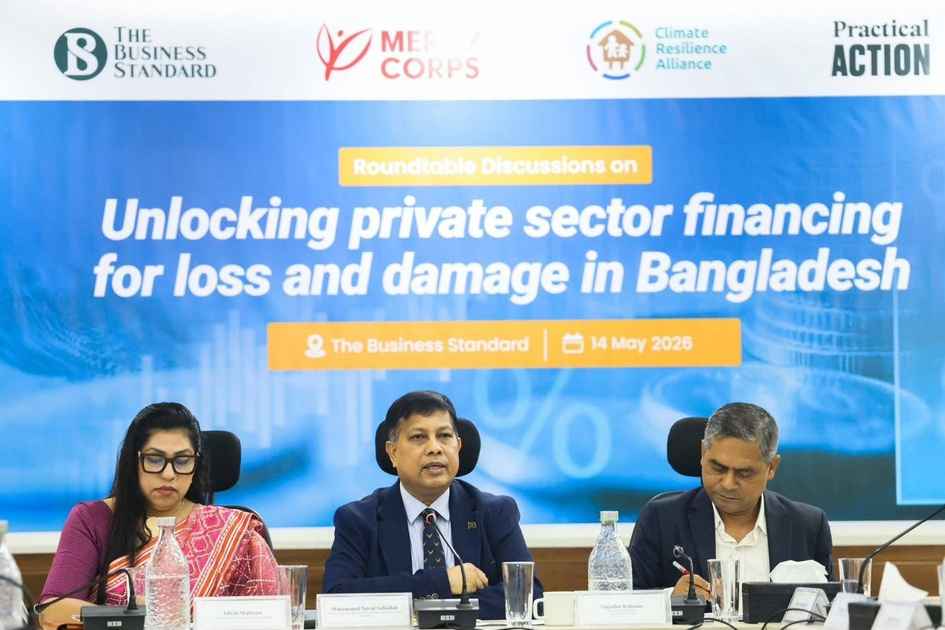



Experts urged Bangladesh to establish a national loss and damage financing mechanism, warning that inadequate global climate funding is leaving vulnerable communities exposed to escalating floods, cyclones, erosion and climate-related shocks.
Bangladesh has been urged to establish a dedicated national mechanism to finance climate-related loss and damage as experts warned that global funding remains far too small to meet the rapidly rising costs of climate disasters.
The call came at a roundtable titled “Unlocking Private Sector Finance for Loss and Damage in Bangladesh” held in Dhaka, jointly organised by Practical Action and Mercy Corps under the Zurich Climate Resilience Alliance and The Business Standard.
Global funding still a fraction of needs
Speakers highlighted that the Global Fund for Responding to Loss and Damage under the UNFCCC has received pledges of about $768 million from 27 contributors, but only a little more than $200 million has actually been deposited.
They noted that this remains far below estimated global requirements of more than $400 billion annually as climate impacts intensify through floods, cyclones, river erosion, salinity intrusion and heat stress.
Call for a national financing mechanism
Experts said Bangladesh can no longer rely primarily on international funding and must develop a coordinated national platform to mobilise and manage loss and damage finance.
They proposed a structured mechanism bringing together government agencies, private sector actors, financial institutions, NGOs and development partners to ensure faster, transparent and accountable support for climate-affected communities.
The discussion also stressed the need to move beyond fragmented corporate social responsibility initiatives and short-term disaster response toward long-term resilience financing.
Government acknowledges governance and funding gaps
Mahammad Navid Safiullah, additional secretary at the Ministry of Environment, Forest and Climate Change, said loss and damage remains under-emphasised in Bangladesh’s climate agenda compared with adaptation and mitigation.
He said non-economic impacts such as displacement, disruption to education and psychological stress often have longer-lasting consequences than direct financial losses.
He also acknowledged governance challenges, including weak coordination and past concerns over the Bangladesh Climate Change Trust Fund, stressing the need for stronger institutional accountability and transparency.
Private sector role and innovation
Speakers said private sector engagement must go beyond CSR and become part of a structured national financing strategy supported by blended finance, green bonds and public-private partnerships.
Md Shamsuddoha of CPRD said a major barrier remains the lack of trust among government, NGOs and businesses. He called for a transparent, multi-stakeholder financing system with clear accountability mechanisms.
Mahbub Anan, managing director of Lal Teer Seed Ltd, stressed the need for early preparedness in agriculture, citing recurring flash floods in the haor region. He said investment in early-maturing and climate-resilient crop varieties could significantly reduce annual losses.
Shift toward integrated climate finance
Experts from WorldFish, Concern Worldwide and Bangladesh Bank said loss and damage remains underdeveloped within financial systems, with no clear banking products or dedicated instruments for affected communities.
They emphasised that future financing must integrate agriculture, fisheries and innovation-driven resilience rather than treating loss and damage as standalone emergency funding.
Way forward
Participants agreed that Bangladesh urgently needs a coordinated national loss and damage financing framework with strong governance, reliable data systems and meaningful private sector participation.
They warned that without such a mechanism, the gap between rising climate impacts and limited global support will continue to widen, leaving vulnerable communities exposed to repeated shocks with inadequate recovery support.




