

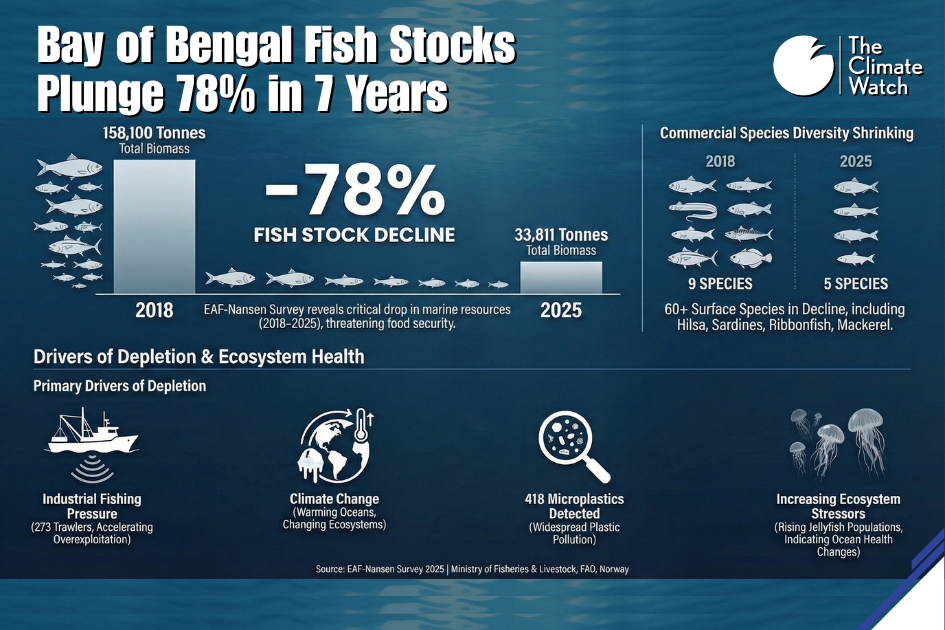



A joint UN-government survey finds Bay of Bengal fish stocks down 78 percent since 2018, blaming overfishing, climate change and pollution, threatening Bangladesh’s blue economy ambitions and marine biodiversity.
Fish stocks in the Bay of Bengal have plunged by nearly 78 percent over the past seven years, according to a joint government and United Nations survey, raising alarm over the sustainability of Bangladesh’s marine resources and dealing a blow to hopes tied to the country’s blue economy ambitions.
The findings come years after Bangladesh resolved maritime boundary disputes with neighboring countries and began looking to the Bay of Bengal as a major driver of economic growth. But the latest survey reveals a stark decline in key marine species due to overfishing, climate change, excessive pesticide use and declining levels of dissolved oxygen in seawater.
The survey shows that since the last assessment in 2018, stocks of small pelagic fish have fallen dramatically. In 2018, small pelagic stocks stood at 158,100 tonnes. By 2025, that figure had dropped to 33,811 tonnes. The abundance of around 60 species of surface-dwelling fish including sardines, hilsa, ribbonfish, hardtail scad, mackerel, croaker, poa and eel has also declined significantly.
The findings were released under the EAF-Nansen Survey 2025, conducted jointly by Bangladesh’s Ministry of Fisheries and Livestock, the UN Food and Agriculture Organization and Norway. Thirteen leading scientists along with regional and international experts took part in the assessment.
The team evaluated the diversity and abundance of mesopelagic and small pelagic species, assessed demersal fish stocks and examined the overall health of the marine ecosystem. Mesopelagic fish inhabit the dimly lit midwater zone of the ocean, between about 200 and 1,000 meters below the surface.
Abdullah Al-Mamun, Assistant Director at the Department of Fisheries and a participant in the survey, said oceanographic measurements were taken from 68 stations across Bangladesh’s 118,813 square kilometer Exclusive Economic Zone. Researchers conducted trawl fishing, collected plankton, jellyfish and microplastic samples and gathered comprehensive marine data.
He told that Bangladesh currently has 273 commercial fishing vessels, a fleet that did not exist a decade ago in its present form. The survey has recommended gradually reducing the number of trawlers.
Recently retired Fisheries and Livestock Adviser Farida Akhter told that excessive fishing, illegal and unregulated practices and the use of harmful nets are driving the decline in marine stocks, describing the situation as deeply concerning.
Of the 273 commercial trawlers, 72 are equipped with echo sounders. She said improper use of the technology is contributing to stock depletion and that steps are being taken to regulate their use.
Previous international surveys have also warned that marine fisheries are under threat from overexploitation. Some species have declined sharply, with tiger shrimp, Indian salmon and large croaker among the worst affected.
At the same time, the new survey has identified 65 additional fish species within Bangladesh’s maritime boundary. Research on these species is underway at the Oceanographic Institute in Chattogram. Five of them are believed to be new to science and are currently undergoing DNA testing at the Institute of Biological Laboratory in South Africa.
According to the Ministry of Fisheries and Livestock, Bangladesh’s marine waters are home to 475 species of fish, 36 species of shrimp, five species of lobster, 15 species of crab, five species of turtle and 13 species of coral. During the survey, researchers also observed that jellyfish, once more common in deep waters, are now appearing in larger numbers along the coast.
Earlier in 2023, the Bangladesh Marine Fish Stock Assessment report prepared by research vessel RV Meen Sandhani also warned of declining marine stocks. At that time, marine fisheries researcher Dr Mohammad Shariful Azam said that fishing in coastal areas typically occurs at depths of around 40 meters.
He noted that fishermen often use a type of net known as behundi, which catches all types of fish from top to bottom. Desired fish are retained while unwanted species are discarded back into the sea, contributing to stock depletion in coastal waters.
Azam added that climate change is further complicating the situation. Extreme temperature variations, whether colder or warmer conditions, are disrupting breeding patterns of many species. As a result, fish are migrating to different environments, placing numerous species at risk.
The Nansen survey also confirmed for the first time the presence of skipjack tuna and other tuna species within Bangladesh’s Exclusive Economic Zone. Researchers observed schools of skipjack tuna inside the zone using trawlers and hook-and-line methods. Skipjack is a small migratory species found throughout tropical and subtropical oceans and is considered the most abundant commercially harvested tuna species worldwide.
Of the country’s 20 principal marine fish species, nine were considered commercially harvestable in 2018. The new survey indicates that number has fallen to just five.
During the study, researchers collected salinity, temperature and depth data from 34 locations. They gathered 275 samples to analyze pH, alkalinity and nutrient content. From 32 sites, they collected plankton and 9,794 fish and fish larvae including tuna. Laboratory analysis detected 418 microplastics in the samples.
Former Director General of the Department of Fisheries Kh Mahbubul Haque said Bangladesh’s marine fish production remains limited because most fishing takes place in shallow coastal waters. Due to limited vessel capacity and inadequate fishing technology, deep-sea fishing has not been effectively developed.
He noted that current fishing operations are largely confined to within 70 kilometers of the coast. Bangladesh harvests only about one percent of the world’s marine catch.
Haque said the country must rethink its strategy, avoid overexploited fishing grounds and shift focus toward deeper waters. Enhancing vessel capacity and modernizing technology to target higher-value species will be essential to accelerate economic growth, he added.
This report was published in The Daily Jatiyo Arthoniti, an economic and business news daily of Bangladesh, on Saturday, February 28, 2026.




