


Ahead of the Santa Marta conference, Bangladesh experts urged grant-based climate finance, warned against fossil fuel lock-in and called for a just, equitable energy transition centered on communities.
Bangladesh has called for urgent equity-based climate action and grant-based financing ahead of the first global conference on transitioning away from fossil fuels, warning that existing mechanisms risk deepening inequality rather than solving the crisis.
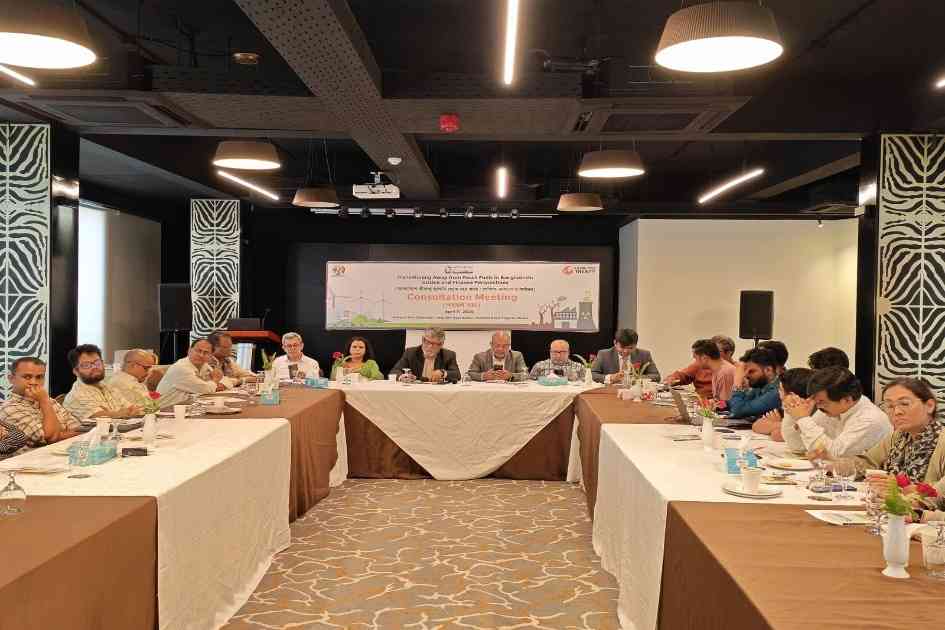
The call came during a consultation titled “Bangladesh’s Transition Away from Fossil Fuels: Justice and Financing Perspectives,” held in the capital on Saturday, just weeks before the landmark global conference in Santa Marta, scheduled for April 24-29.
Climate experts and policymakers stressed that carbon markets and offset systems risk prolonging fossil fuel dependence instead of delivering real emissions reductions, allowing high-emitting nations to continue polluting while shifting responsibility elsewhere.
They emphasized that Bangladesh, contributing less than 0.5 percent of global emissions yet among the most climate-vulnerable countries, is already facing severe impacts, from salinity intrusion and flooding to displacement and livelihood loss in coastal and riverine regions.
Opening the session, Sharif Jamil, member secretary of Dhara, said a fossil fuel phase-out roadmap alone is not enough without addressing the realities of vulnerable communities.
He highlighted that farmers, fishers, women and marginalized populations are already experiencing disproportionate climate impacts, calling for stronger local renewable energy systems and inclusive, participatory energy policies.
Mustafa Al Mahmud, president of the Bangladesh Sustainable and Renewable Energy Association, said the energy transition is as much a development issue as it is a climate priority.
He pointed to structural barriers including heavy reliance on energy imports and the influence of powerful business groups. He also noted that despite reduced tariffs, inflated costs in the solar sector continue to hinder the expansion of renewable energy.
Dr Mosahida Sultana, associate professor at the University of Dhaka, warned that global conflicts and energy volatility are pushing Bangladesh toward increased dependence on liquefied natural gas, creating long-term economic pressure.
She said investments in renewable energy would be more sustainable and cost-effective than continued spending on LNG imports and subsidies, adding that gaps in national capacity and foreign influence have contributed to a “lock-in” effect in energy planning. She also urged improvements in the quality and maintenance of rooftop solar systems to restore public confidence.
Mohammad Shamsuddoha, chief executive of the Center for Participatory Research and Development, said a just transition must integrate adaptation, employment and equity, but noted that global commitments have yet to translate into effective national policies.
He called for clear and actionable roadmaps within frameworks such as NDCs, NAP and LT-LEDS, warning that without strong political leadership and alternative policy narratives, the transition would remain out of reach.
Abul Kalam Azad, manager for Just Energy Transition at ActionAid Bangladesh, said the technology and global support needed for transition already exist, but the space continues to be dominated by fossil fuel interests.
He called for coordinated action and stronger policy engagement to accelerate change.
The consultation was jointly organized by Dhara, Waterkeepers Bangladesh and the Fossil Fuel Treaty Initiative.
Global focus on Santa Marta
The Dhaka consultation comes ahead of the first-ever global conference on a just transition away from fossil fuels in Santa Marta, co-hosted by Colombia and the Netherlands and aligned with the Belém Declaration.
At the consultation, climate activist Sohanur Rahman, executive coordinator of YouthNet Global, underscored key demands from Bangladesh and the broader Global South.
He called for an immediate halt to new fossil fuel expansion, delivery of climate finance as grants rather than loans and prioritization of community-led renewable energy systems.
“We are not asking for charity. We are demanding justice,” he said.
Rahman also stressed the need for investment in green skills and just livelihoods to support workers and communities dependent on fossil fuels, alongside strong social protection systems.
He added that the transition must be grounded in decolonial, feminist and intergenerational principles, ensuring it is inclusive, equitable and people-centered.
Experts warned that without fairness, accountability and rights-based approaches, the global transition away from fossil fuels risks reinforcing existing inequalities instead of addressing the climate crisis.




