




Bangladesh is testing agrivoltaics and expanding solar irrigation to produce food and clean energy simultaneously, aiming to reduce diesel dependence, strengthen food security and support a just climate transition.
As Bangladesh grapples with rising fuel import bills, worsening climate impacts and growing food demand, the country is testing whether the same plot of land can produce both electricity and crops. The approach could reshape the future of farming while strengthening energy security and addressing long-standing tensions between food production, land scarcity and energy demand.
Bangladesh is among the countries most vulnerable to climate change despite contributing very little to global greenhouse gas emissions. According to the Asian Development Bank’s 2023 report Road Map to Scale Up Solar Irrigation Pumps in Bangladesh (2023-2031), widespread adoption of solar irrigation could reduce diesel consumption by nearly one million tonnes annually and prevent around three million tonnes of carbon dioxide-equivalent emissions each year.
Researchers, policymakers and development practitioners are increasingly turning to renewable energy solutions that support both agriculture and clean power generation.
Agrivoltaics: Sharing Land for Food and Energy
One promising approach is agrivoltaics, an emerging system in which crops and livestock share space with solar panels, allowing farmland to generate renewable electricity while continuing agricultural production.
The Bangladeshi development organisation BRAC and research organisation BIGD (Institute of Governance and Development) this year launched a research project in Manikganj district, about 50 kilometres west of Dhaka. Funded by the H&M Foundation, the project is testing whether elevated solar panels above farmland can support both crop production and electricity generation without reducing yields.
With more than 1,300 people per square kilometre, Bangladesh is among the most densely populated countries in the world, making competition for land a persistent challenge for both agriculture and renewable energy development.
Bangladesh, home to around 175 million people, remains heavily dependent on imported fossil fuels, with imports accounting for approximately 95 per cent of total energy needs. Although solar energy is the country’s largest renewable source, it still represents a small share of total electricity generation.
“Bangladesh cannot afford to choose between food security and energy security. Agrivoltaics offers an opportunity to address both challenges while supporting climate resilience and rural livelihoods,” said Sohanur Rahman, Executive Coordinator of YouthNet Global.
Unlike neighbouring countries such as India and Pakistan, which have developed large-scale solar parks in arid regions, Bangladesh has limited non-agricultural land available for utility-scale solar development. As a result, many large solar projects have been delayed or shelved due to concerns over farmland loss and rural livelihoods.
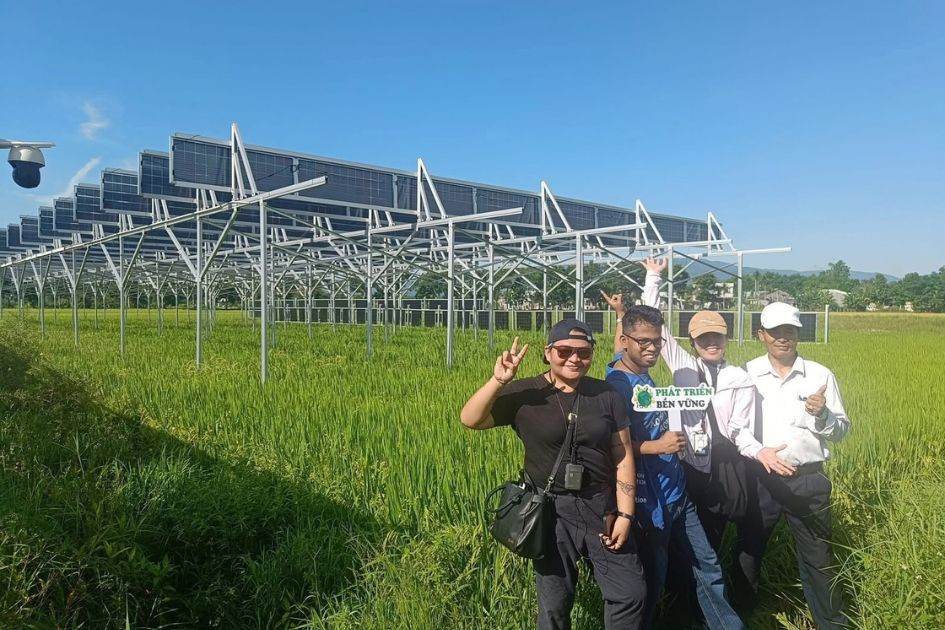
In Vietnam’s Da Nang region, rice cultivation has not been displaced. Instead, it continues alongside renewable energy generation on the same farmland. Elevated and strategically angled solar panels are installed above paddy fields, enabling a dual harvest of food and electricity from a single plot of land.
This model demonstrates agrivoltaics in practice, an approach that allows countries to expand clean energy without sacrificing agricultural land.
In contrast, concerns are growing in Bangladesh that some solar energy projects are being developed on fertile, multi-crop agricultural land designated for solar parks. While expanding renewable energy is essential for addressing the climate crisis, it also raises questions about the long-term sustainability and fairness of such transitions when they come at the cost of productive farmland.
The experience in Vietnam highlights an alternative pathway, one where food security and energy security are not treated as competing priorities but as complementary goals.
For Bangladesh, this underscores the urgent need to rethink how agriculture and renewable energy can be integrated in a way that advances a just transition, one that reduces emissions while also protecting farmland, livelihoods and long-term food security.
At the Manikganj site, solar panels are installed more than two metres above the ground, allowing filtered sunlight to reach crops beneath them.
Researchers are monitoring rainfall, wind speed, temperature and other microclimate conditions while comparing yields with nearby control plots. The goal is to identify optimal panel heights, spacing and crop combinations that balance food production with electricity generation.
Farmers are cultivating rice, coriander, pumpkins, bottle gourds and onions beneath the elevated structures.
“The shade helps preserve soil moisture while also making it more comfortable for workers during hot summer days,” said farm worker Biswas.
Early observations suggest that reduced heat stress and lower evaporation may help maintain agricultural productivity.
Shade-tolerant crops such as ginger and turmeric have already performed well in agrivoltaic pilots conducted by GIZ in Manikganj and by the Wave Foundation in Chuadanga in western Bangladesh. Similar experiments in Chuadanga have also explored integrating goats and poultry beneath solar installations.
However, rice cultivation remains a key challenge. As Bangladesh’s staple food, rice requires high levels of sunlight, making integration with solar systems more complex. Researchers are therefore focusing on rice varieties and system designs that can coexist effectively.
“Flood-tolerant rice varieties are needed in low-lying areas like Manikganj that are submerged during the monsoon, while solar mounting structures must be strong enough to withstand storms,” said Rohini Kamal, Assistant Professor at BIGD.
Solar Irrigation Reducing Costs for Farmers
Beyond agrivoltaics, solar energy is transforming Bangladesh’s irrigation sector, which remains heavily dependent on diesel fuel.
Rising geopolitical tensions and persistent instability in global energy markets, driven by conflicts involving Iran, Israel, the United States and Russia-Ukraine, have triggered sharp fluctuations in oil prices and supply uncertainties worldwide. The ripple effects are increasingly felt in Bangladesh’s agriculture sector, particularly during the peak irrigation season when dependence on diesel remains high and electricity supply is often strained.
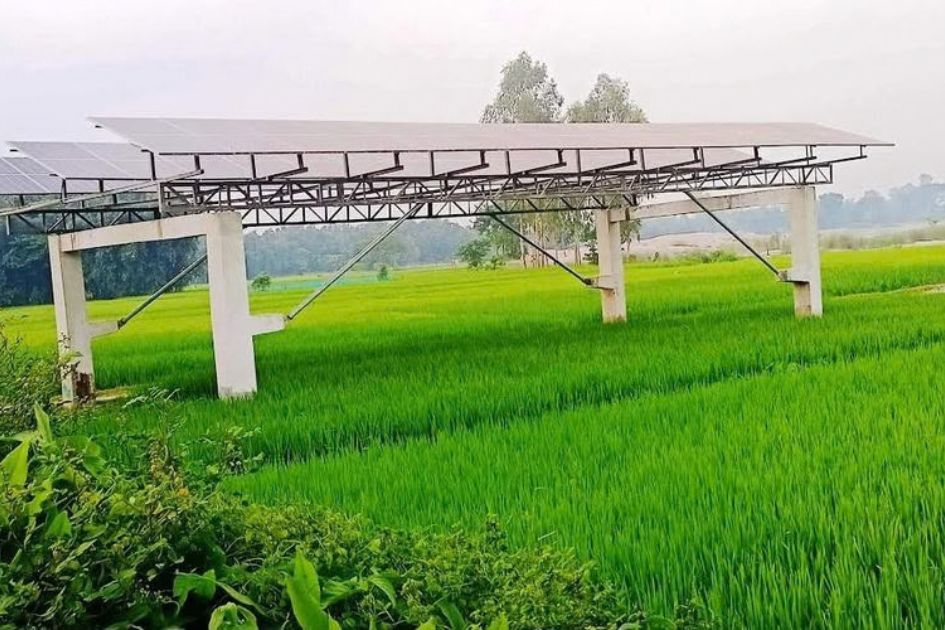
Against this backdrop, solar-powered irrigation is emerging as a practical solution in the Rangpur region, offering farmers a more stable and cost-effective alternative. Officials say around 5.9 megawatts of electricity is being generated daily through solar irrigation systems across different areas of Rangpur Division, significantly reducing pressure on fossil fuel use.
The shift is already translating into tangible savings, with nearly 7.5 million litres of diesel expected to be saved in a single irrigation season, easing both import pressure and farmers’ production costs.
Farmers report that timely irrigation is now possible without the disruptions of fuel shortages, rising prices or load-shedding, helping improve crop reliability and reduce cultivation costs.
In Lalmonirhat’s Hatibandha upazila, Atiar Rahman oversees a Bangladesh Agricultural Development Corporation-managed dugwell in Doani village of Gaddimari Union, where solar irrigation is quietly reshaping local farming practices and offering a more resilient path forward for climate-vulnerable agriculture.
In Dhitpur village of Mymensingh district, a solar-powered irrigation system now pumps water from the Sutia River, serving around 70 farmers. The project has significantly reduced irrigation costs and lowered exposure to volatile fuel prices.
“Previously, irrigation cost farmers around Tk 800 per katha of land. Now it costs about Tk 300,” said local resident Rokonuzzaman.
The facility also integrates rice processing, crop drying, cold storage and charging stations for battery-powered agricultural transport.
According to the Bangladesh Agricultural Development Corporation (BADC), the country operates 1,035,639 diesel-powered shallow tube wells, 737 deep tube wells and 184,375 low-lift pumps. During the 2025-26 fiscal year, operating more than 1.22 million irrigation machines required around 769,000 tonnes of diesel.
The Sustainable and Renewable Energy Development Authority (SREDA) estimates that nearly 80 per cent of irrigation equipment still relies on diesel, consuming about 1.49 billion litres annually and placing heavy pressure on fuel imports and foreign exchange reserves.
At least nine government and state-owned institutions are involved in promoting solar irrigation, including BADC, Barind Multipurpose Development Authority, Department of Agricultural Extension, Infrastructure Development Company Limited (IDCOL), Bangladesh Rice Research Institute (BRRI), Bangladesh Agricultural Research Institute (BARI), Bangladesh Rural Electrification Board (REB), Bangladesh Academy for Rural Development (BARD) and Rural Development Academy (RDA).
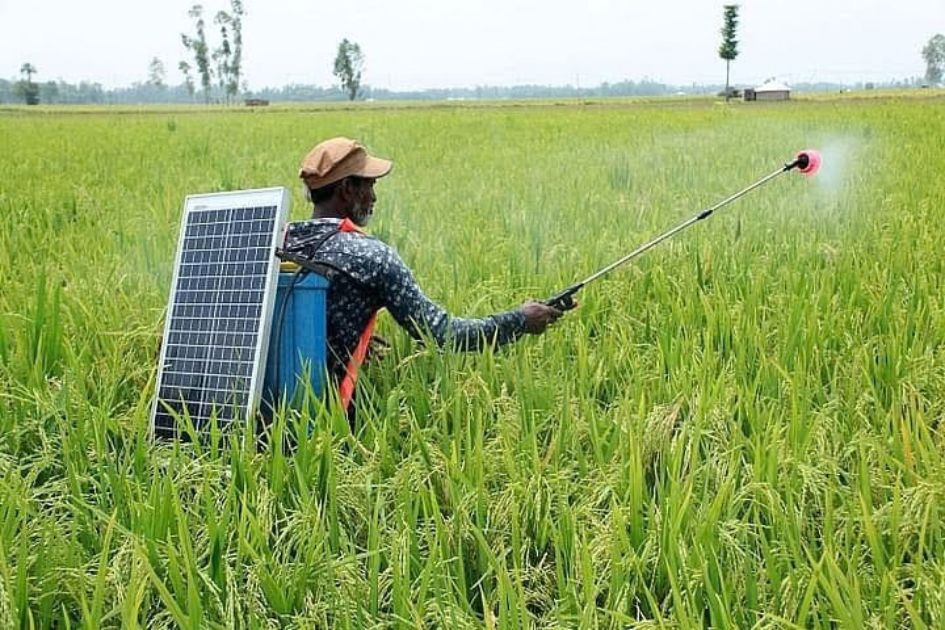
Scaling Up Solar Irrigation
According to BADC, Bangladesh currently operates 5,139 solar-powered irrigation pumps, generating around 73 MW of installed capacity. However, this still covers only about one per cent of the country’s 5.56 million hectares of irrigated land.
Despite steady expansion, the overall impact remains limited compared with national agricultural demand, highlighting both progress and the scale of untapped opportunity.
The Infrastructure Development Company Limited (IDCOL), a leading promoter of solar irrigation, notes that high upfront costs remain a major barrier despite available grants and financing support.
Experts also stress the need for stronger policy frameworks, particularly allowing farmers and operators to sell surplus electricity back to the national grid to improve financial viability.
Studies by development agencies and international institutions suggest that large-scale solar irrigation could save hundreds of millions of dollars in fuel imports annually while significantly reducing greenhouse gas emissions.
It could also help Bangladesh meet its climate commitments by reducing dependence on diesel and easing pressure on foreign exchange reserves.
Evidence from Field and Research
A study by the International Water Management Institute (IWMI) shows that solar irrigation pumps can reduce farmer costs by 20 to 30 per cent, significantly lowering dependence on imported diesel, which powers around 80 per cent of the country’s 1.6 million irrigation pumps.
Jayanta Bhattacharya, Associate Scientist at IWMI, said the second phase of the SoLAR project combines solar irrigation with Alternate Wetting and Drying (AWD) techniques to promote water conservation.
He said this integrated approach aims to maximise “crop per drop” while also reducing methane emissions from paddy cultivation.
Researchers at Bangladesh Agricultural University argue that a truly renewable agricultural system must go beyond irrigation and cover the entire value chain from production to post-harvest processing.
Renewable Energy Push Amid Land Use Dispute
Thousands of farmers in Ramakantpur village under Sujanagar Upazila have alleged displacement and loss of livelihoods following the establishment of a 64-megawatt solar power plant on the floodplain of the Padma River, developed by the Bangladesh-China Renewable Energy Company Limited (BCRERCL).
Locals claim that around 206 acres of multi-crop land, traditionally cultivated for generations after re-emerging from river erosion, were reclassified as government khas land and leased for the project, leading to eviction without adequate compensation. They further allege irregularities in compensation processes, including multiple collections of money by intermediaries and legal action against protesting farmers, though these claims remain unverified.
While the district administration, led by Deputy Commissioner Mohammad Aminul Islam, says compensation is not applicable due to the absence of private ownership, it has promised a review and possible rehabilitation if misclassification is found. Project officials maintain that the solar park was established legally and has been supplying electricity to the national grid since August last year, highlighting a growing tension between Bangladesh’s renewable energy expansion and the land rights of rural farming communities.
Toward a Just Transition in Agriculture
Bangladesh faces escalating risks from floods, cyclones, droughts, salinity intrusion and river erosion. At the same time, it must ensure food production and energy security for a growing population.
Within this context, agrivoltaics and solar irrigation are emerging as key elements of a just transition in agriculture, a shift that goes beyond decarbonisation to ensure that smallholder farmers, rural workers and climate-vulnerable communities are not left behind but instead benefit from new clean energy and climate-resilient farming systems.
The question of how to use surplus solar electricity is becoming increasingly important, with experts calling for stronger integration with the national grid.
Dipal Chandra Barua, founder of Bright Green Energy Foundation, argues that grid connectivity for solar pumps would significantly improve economic viability while lowering electricity costs.
He also recommends low-interest loans for solar irrigation expansion and related technologies. With more than 10,000 bank branches across Bangladesh, he suggests that even small-scale financing could accelerate adoption if properly structured.
Professor Chayan Kumar Saha of Bangladesh Agricultural University said initiatives like the Dhitpur model could serve as a national template, as they integrate irrigation, rice threshing and drying, reducing dependence on diesel-powered machinery and lowering production costs.
For farmers like Taijul Islam, the shift is already visible. Where diesel deliveries once determined whether crops could be irrigated on time, sunlight is now helping power the fields that sustain rural livelihoods.
If supported by financing, policy reform and research, solar-powered agriculture could strengthen food security, reduce fossil fuel dependence and accelerate Bangladesh’s transition toward a low-carbon economy.
In a country on the frontline of climate change, the future of farming will depend on how effectively sunlight is turned into both food and energy from the same land, ensuring that the transition is not only green but also just.




