

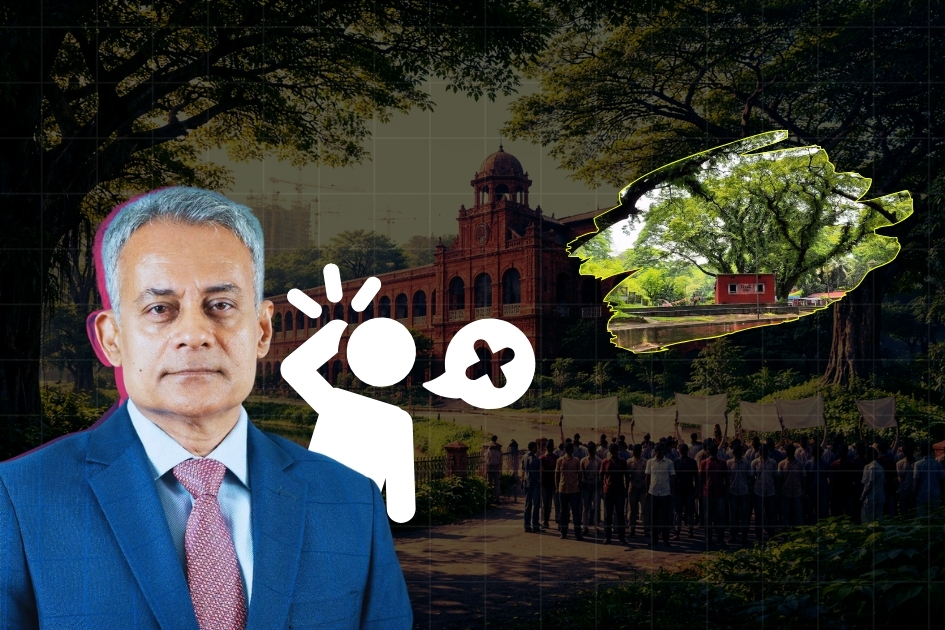



Mixed signals from the rail minister reignite uncertainty over a controversial hospital project at CRB, as activists warn of environmental risks and demand clarity on the future of the protected site.
Confusion and concern have intensified over a renewed push to build a hospital in CRB, the Central Railway Building area and a key green zone in Chattogram, a major port city in southeastern Bangladesh, following mixed signals from Railways Minister Sheikh Rabiul Alam.
Speaking to reporters on Sunday evening after inspecting the proposed railway site, the minister said the government is not currently moving forward with the project. However, he added that future decisions could be taken in consultation with stakeholders, leaving activists and residents questioning whether the plan has been abandoned or quietly revived.
“There is no situation where the government is being compelled or proceeding to construct a hospital at CRB at this moment,” he said, adding that any future move would involve discussions with the people of Chattogram.
The latest uncertainty comes amid reports that the government has again taken steps to revive the hospital project at CRB, just two months after assuming office. The move has triggered fresh concern and anger among various groups in the port city, recalling a similar initiative under the previous Awami League government that was shelved following mass protests.
Under the earlier plan, railway authorities signed an agreement on March 18, 2020 with United Enterprise and Company to develop a 500-bed hospital and a 100-seat medical college under a public-private partnership model. The proposal also included upgrading the existing railway hospital to 500 beds and establishing a 50-seat nursing institute.
At the time, social, environmental and political groups in Chattogram united in strong opposition, forcing the government to suspend the project.
The minister said a deposit had been paid as part of the PPP process and that any future course of action would be decided through consultations with all relevant stakeholders. He noted that discussions had previously taken place at the parliamentary standing committee level, but no decision has yet been taken by the current government.
Asked about alternative locations, he said earlier proposals suggested construction could proceed only if no trees were harmed and the existing environment remained intact, though no position has been adopted so far.
He confirmed that no discussions had taken place with the Chattogram City Corporation mayor, adding that the mayor had only indicated that a section of residents opposes building a hospital at the site. “People can have such views, and concerns about the environment are natural,” he said, adding that any project deemed reasonable and beneficial would be considered.
He stressed that no initiative would be undertaken if it puts residents at environmental risk. “If a project genuinely serves public interest and is necessary, it will be considered with importance,” he said.
On ongoing protests, the minister said demonstrations are part of democratic rights and that there is currently no reality in which the railway authorities are proceeding with the PPP project. He also said that under the present government, railway land cannot be leased for commercial or beneficiary-driven construction.
Earlier on Sunday morning, the CRB Protection Committee formed a human chain at the CRB Seven Road intersection. Its convener, Dr Mahfuzur Rahman, said CRB is a government-declared heritage area where constructing any private or commercial establishment would violate the law. He alleged that influential groups are attempting to seize the land through the hospital project.
He suggested that if a hospital is necessary, it could instead be built at the abandoned Haji Camp in Pahartali or at the TB hospital area in Kumira.
According to a study by Effective Creation on Human Opinion (ECO), CRB is home to 223 plant species, including 183 medicinal plants, 34 shrub species and 34 types of climbers. The area also contains nine endangered plant species and 88 varieties of trees. Its century-old garjan and sirish trees have earned it the reputation as the “lungs” of the city.
In 2008, the Chattogram Development Authority designated CRB as a cultural heritage site under its Detailed Area Plan. The guidelines prohibit commercial use of the area and ban the construction of high-rise buildings, allowing only environmentally friendly attractions such as bird sanctuaries, museums and butterfly parks.
Protesters warn that any damage to CRB would severely disrupt Chattogram’s ecological balance. Critics also allege that railway land worth billions of taka has become an unaccountable asset, with projects stalled in some places, quiet commercial interests emerging in others, and attempts made to impose decisions despite public opposition.
Observers say CRB is not just land but a vital part of the city’s environment, history and culture, and that its destruction would deal a lasting blow to Chattogram’s ecological stability.




