

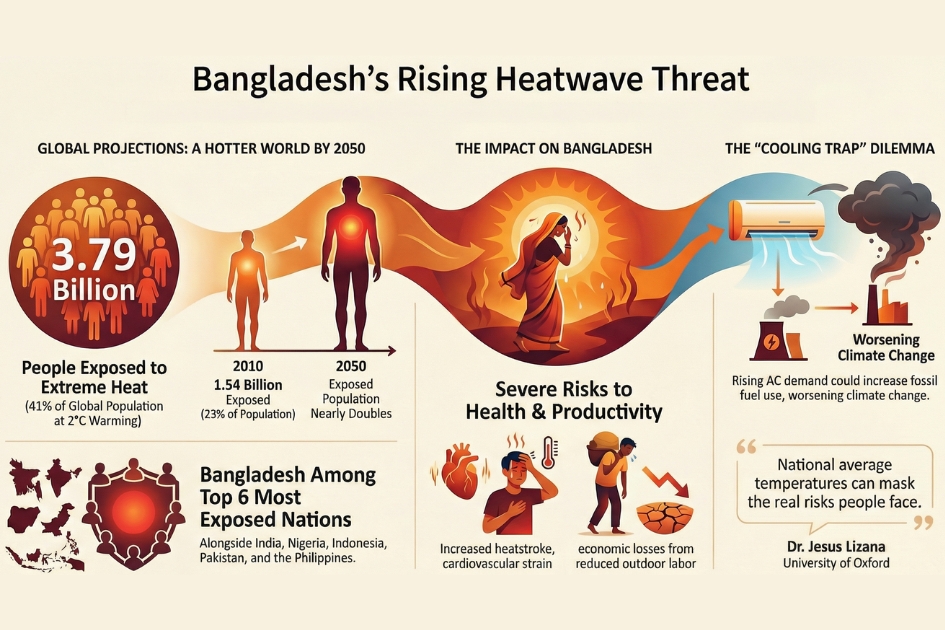

A new Oxford-led study warns Bangladesh will be among the worst hit by extreme heat by 2050, threatening health, livelihoods and productivity unless global warming is sharply curtailed worldwide today.
Bangladesh is projected to be among the six countries with the largest populations exposed to extreme heat by mid-century, according to a new international study led by researchers from the University of Oxford.
The study, published on Monday in the journal Nature Sustainability, warns that intensifying heatwaves pose a growing threat to public health, economic productivity and daily life worldwide, particularly if global reliance on fossil fuels continues.
Researchers estimate that the proportion of the world’s population exposed to extreme heat could nearly double over the next 25 years. If global warming reaches 2 degrees Celsius above pre-industrial levels, around 41 percent of the global population, approximately 3.79 billion people, would be living under extreme heat conditions by 2050. This compares with 23 percent, or about 1.54 billion people, in 2010, the study said.
Using high-resolution climate and population models, the research team assessed heatwave risk through the Cooling Degree Days (CDD) index, a metric that measures the amount of cooling required to maintain safe indoor temperatures. Regions registering more than 3,000 CDDs per year were classified as extreme heat-prone.
Based on this threshold, the countries with the largest numbers of people exposed to extreme heat include India, Nigeria, Indonesia, Bangladesh, Pakistan and the Philippines.
“National average temperatures can mask the real risks people face,” said lead author Dr Jesus Lizana of the University of Oxford. “In Bangladesh, most people live in areas where annual cooling demand exceeds 3,000 CDDs. This means prolonged and dangerous exposure to heat, affecting health, productivity and in some cases human survival.”
Bangladesh is already considered one of the world’s most climate-vulnerable countries, with international attention often focused on sea-level rise, cyclones and flooding. The new findings highlight extreme heat as an additional and increasingly severe threat, particularly for densely populated urban and rural areas where access to cooling is limited.
The study notes that prolonged heat exposure increases the risk of heatstroke, cardiovascular strain and kidney disease, with disproportionate impacts on older people, children and low-income communities. In countries such as Bangladesh, where large segments of the population work outdoors or in poorly ventilated environments, extreme heat can also reduce labour productivity and increase economic losses.
The Oxford-led research further predicts that rising temperatures will drive the fastest growth in cooling demand in low- and middle-income countries across tropical and subtropical regions. By contrast, wealthier nations in the Global North are expected to see declining heating needs as winters become milder.
Per capita cooling demand is projected to rise most sharply in countries including the Central African Republic, Nigeria, South Sudan, Laos and Brazil, reflecting both population growth and increasing exposure to extreme heat. Meanwhile, countries such as Canada, Russia, Finland, Sweden and Norway are expected to require less heating energy by mid-century.
By 2050, the share of the global population living in very cold regions is projected to fall from 14 percent to just 7 percent, the researchers said.
The study also warns of a potential cooling trap in extreme heat-prone countries. Rising demand for air conditioning could sharply increase energy consumption and if met primarily through fossil fuels, further accelerate climate change, intensifying the very heat risks countries are seeking to manage.
The findings underline the narrowing window to prevent the most severe impacts of extreme heat. The researchers said limiting global warming to 1.5 degrees Celsius would significantly reduce the number of people exposed to life-threatening heat conditions by mid-century.




