




Bangladesh civil society groups demand suspension of the draft Energy and Power Sector Master Plan 2025, citing fossil fuel dependence, climate risks, inflated demand projections and lack of public consultation.
Bangladesh civil society groups on Sunday (January 18) called for the immediate suspension and cancellation of the draft Energy and Power Sector Master Plan 2025, warning that the long-term strategy would deepen fossil fuel dependence, undermine climate commitments and impose heavy financial burdens on citizens.
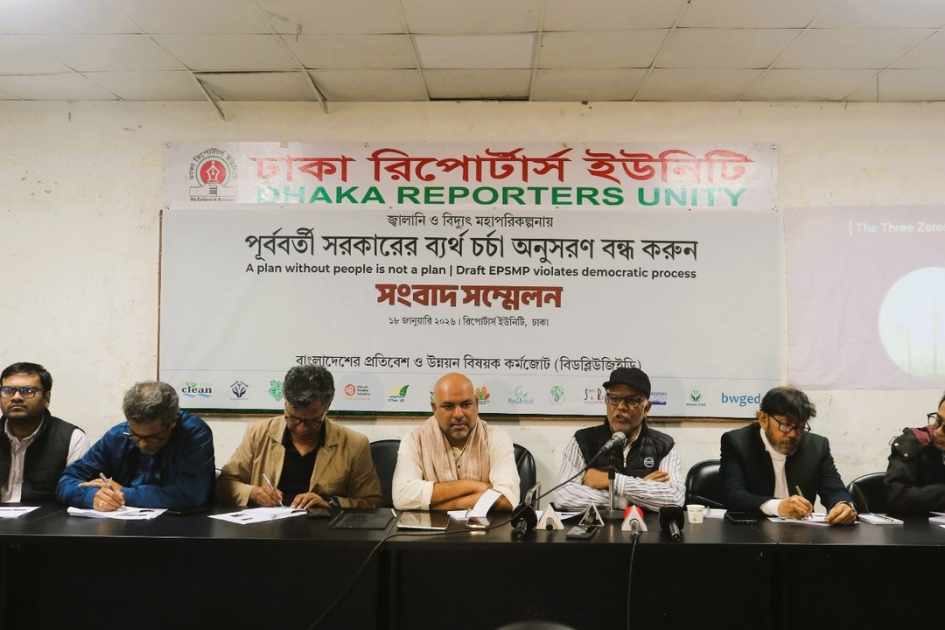
At a press conference held at the Dhaka Reporters’ Unity, representatives of multiple citizen groups said the 25-year plan for 2026 to 2050 was being pushed forward by the interim government without democratic process, transparency or public participation, despite High Court directives requiring meaningful consultation.
The event was organised by the Bangladesh Working Group on Ecology and Development and co-organised by the Coastal Livelihood and Environmental Action Network, Amrai Agami, Bangladesh Environmental Lawyers Association, Center for Environment and Participatory Research, Ethical Trading Initiative Bangladesh, Jet-Net BD, Lawyers for Energy, Environment and Development, Manusher Jonno Foundation, Re-Global, Souhardo Youth Foundation, Safety and Rights, Waterkeepers and the Worker-Led Climate Action Network.
Delivering the keynote address, Monwar Mostafa, network adviser of CLEAN, said the interim government was exceeding its mandate by advancing a high-risk, long-term energy plan with far-reaching consequences. He said the plan was being framed to legitimise future fossil fuel projects, similar to past controversial approvals under the Electricity and Energy Supply (Special Provisions) Act.

“Bangladesh will not require 40,000 megawatts of electricity demand as projected,” he said, adding that although the plan promotes an “energy transition,” renewable energy actually accounts for only 17 percent, while it is presented as 44 percent.
According to Mostafa, the draft proposes increasing gas-based power generation capacity from 15.8 gigawatts to 25.2 gigawatts and maintains reliance on liquefied natural gas, coal and oil at around 50 percent even after 25 years. He warned this would pose serious risks to energy security and the economy.
He also criticised the inclusion of costly and experimental technologies such as hydrogen, ammonia co-firing and carbon capture and storage, calling them unrealistic options that could burden the country with debt, subsidies and environmental crises.
The plan projects Bangladesh’s carbon emissions to reach 186.3 million tonnes of carbon dioxide equivalent by 2050, a figure speakers said directly contradicts the country’s nationally determined contributions and Nobel laureate Professor Muhammad Yunus’s “Three Zero” vision of zero poverty, zero unemployment and zero carbon.
Speakers further said the draft largely ignores critical social issues, including worker rehabilitation, gender equity, agriculture, health, education and the greening of the garments sector.
BWGED secretary Hasan Mehedi said the plan had been finalised without consulting the public, civil society or independent experts. “This crucial national plan is repeating the opaque and non-accountable policies of previous autocratic governments,” he said.
LEED research director Advocate Shimonuzzaman said it was disappointing that a master plan similar to the Integrated Energy and Power Master Plan 2023 was being prepared just before an election, while ignoring civil society voices.
ETI Bangladesh programme director Munir Uddin Shamim said citizens’ constitutional rights had been violated. He warned that if the plan moves forward, the export sector would face severe crises and new challenges from 2027 onward.
Other speakers included Abul Kalam Azad of Jet-Net BD, Wasiur Rahman Tanmoy of Manusher Jonno Foundation and Syed Tapas of Waterkeepers.
Civil society representatives outlined several key concerns, including what they described as grossly overestimated electricity and energy demand that could lead to excess capacity, capacity payments and additional financial pressure on consumers.
They said the plan’s heavy dependence on imported LNG, coal and oil, projected to reach 50 percent by 2050, could cost the economy an estimated 192 billion dollars, threatening energy security, foreign reserves and economic stability.
They also said renewable energy and energy efficiency potential had been severely underestimated, while carbon reduction, climate risk mitigation and biodiversity protection measures were inconsistent with national realities and international commitments.
Speakers warned that past failures in earlier master plans had not been critically reviewed, raising the risk of repeating similar mistakes. They also questioned the inclusion of unproven technologies such as ammonia and hydrogen for future power generation, as well as wave energy, which had previously been deemed unfeasible.
The groups demanded the immediate suspension and cancellation of EPSMP 2025, the launch of a transparent and inclusive national consultation process and the rapid reduction of fossil fuel dependence across all sectors.
They called for a realistic roadmap toward 100 percent renewable energy and a new plan grounded in fairness, social inclusion and environmental sustainability.
Without such changes, they warned, the draft plan risks becoming another non-transparent policy that excludes citizens and places long-term economic and environmental costs on the public and future generations.




