

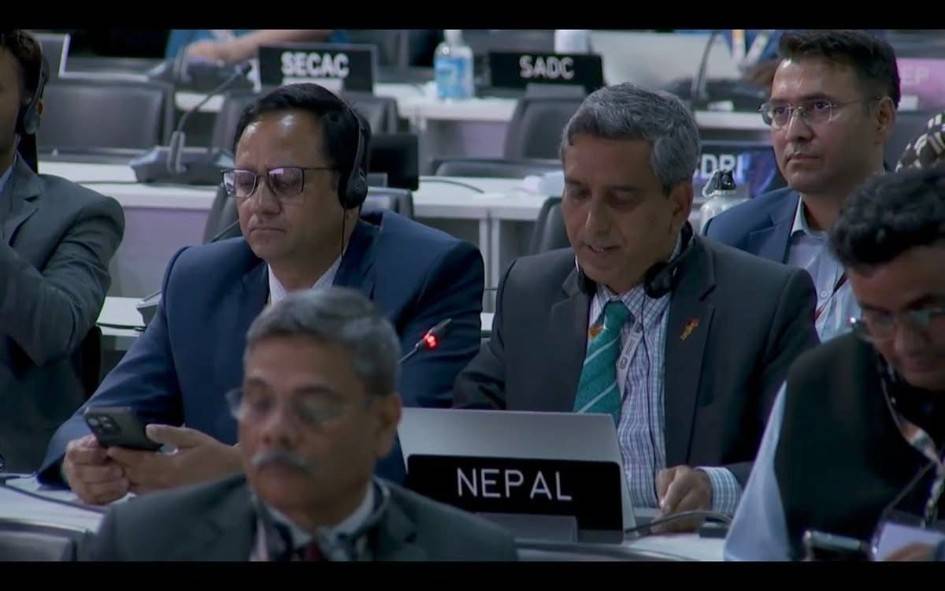

In a joint statement at the COP30 climate conference in Belém on Tuesday, Nepal spoke on behalf of Bangladesh, Bhutan and Nepal, calling for urgent global action to safeguard the planet, strengthen regional cooperation and protect vulnerable communities.
Delivering the statement, Nepal emphasized that the three South Asian nations, bound by shared geography and intertwined vulnerabilities, remain among the most climate-exposed countries in the world despite contributing the least to global emissions.
“Our three countries are united by shared geography, deep climate vulnerability and a strong commitment to sustainable development,” Nepal said. “Despite contributing least to global emissions, we continue to demonstrate high climate ambition but with limited capacity to respond.”
Nepal country representative noted that while Bhutan has already graduated from Least Developed Country (LDC) status and Bangladesh and Nepal are in the process of graduation, such progress “does not reduce our climate vulnerability nor the scale of support required to safeguard development gains.”
Statement described the worsening realities across the region: rapid glacier melt in the Himalayas threatening downstream communities in Bhutan and Nepal and rising sea levels and saltwater intrusion devastating coastal livelihoods in Bangladesh. “These are interlinked impacts,” statement read, “with melting glaciers feeding rising seas downstream, turning slow-onset changes into severe climate extremes with cascading consequences.”
“Science is clear, keeping 1.5°C within reach is a matter of our survival,” Nepal declared. “COP30 must close the ambition gap in Nationally Determined Contributions (NDCs) in line with the first Global Stocktake and accelerate implementation. Revisiting and enhancing 2035 NDCs to align with the 1.5°C pathway is essential.”
On climate finance, he urged delegates to operationalize the New Collective Quantified Goal (NCQG) with a clear pathway to mobilize USD 300 billion annually, within the broader USD 1.3 trillion roadmap agreed in Baku. The joint statement reiterated the call to triple grant-based adaptation finance to at least USD 120 billion per year by 2030, ensuring simplified and direct access to funds for implementing national adaptation plans.
“Adaptation is an investment in survival and a foundation for sustainable development,” Nepal stressed. “Belém must deliver a comprehensive set of indicators under the Global Goal on Adaptation and ensure support is predictable, rapid and directly accessible.”
The delegation further welcomed the Belém Implementation Mechanism (BIM) and the Framework for Resilient and Locally-Driven Development (FRLD), emphasizing that climate justice and equitable finance are central to effective global climate governance.
Bangladesh Youth delegate Sohanur Rahman, Executive Coordinator of YouthNetGlobal praised the joint initiative, saying:
“This united voice from Bangladesh, Bhutan and Nepal sends a powerful message from the most climate-vulnerable frontlines. Our survival depends on global solidarity and stronger regional cooperation. The time for promises is over, COP30 must deliver real action, real finance, and real accountability.”
Nepal concluded with a strong appeal, “Belém must serve as a turning point, to reaffirm our shared commitment and uphold the spirit of Mutirão, the Brazilian call for collective action toward a just and sustainable future.”




