

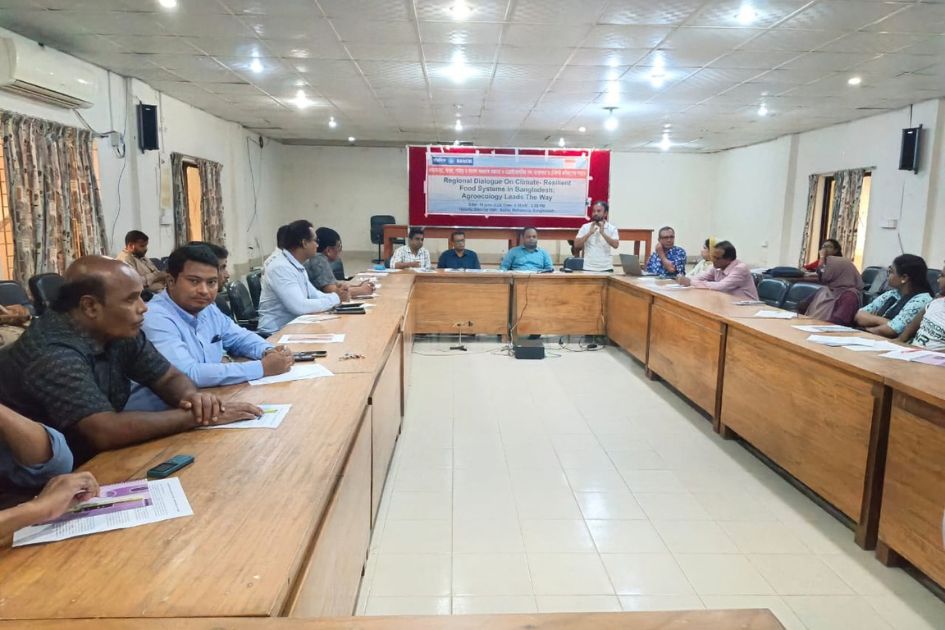



A regional dialogue in Netrokona highlighted agroecology as a practical solution for climate-resilient food systems, stressing biodiversity protection, indigenous knowledge, reduced chemical use and stronger support for farmers.
Agroecology offers a viable pathway to building climate-resilient and farmer-friendly food systems amid growing environmental challenges, speakers said at a regional dialogue in Netrokona on Wednesday.
The dialogue, titled “Regional Dialogue on Climate-Resilient Food Systems in Bangladesh: Agroecology Showing a New Path”, was held at the Netrokona Sadar Upazila Parishad Hall Room. It was organized by development research organization BARCIK with support from Rosa Luxemburg Stiftung South Asia.
Farmers, researchers, development workers, journalists, youth, students, civil society representatives and professionals from different sectors participated in the event.
The discussion focused on water scarcity in haor, hill and plain areas, the impacts of climate change, growing dependence on agricultural chemicals, preservation of indigenous seeds, the role of women farmers and the importance of agroecology-based food systems.
Speakers stressed that tackling the climate crisis requires strengthening local knowledge, protecting biodiversity, promoting low-cost farming practices and establishing food systems that remain under farmers’ control. They said agroecology is not merely an agricultural approach but also a practical pathway toward environmental sustainability and social justice.
The programme was inaugurated by Netrokona Sadar Upazila Nirbahi Officer Abdullah Al Bakiul Bari.
BARCIK Director Silvanus Lamin delivered the welcome address while BARCIK Regional Coordinator Md Ahidur Rahman moderated the session. At the beginning of the dialogue, BARCIK Policy and Research Officer Amrin Binte Azad presented a PowerPoint presentation highlighting field experiences related to agroecological challenges and opportunities.
During the open discussion, participants shared recommendations on how to strengthen agroecology and climate-resilient food systems in the Netrokona region. The dialogue concluded with a call for coordinated efforts to establish sustainable, climate-resilient and farmer-friendly food systems.
Speaking at the event, journalist Alpana Begum, vice-president of Green Coalition’s Netrokona district committee, said the haor region is one of the country’s richest ecological zones and should diversify beyond water-dependent rice cultivation.
“The cultivation of rabi crops should be expanded and fish farming should be increased,” she said.
Begum also said environmental destruction must be prevented to preserve agroecological balance.
“There is no need for crop protection embankments,” she added.
Farmer-researcher Golam Mostafa called for reducing the use of toxic pesticides in agriculture and highlighted the lack of recognition given to women’s contributions in farming.
He demanded separate budget allocations for women in agricultural policies.
The chief guest said different regions of Bangladesh face different agricultural challenges while possessing valuable natural resources including rivers, haors and forests.
“We must survive by protecting all these resources through collective efforts,” he said.
He added that no nation can progress without ensuring food safety and environmental protection.
Among others who spoke at the dialogue were Green Coalition committee members Mirza Hridoy Sagar, Rifat Ahmed Russell and Tanvir Hayat Khan; former Netrokona Press Club General Secretary Mokhlesur Rahman Khan; Netrokona University students Md Nasim and Jerin Akter; Assistant Professor Nazmul Kabir Sarkar; Principal Anwar Hasan; Syed Maksudul Haque; and researcher and writer Ali Ahmad Khan Ayub.
In his closing remarks, BARCIK Regional Coordinator Md Ahidur Rahman shared his experiences of agroecology-based practices and warned that environmental degradation is putting agroecological systems under increasing pressure.
“The more we destroy the environment and ecosystems in the name of development, the more agroecological practices fall into crisis,” he said.
“Let the haors and hills remain as they are. Reduce the use of pesticides and protect biodiversity.”




