

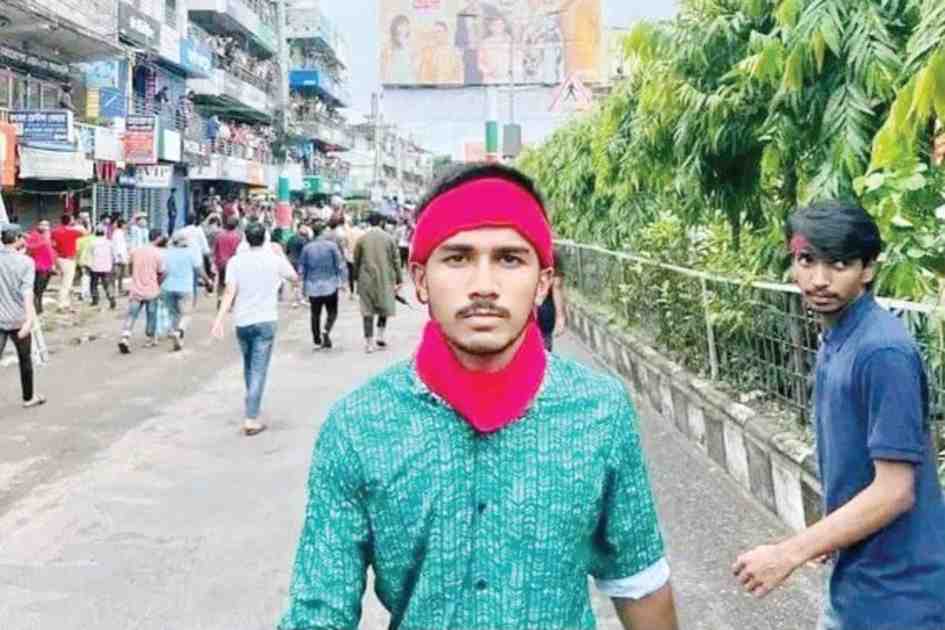



From YouthNet’s Feni Unit to a Geneva exhibition, Srabon’s red scarf has come to symbolize youth leadership, climate justice and the cost of standing for dignity in Bangladesh.
Some people leave this world, but their presence continues to live through memories, stories, and the change they inspire. Shaheed (martyr) Ishtiak Ahmed Srabon is one such person.
On August 4, 2024, while I was connected with YouthNet Global’s work, I received the heartbreaking news that our young member from the Feni Unit, Ishtiak Ahmed Srabon, had been critically injured during the protest at Mohipal, Feni. I prayed with all my heart that he would survive. I hoped that his familiar voice would return, that he would once again share his ideas, hopes, and plans with us. But the final news broke my heart. Srabon was no longer with us.
Srabon’s death took place during one of the most defining moments in Bangladesh’s recent history. The July 2024 mass uprising began as a student-led movement demanding reforms to the civil service job quota system. Led by Students Against Discrimination, it expanded into a nationwide movement calling for justice, dignity, and accountability amid state crackdowns. The movement culminated in the resignation of Prime Minister Sheikh Hasina on August 5, 2024, ending her 15-year rule.
For many young people, including Srabon, the July uprising represented a hope for a more just society where young voices could be heard and respected. His participation reflected his belief that young people have a responsibility to stand for human rights, dignity, and a better future.
But behind this historic moment was a young man with ordinary joys, deep family bonds, extraordinary compassion, and a lifelong commitment to creating positive change.
Even today, it sometimes feels as if I could suddenly call him and hear his familiar voice from the other side. But reality is painfully different. Srabon will never return.
Yet Srabon’s story is not only about the day we lost him. It is about the life he lived, the people he inspired, the values he carried, and the impact he left behind.
A Young Dreamer Committed to Change
My connection with Srabon goes back to our school days. He was not only a friend and a fellow youth activist but also a young person whose energy, kindness, and determination inspired everyone around him.
From childhood, Srabon had an extraordinary passion for sports, leadership, and social activities. He was admired on the playground, but what truly distinguished him was his sincerity toward people and his commitment to serving society.
During his journey as a young leader, Srabon served as the Vice President of the National Children’s Task Force (NCTF), a platform that promotes children’s participation and leadership. Later, as an active member of YouthNet Global’s Feni Unit, he contributed to youth-led initiatives on climate justice, environmental protection, pollution awareness, and sustainable development.
Srabon believed that young people should not only talk about challenges but also become part of the solutions. He envisioned a Bangladesh where people and nature could thrive together, where young voices would be valued, and where justice and dignity would guide society.
His commitment to climate action was not limited to words. Through YouthNet Global, he participated in youth initiatives focused on climate justice, environmental awareness, and protecting the planet for future generations. He raised his voice against environmental pollution and worked to encourage young people to recognize that the climate crisis is not only an environmental issue but also a question of justice, equality, and human dignity.
For Srabon, climate action was connected with protecting vulnerable communities and building a more equitable future. His dedication reflected the belief that young people could become leaders in creating solutions for both environmental and social challenges.
However, remembering Srabon only as an organizer or climate activist would be incomplete. He was a person driven by curiosity, compassion, and a constant desire to learn. Whenever someone needed help, he tried to be there. His responsibility, sincerity, and empathy made him unforgettable.
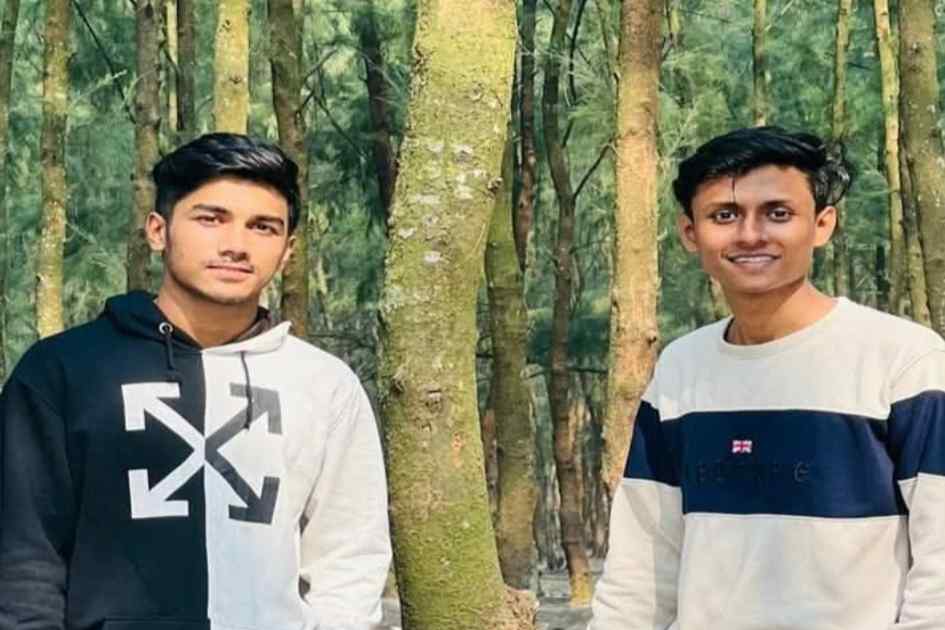
He often used to say, “Brother, let’s go travel somewhere.” Despite our busy schedules, we always tried to arrange a trip together at least once a year. Those simple moments have now become priceless memories.
The Brother Who Wanted to Make His Family Proud
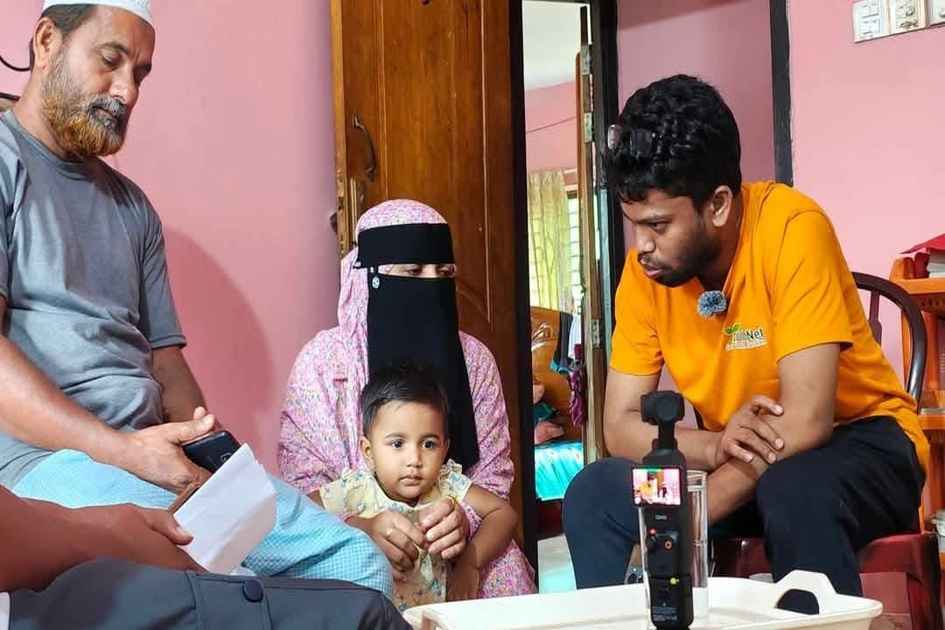
After meeting Srabon’s family, I discovered another beautiful side of his personality.
His mother, Fatema Akter, shared that every day Srabon would spend time teaching his younger sister Inaya how to draw and introducing her to new things. His middle sister would jokingly tease him, saying, “You can’t do anything!”
Srabon would laugh and reply, “One day, you all will ask me for my autograph and feel proud of me.”
Those words carry a different meaning today. Srabon truly believed he would achieve something meaningful and make his family proud. His journey ended too early, but his aspirations continue through those he inspired.
Once, I asked his younger sister Inaya, “Who am I to you?”
With an innocent smile, she replied, “Brother.”
Perhaps she still cannot fully understand that her brother will not return. Perhaps she still waits for the day when Srabon will sit beside her again and teach her how to draw.
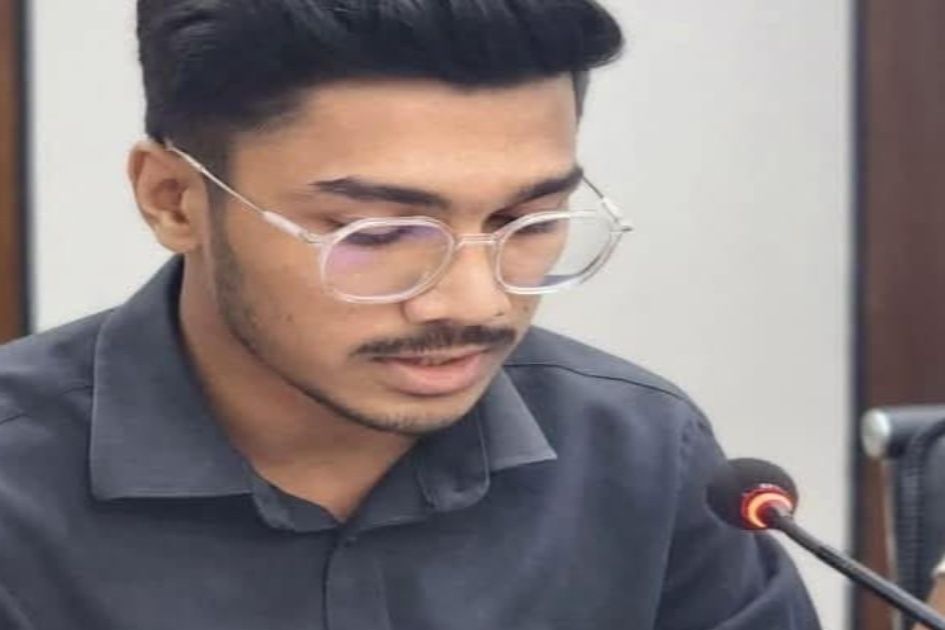
A Mother’s Red Scarf Became a Symbol of Courage
Among all memories of Srabon, one story from his mother remains especially powerful.
Fatema Akter recalled:
“On August 3, my son came to me and said, ‘Give me a red cloth.’ I told him I had a red scarf. He said, ‘Give me that.’ Since there was no red flag, he wrapped his mother’s red scarf around his head and joined the protest.”
A simple red scarf from a mother’s wardrobe became a symbol of a son’s courage, love, and commitment to justice.
When his friends jokingly asked whether it was a girlfriend’s scarf, Srabon replied, “Why can’t it be my mother’s scarf?”
For Srabon, the scarf represented love, family, identity, and the strength he carried from his mother.
On August 4, 2024, Srabon joined the protest at Mohipal in Feni. During the violence, he was critically injured by gunfire. Despite receiving medical treatment, he could not survive. His death became one of the painful chapters of Bangladesh’s recent history.
Fatema continues to carry the unbearable pain of losing her son. She recalled the devastation of seeing him injured and the pain of having to arrange his burial soon after his body was brought home.
“I kept asking to hold him a little longer, to keep him close to my chest. I wanted to see him and love him for a little more time,” she said.
At their home in Feni, Srabon’s memories remain carefully preserved. His cricket trophies, belongings, photographs, and personal items remind his family and friends of a young man who brought happiness and hope into their lives.
Fatema later donated Srabon’s red scarf and his blood-stained clothes to the July Museum so that future generations could remember his courage and sacrifice.
“Sometimes I feel that Srabon is still at home, walking around. Sometimes I forget that he is gone. I prepare food and call his name, asking him to come and eat,” she said.
A Portrait That Carried Srabon’s Story to the World
Srabon’s courage and sacrifice have not remained only within Bangladesh. His story has reached a global audience through art, where his memory has become a symbol of the struggles faced by young climate and human rights defenders around the world.
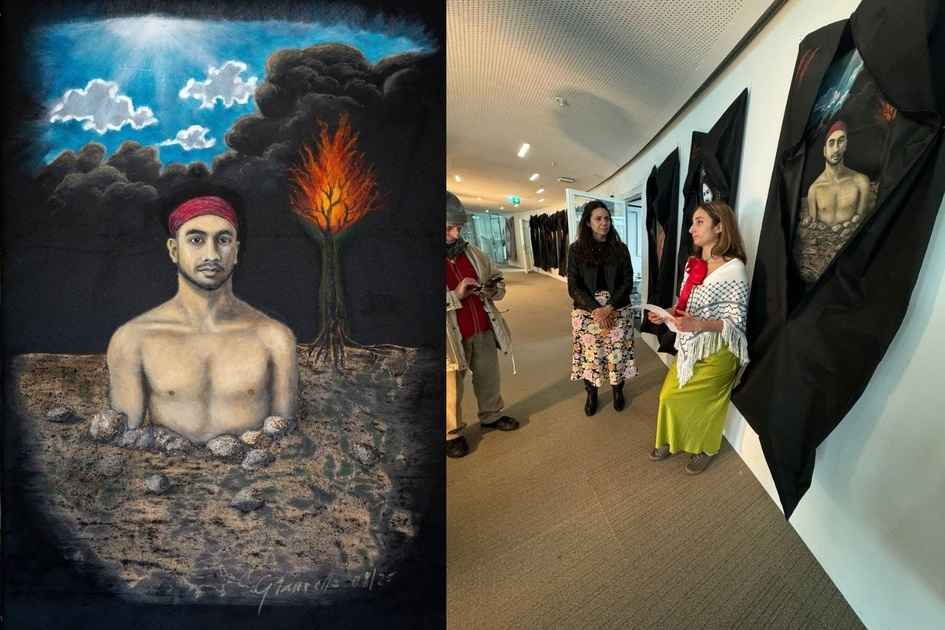
The portrait of martyred Bangladeshi youth climate activist Ishtiak Ahmed Srabon, who lost his life during the July uprising in Feni, gained international recognition after being featured at an international art exhibition in Geneva, Switzerland, held during Peace Week 2025.
The exhibition, titled “Echoes of Reality,” served as a powerful tribute to frontline human rights and environmental defenders from across the globe. It was curated by Alvaro Sebastián Quiroz Ballanos, a 26-year-old Mexican artist and activist known for combining visual art with social rehabilitation and human rights advocacy.
Hosted at the Geneva Graduate Institute, the exhibition presented portraits of 11 prominent environmental and human rights defenders painted on body bags, creating a haunting yet powerful reflection on the sacrifices made by those who stand for justice and the protection of our planet.
Among them, Srabon proudly represented Bangladesh and was immortalized as portrait number 11. Immediately following his portrait was an empty frame carrying the question, “Who will be next?” The message highlighted the continuing threats faced by people across the world who raise their voices for human rights, environmental protection, and justice.
According to the Iris Art Collective, Srabon’s portrait captures his unyielding spirit through an upright posture, with part of his body appearing embedded in the ground. This imagery represents both his deep connection with the land he loved and the sacrifice he made.
The red scarf tied around his head, the same scarf gifted by his mother, appears as a powerful symbol of love, solidarity, courage, and hope. Against a backdrop of black smoke and burning trees, the artwork portrays the painful intersection between human actions, environmental destruction, and the struggle for a sustainable future.
For those who knew Srabon, seeing his portrait displayed internationally was both a moment of pride and a reminder of the painful absence of a young life that had so much more to give.
The exhibition also featured the portrait of slain Rohingya refugee leader Muhib Ullah, who was assassinated at the Kutupalong refugee camp in 2021 after becoming internationally recognized for advocating refugee rights.
Through interactive “Meet the Artist” sessions held on October 15 and 16, visitors engaged with Quiroz about the inspiration behind his work. The exhibition concluded with a closing ceremony on October 17, emphasizing the vital role of art and culture in advancing global peace, accountability, and justice.
Srabon’s portrait in Geneva represents more than remembrance. It carries the voice of a young climate activist whose life was dedicated to justice, environmental protection, and a better future. His red scarf, once a symbol of a mother’s love, now stands before the world as a symbol of courage and the enduring struggle for a just and sustainable planet.
A Legacy Beyond Loss
Srabon’s departure is not only a loss for one family; it is a profound loss for an entire generation. The loss of a talented, compassionate, and visionary young person cannot be measured by numbers.
He was not only a climate activist. He was a voice for justice, dignity, democracy, environmental protection, and meaningful youth leadership.
His life reminds us that young people do not only fight for the planet; they also stand for human rights, equality, and a better future.
Today, on Srabon’s second anniversary of the Mohipal tragedy, YouthNet Global remembers him with deep respect and love.
Dear Srabon,
“I want to cry out loud, but I cannot shout,
Suppressing the pain in my chest, I curse myself.”
You may not return, but your smile, your kindness, your aspirations, and your dedication to serving others will continue to inspire us.
The red scarf that began as a mother’s gift has become a global symbol of courage, reminding us that Srabon’s vision for justice, climate action, and a better Bangladesh continues through every young person who chooses to stand for change.
Your unfinished vision will continue through every young person working for climate justice, democracy, equality, and a more equitable future.
Remembering Martyr Ishtiak Ahmed Srabon.
Your courage continues to inspire our journey for climate justice, youth leadership, democracy, and a Bangladesh where every young person can dream, lead, and create change.
The witer is a Coordinator, Environmental Justice and Sustainable Development, YouthNet Global.




