

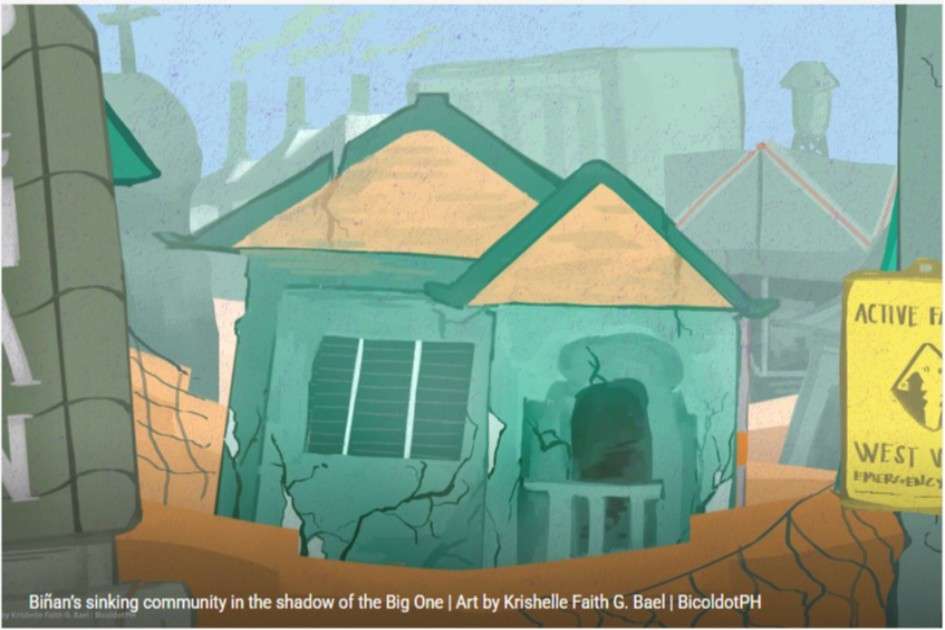



A community in Biñan, Philippines is literally sinking due to groundwater extraction for nearby data centers, compounding the danger from the nearby West Valley Fault and the looming threat of the next massive earthquake.
n San Francisco, Biñan, barangay (village) local officials and the homeowners’ association are training residents for the Big One: a magnitude 7.2 earthquake that could change the community forever.
The West Valley Fault, after all, runs along this urban community with million-peso homes (US$17,000) in this Southern Luzon province and cuts through densely populated areas of Metro Manila.

“We’re monitoring [over] 600 households deep inside Juana 3,” says Vincent Rafael Canonizado, head of residential subdivision operations. “We’re studying how to evacuate them safely if the earthquake hits.”
Canonizado has witnessed the changes firsthand:
“Over the years, I’ve seen big changes. Our small firetruck used to climb the road near the fault line easily. Now, it can’t.”

The ground is already sinking, not from tectonic shifts but from groundwater extraction. The rise of nearby data centers, which require vast amounts of water and energy for cooling, could worsen the problem.

Experts attribute the damage to subsidence, a slow or sudden collapse caused by extracting potable water for homes, industries, agriculture, and recreation. Laguna, with its sprawling industrial parks, alongside a fault line, is especially at risk.
Even as Juana 3’s walls crack and roads crumble, groundwater extraction risks remain absent from provincial public and policy agendas. How long can families endure when the danger is already here?
Digital infrastructures rise nearby
Just kilometers from Juana 3, Narra1 operates inside Laguna Technopark. Built by Singapore-based Digital Edge, it is Southeast Asia’s first sealed-loop data center. It promises low-impact cooling, reduced emissions, and 20 percent less water use than traditional facilities.
“That’s like skipping 80 Olympic pools a year,” said country manager Vic Barrios.

Its location, however, raises concern. A 2020 study by Eco et al. found that subsidence in Biñan is happening independently of fault activity, driven primarily by groundwater extraction. Satellite data from 2003 to 2010 and 2007 to 2011 showed rising well casings and frequent road elevation adjustments, which are direct signs of ground sinking.
A 2024 research paper reinforced these findings by using higher-resolution satellite imagery to measure continued sinking in Biñan and other subsidence-prone cities in the Philippines, including areas beyond Metro Manila and nearby provinces, at rates between 2 to 4.2 centimeters per year.
Jolly Joyce Sulapas of UP Resilience Institute said their research mostly found subsiding areas concentrated in industrial zones.
In San Francisco they found misaligned roads, bulging fences, and slanted walls. Nena Yeneza, president of Juana 3’s homeowners’ association, said some residents built their homes directly on top of it. “We warned them, but they can’t afford to move.”
Yeneza has lived in the subdivision since 1989.
“We started noticing it around 2010,” she said. “[The Philippine Institute of Volcanology and Seismology] (Phivolcs) told us the ground sinks about three centimeters a year. You can see it clearly: the cracks, the tilted homes, the roads that used to be flat.”
Sulapas suggests reducing groundwater reliance and shifting to surface water to curb land subsidence, which worsens flooding and damages infrastructure. She warns Laguna’s rising data centers may worsen subsidence, compounding threats from fault lines and climate-driven sea-level rise.
Yet the affected communities are preparing mainly for an exit plan for the Big One. According to Canonizado, the barangay checks fault-affected areas monthly.
We’ve submitted evacuation plans, but the terrain keeps changing,” he said. “We check the streets and subdivisions regularly.”
Phivolcs monitors earthquakes, volcanoes, tsunamis, and other geologic hazards to reduce disaster risks. Referencing the 2020 study, Phivolcs supervising science research specialist and geologist Jeffrey Perez, and one of the mappers of the West Valley Fault, reiterates in a Zoom interview that the problem with groundwater extraction falls outside their mandate.
Still drawing deep
Sulapas noted the government has yet to set extraction thresholds, and Narra1 still relies on groundwater.

Laguna Water operates 115 deep wells, sourcing 92 percent of supply from groundwater, including Technopark’s 10,000-square-meter Laguna Well Field (roughly the size of a football field). The facility supplies over 100 million liters daily, around ten times more than what 18,000 Laguna Water households currently require.
Narra1’s 10 MW facility reports 1.355 liters/kWh Water Use Efficiency, circulating 240,000 liters daily or 118 million annually, assuming at full utilization. A 20 percent savings suggests Narra1’s water use could reach 800 million liters yearly, equal to 5,400 Laguna households’ needs. This estimate exceeds Narra1’s reported WUE, likely due to indirect use, full system draw, or peak IT load projections.
Other Laguna data centers, including PLDT Vitro and A-Flow ML1, share limited publicly available data on water consumption.
Ignored hazards
The first study linking extraction to subsidence prompted regulation by the National Water Resources Board, but implementation remains uneven.
“The problem really is the implementation,” Sulapas said, noting Metro Manila complied while surrounding provinces struggled to enforce the policy.
Bündnis Entwicklung Hilft (BEH) and the Institute for International Law of Peace and Armed Conflict (IFHV) have ranked the Philippines as the most at-risk country in the world for four consecutive years.
The 2025 WorldRiskReport ranks Laguna as the second least flood-exposed province, crediting its unsealed rural areas and strong infiltration. Still, it flags low-lying towns like Bay, Biñan, and Los Baños for “slow and manageable” flooding. To ease groundwater reliance, Sulapas urged the government to incentivize rainwater harvesting and to factor in multiple hazards and environmental impact when revisiting policies.
Community awareness remains limited. “We don’t really know,” Yeneza said. “There’s Splash Island nearby, and tanks around the subdivisions. Maybe that’s one factor.”
Juana 3 alone has 645 households. With Juana 3A, 3B, Southwood Mall, and nearby condo towers over 24 floors, Yeneza sees evacuation turning into a logistical nightmare.
Meanwhile, Yeneza said one homeowner stayed despite her house leaning dangerously. A 2024 landslide dislodged a boulder into a home’s backyard, forcing relocation though the family returns regularly for their belongings. She also warned that flooding near Laguna Lake is getting worse.
“We can only keep reminding them. But where will they go?” Yeneza observes.

Still, we try to live normal lives, Yeneza said. When disasters strike, like Cebu’s 6.9 quake last September that shattered weak buildings and homes in vulnerable areas, fear surges back. “It shakes us up.”
Regulation cannot wait
Digital Edge chose Laguna for the presence of infrastructures. “Hopefully, there will be more regulations. A Digital Edge representative, who requested anonymity, said they would welcome that development.
But for sinking communities, regulation cannot wait. “If the government relocates them,” Yeneza said, “it should be to a place they actually want to live.”

Phivolcs’ Perez stresses that stopping excessive groundwater extraction would halt subsidence. Without intervention, the ground will keep sinking.
With reports from Aireen Perol-Jaymalin and Justin Umali; QGIS map by Sam Schramski.
The report was produced with support from Internews’ Earth Journalism Network as part of the “Dark Side of the Boom” collaborative reporting project on resource-intensive digital technology in Asia. It was lightly edited for length and clarity. The original story was published by BicolDotPH and can be found here.




