

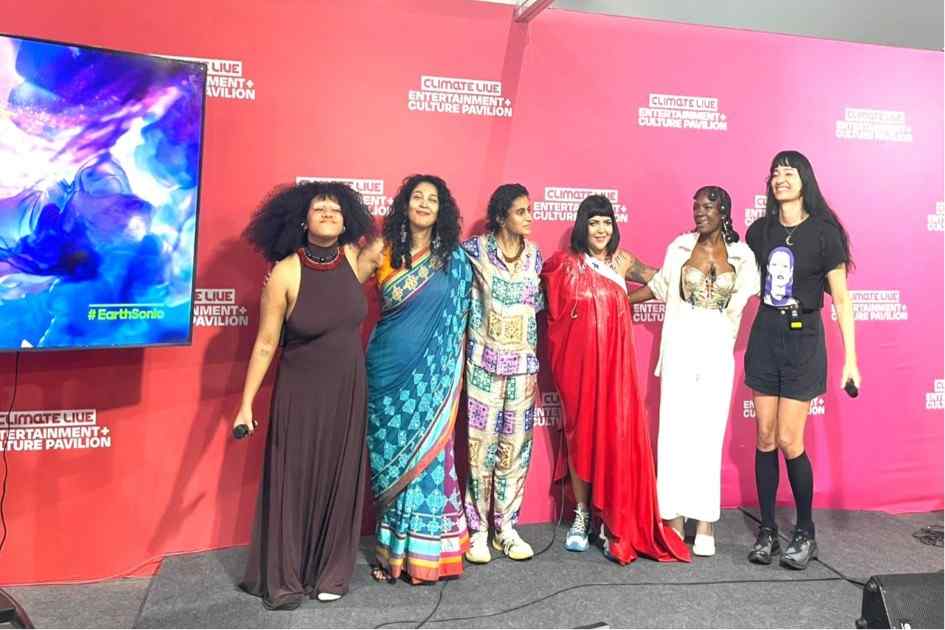



A haunting river song from Bangladesh stops diplomats inside COP30’s Blue Zone, as the women-led global collective FLOW uses music to bridge continents, reframe climate grief, and pull frontline communities into the heart of a policy-driven summit.
Inside the Blue Zone of UN Climate Summit COP30, where high-stakes negotiations unfold behind guarded doors, an unexpected sound rose above the diplomatic bustle: a Bangla melody drifting through the corridors, catching the attention of delegates who had grown accustomed to the hum of policy debates. Though Dhaka lies almost 3,000 miles away, for a moment its riverbanks felt startlingly close.
Climate Watch reporters followed the sound to the Climate Live Pavilion, where a young woman in a traditional saree stood beneath soft stage lights singing, “Nodir lagi ami kandi, amar lagi kew kandena” — “I weep for the river, yet no one weeps for me.” Her voice carried with it the weight of Bangladesh’s river erosion tragedies, weaving stories of loss, broken livelihoods and climate-forced displacement into the air of an international summit.
When the applause softened, the singer introduced herself as Sohini Alam, a British-Bangladeshi vocalist and music director of the recent hit film Barir Nam Shahana. “I wear a saree and choose at least one Bangla song to spread my country. I am Bangladesh,” she told reporters. For her, the performance was not simply artistic expression — it was testimony. A way to bring marginalised voices into a space dominated by policy language and diplomatic caution.
FLOW Bridges Culture and Climate
Alam’s performance formed part of a broader cultural intervention led by FLOW, an international women’s music collective determined to fuse climate urgency with artistic resistance. The ensemble — featuring São Paulo’s Bebé Salvego, Paraense artists Jaloo and Keila, Zimbabwean singer Shingai, Alam, and US-based Indian-origin performer Madame Gandhi — delivered three sets inside the Blue Zone before carrying their sound into Belém’s streets and independent venues.
What made their performances stand out was not only the diversity of voices but the clarity of purpose. Keila and Jaloo evoked the struggles of Amazonian communities fighting for land and identity. Alam brought South Asia’s climate vulnerability into sharp focus. Together, they reframed climate change as lived experience rather than abstract negotiation. Observers said the collective’s presence made the summit feel less sterile, more human.
Belém Responds with Festival Energy
Beyond the official COP30 perimeter, FLOW’s concerts at Casa Apoena and Casa Ninja Amazônia drew capacity crowds, with long queues spilling into the street long before the performances began. Local fans — many followers of iconic festivals such as Se Rasgum, Psica and Lambateria — sang, danced and filmed the shows in collective exuberance. Visiting international artists joined in, creating moments of cultural collision that felt rare and electric.
“It felt like the Amazon meeting the world,” said one attendee. “You could feel the energy shift.”
‘Spice Girls of COP’
As clips of their sets spread quickly across social media, FLOW earned a nickname that captured both their chemistry and their global reach: the “Spice Girls of COP.” The playful title stuck — a sharp contrast to the usually sober tone of climate summits, but perhaps a sign of how hungry people were for energy, artistry and human connection amid policy paralysis.
Next Stop: Manchester
With their week in Belém complete, FLOW now prepares for their next stage: Manchester, where they will perform on 22 November, this time again featuring the three Brazilian artists who electrified COP30. Organisers hope the blend of Amazonian rhythms, Bangladeshi laments and global feminist energy will resonate just as powerfully with UK audiences.
If COP30 often feels like a place where voices from vulnerable communities get lost in translation, FLOW and Alam proved that sometimes it takes a song — a lament for a river — to make the world listen.




