

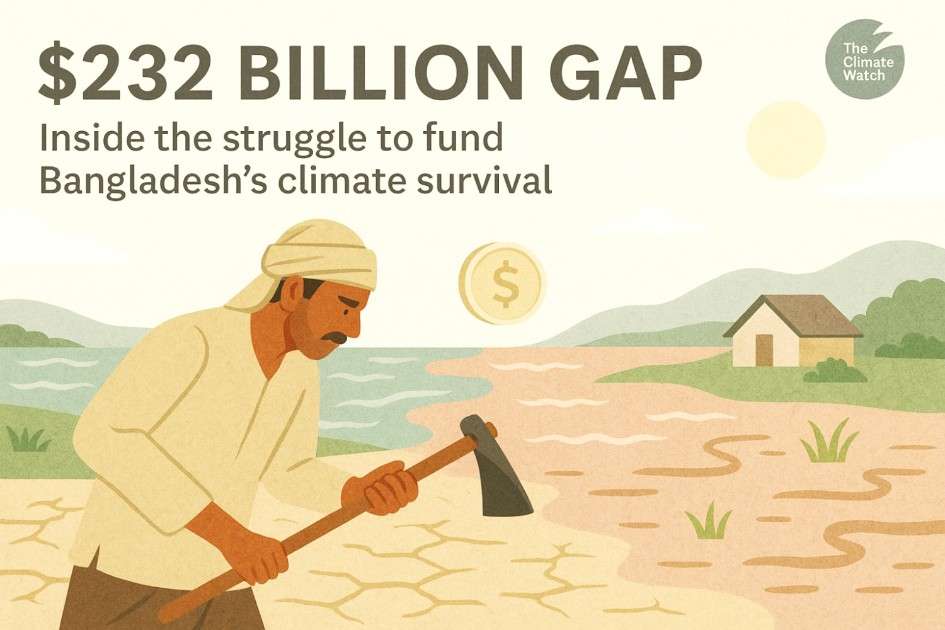

Bangladesh faces a $232 billion climate finance gap by 2030. Farmers endure salt-poisoned soil, rising seas, and debt, while MDB loans dominate funding. Experts urge grants, systemic reforms, and just financing to secure resilience, adaptation, and survival for millions.
For the farmers of coastal Satkhira, the climate crisis is measured in the creeping salinity of their soil, the ruins of a home washed away by a cyclone, and the increasingly desperate search for fresh water. For the policymakers in Dhaka, it is measured in billions of dollars.
Bangladesh, often cited as a global case study in climate resilience, has a plan.
Its Nationally Determined Contributions (NDCs) provide a detailed roadmap to fortify the nation against a crisis it did not cause. But the price tag for survival and sustainable development is staggering – $232.6 billion by 2030.
Yet, behind the scenes, a fierce debate is unfolding – one that pits the sheer scale of need against the architecture of international finance. The outcome will help determine the future of millions of Bangladeshis.
The core issue: A clash of perspectives
On one side stands the analysis of the local think tank Change Initiative (CI). Its assessment of Multilateral Development Bank (MDB) funding paints a bleak picture. MDBs have approved around $720 million for Bangladesh, but only about $232 million has actually been disbursed.
The disbursement rate, therefore, is just 32%. Measured against the country’s needs, this represents a mere 0.1% of the finance required by 2030. The funding is overwhelmingly loan-heavy, fragmented into small projects, and painfully slow to arrive.
CI warns that this structure risks plunging Bangladesh into a “climate debt trap,” forcing the country to go into debt merely to protect itself.
On the other side stands the World Bank, by far the largest single provider of climate finance in Bangladesh.
In a detailed response, the Bank presents a counter-narrative of massive and growing engagement. Between 2016 and 2024, it committed $7.2 billion for climate resilience – $4.1 billion for adaptation and $3.1 billion for mitigation.
Nearly 40% of its total country commitments now carry climate benefits. The Bank defends its model of using concessional loans and credits, insisting that projects are aligned with national priorities and that this approach “does not add extra loan burden for climate benefits.”
Keisuke Iyadomi, Senior Climate Change Specialist at the World Bank, underscored this commitment. “Our analysis shows the country can raise up to $12.5 billion in additional financing in the medium term for climate action.
The World Bank is committed to supporting Bangladesh on its path to a resilient, inclusive, and sustainable growth,” he said.
Chasm between commitment and need
How can two such different analyses exist? The discrepancy lies in the lens of measurement.
The World Bank’s $7.2 billion figure, while substantial and the largest from any single institution, is spread over eight years. When broken down, this amounts to roughly $900 million annually.
The CI, however, looks at the entire MDB system and sets it against the country’s annual requirement of approximately $23 billion until 2030. Viewed this way, even the World Bank’s impressive sum seems minuscule in the face of such colossal needs.
“The volume received is tiny compared to needs—barely 0.1% of what is required. The quantity is therefore far from enough,” CI concludes in its assessment.
The human cost: A farmer’s story
In the village of Burigoalini in Satkhira, these debates over loans, grants, and disbursement ratios feel remote.
For 36-year-old Abdullah Al Mamun, farming is not a policy question but a daily struggle. He tills the same land his father and grandfather once cultivated, but where they harvested abundant rice and vegetables, he now fights against soil poisoned by salt.
“The water turned salty years ago. It is in the earth, in the ponds, in the wells,” Mamun says, running his hands across the cracks in the pale, dry soil. “The cyclones push the sea further inland. Each time, it gets worse. My land is tired. It is sick.”
With rice production dwindling due to salinity, Mamun – like many others – turned to shrimp and crab farming. “I have to feed my three children. Without cultivating my ancestral land, I have no option. We are helpless in the face of this natural crisis,” he explains.
Nearby, a crumbling mud embankment represents a fragile, local effort to hold back the advancing sea. “This breaks every year. We repair it ourselves. It is like using a bucket to stop a flood,” Mamun laments.
When asked about international aid and climate projects, his expression turns from puzzled to resigned. “I hear officials come sometimes. They take pictures. We see signs for projects. But the water is still salty.
“Last year, I had to take a loan just to buy food. Now I am in debt because the rain is salt and the soil is dead.”
His story mirrors the broader crisis outlined in countless reports: the urgent demand for large-scale, resilient infrastructure such as strong embankments, the crushing income losses from adaptation measures, and the devastating human toll of delays.
For Mamun, the “disbursement ratio” is not an abstract figure – it is measured in lost harvests and growing debt.
The quality quagmire: Loans versus grants
Beyond sheer volume, the deeper dispute lies in the form of financing being offered. CI warns that the loan-heavy structure of MDB finance – with a loan-to-grant ratio close to one-to-one—is particularly dangerous for adaptation.
Projects like embankments, cyclone shelters, and saline-resistant water systems save lives but generate no revenue to repay debts.
“This increases the debt service burden, reduces fiscal space for social spending, and pushes Bangladesh toward a climate debt trap,” the report argues.
The World Bank counters by emphasizing the “highly concessional” nature of its credits from the International Development Association (IDA), which carry zero or very low interest and long grace periods.
It insists that grants for pure adaptation should come from other mechanisms such as the Green Climate Fund.
But climate experts see the issue differently. Md Shamsuddoha, chief executive at the Centre for Participatory Research and Development (CPRD), frames it as a question of justice.

“It is not fair,” he says. “Rich countries polluted the world and caused this climate crisis. But now, they are asking us to take loans to protect ourselves from it. This is wrong. We should not have to go into debt to build embankments or cyclone shelters.
“This is a burden on our children. The MDBs, including the World Bank, should give us the money as grants, not loans. That would be true help.”
Harnessing MDBs for energy transition
While loans may be unsuitable for adaptation, some experts argue they can be effective for mitigation projects – particularly in renewable energy – that can generate revenue to pay down debt.
Shafiqul Alam, lead energy analyst at the Institute for Energy Economics and Financial Analysis (IEEFA), sees MDBs playing a critical role in spearheading Bangladesh’s energy transition. “MDBs will likely play a significant role in spearheading Bangladesh’s energy transition,” he stated.
With Bangladesh aiming for 30% renewable energy by 2040, Alam highlights innovations already underway. “As ADB now provides loans in local currency to utility-scale projects, the private sector can tap into this potential.
“This will address the foreign currency risks.”
He stresses, however, that Bangladesh must also play its part by developing an investment-ready renewable energy project pipeline. For technologies like rooftop solar, he suggests pursuing grant support for technical assistance projects, effectively blending different forms of finance.
Alam points to other tools MDBs can provide, such as credit risk guarantee schemes to attract private capital. He notes that MDBs, having substantially reduced fossil fuel financing, are now well-positioned as partners in the energy transition.
“This is an opportunity for Bangladesh to tap into their funding for its energy transition,” he said.
To maximize access to grant support, Alam proposes a strategic step: Bangladesh should enhance its conditional GHG mitigation targets in the new NDC to be submitted in 2025. This, he argues, would strengthen the country’s competitiveness for limited grant funding.
Thus, while the debate over loans versus grants continues, the energy sector offers a case where concessional loans, particularly in local currency, blended with strategic grants, could pave a viable path forward – provided Bangladesh prepares a bankable portfolio of projects.
A system in crisis: Delay and fragmentation
Despite their differences, both CI and the World Bank point to a shared challenge – delivery.
CI highlights that only a third of approved funding has been disbursed, evidence of a system bogged down by bureaucracy. Government officials quoted in the CI report, speaking on condition of anonymity, describe a “culture of cumbersome conditionalities” that delays life-saving projects.
The World Bank acknowledges this challenge, noting that disbursement is linked to implementation readiness. It points to its collaboration with the government to streamline procurement and financial management processes to accelerate fund flows.
Another challenge is fragmentation. CI finds that climate finance is often scattered across small, piecemeal projects rather than the billion-dollar, systemic transformations outlined in Bangladesh’s climate plans.
The path forward: Negotiating survival
The World Bank positions itself as a strategic partner, citing its Country and Climate Development Report (CCDR), which estimates Bangladesh can raise $12.5 billion in the medium term.
It highlights its involvement in iconic projects such as cyclone shelters and embankments that have already reduced cyclone-related deaths a hundred-fold since 1970.
But for climate experts and local stakeholders, these measures remain inadequate. They argue that the conversation must move beyond project funding to systemic transformation.
According to Zakir Hossain Khan, chief executive of Change Initiative, Bangladesh must strategically align itself with MDB priorities to unlock larger and faster flows of finance. He points to lessons from climate-vulnerable countries like Fiji, Rwanda, and the Maldives.
“To unlock more climate funds from MDBs, Bangladesh should build a pipeline of resilience projects, use national climate funds as co-financing anchors, ensure strong safeguards and fiduciary standards, and push for programmatic, not just project-by-project, financing,” Khan said.
“This alignment with MDB priorities can scale up both speed and volume of climate finance.”
For Bangladesh, the imperative is clear. The nation must negotiate not only for more funding but for better funding – predictable, programmatic, and grant-based for adaptation.
It must explore innovative tools such as debt-for-climate swaps and ensure all financing is tied explicitly to the multi-billion-dollar sectors outlined in its NDC. The outcome of these negotiations is more than a matter of balance sheets. It is a matter of survival for farmers like Mamun in Satkhira, and millions like him, caught between the rising seas and the slow pace of international finance.




