

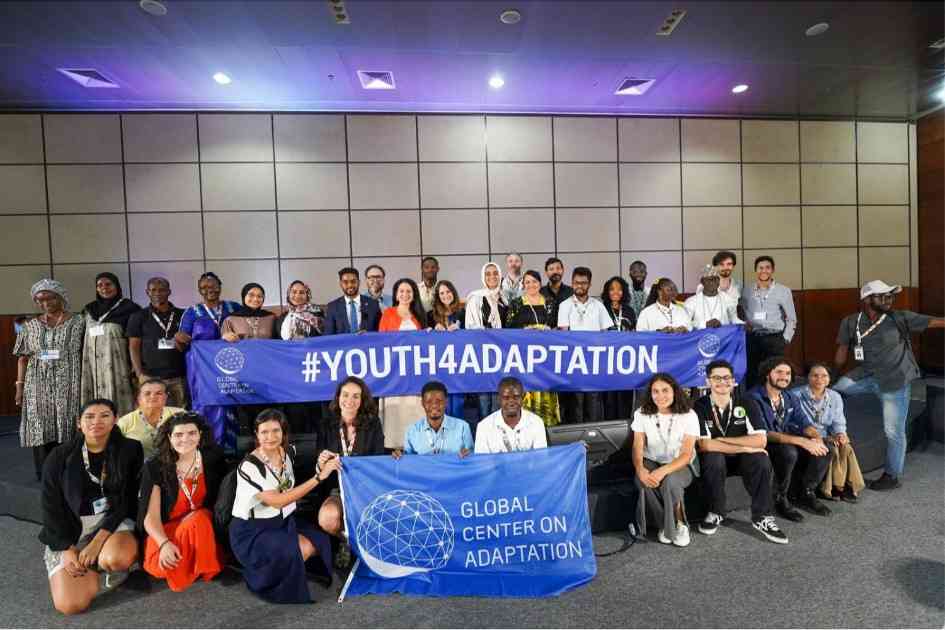



Youth leaders at COP30 launched a Global Call to Action on Adaptation, urging governments to integrate youth priorities into NDCs and NAPs. They called for inclusive decision-making, flexible finance, Indigenous knowledge, innovation, and investment to strengthen community resilience worldwide.
Young people from across the world issued a sweeping call for stronger climate resilience on Education Day at COP30 in Belém, as the Global Center on Adaptation (GCA) launched the Global Youth Call to Action on Adaptation, urging governments to integrate youth priorities directly into their national climate plans.
The document, developed through one of the largest youth-led consultation processes on adaptation to date, outlines proposals for strengthening Nationally Determined Contributions (NDCs) and National Adaptation Plans (NAPs). The launch was moderated by Adriana Valenzuela Jimenez, Team Lead for GCA’s Youth Leadership and Education Program.
Kiribati’s Minister for Women, Youth, Sports and Social Affairs, Ruth Cross Kwansing, delivered a forceful appeal for meaningful youth participation in climate governance. She said the principle of “nothing about us, without us” must guide every global process involving young people. Kwansing praised youth leaders for advancing climate justice, gender equality and social inclusion, and highlighted the role of Pacific youth whose campaign earlier this year helped prompt the International Court of Justice to issue a historic advisory opinion clarifying states’ climate obligations.
She warned that rigid and bureaucratic funding systems continue to constrain youth-led innovation, arguing that young people need both accessible resources and freedom to create solutions within their own communities. Kwansing pointed to resilience initiatives in Kiribati—hydroponic farming, mangrove restoration and traditional food preservation workshops—as examples of how young people combine ancestral knowledge with modern tools to strengthen food security. Quoting youth engaged in the Kiribati Loss and Damage Dialogue, she said: “We cannot escape climate change, but we can find ways and means to survive with climate change.” She added that the rising tide of youth leadership “lifts all canoes,” but only if global efforts are anchored in equity and action.
From South Asia, Sohanur Rahman, Executive Coordinator of YouthNet Global, emphasized that adaptation must remain central at COP30. He said the story of adaptation “is the story of survival, resilience and renewal,” and noted that many participants see Belém as the “Adaptation COP.” Rahman said Bangladesh has become a global example of locally led adaptation, with youth already engaged in national NAP and NDC processes. What is needed now, he stressed, is fair and timely investment that reaches frontline communities and youth-led initiatives.
According to GCA, the Global Youth Call to Action represents contributions from thousands of young people across more than 90 countries. Consultations were conducted with youth-led organizations, students and grassroots networks, guided by GCA’s toolkit designed to enable young people to participate directly in adaptation policy discussions. The resulting recommendations call on governments to build resilient and inclusive economies, expand adaptation finance, ensure vulnerable groups can access funds, and align national climate plans with both development needs and community well-being. They also highlight the need for stronger monitoring systems, integration of local and Indigenous knowledge, expansion of green jobs and entrepreneurial opportunities for youth, and greater investment in innovation, including responsible use of AI and emerging technologies.
Professor Patrick V. Verkooijen, President and CEO of GCA, said youth leadership must remain at the heart of global adaptation efforts. He noted that under the African Adaptation Acceleration Program (AAAP), youth-led initiatives have already improved resilience in vulnerable communities, and said AAAP 2.0 will continue to place young people at the center of adaptation planning and implementation. “This generation turns ideas into action and action into impact,” he said.
As governments negotiate in Belém, youth leaders delivered a unified message: adaptation efforts will fall short without meaningful inclusion, sustained investment and support for the next generation of climate leaders. They urged governments and international institutions to ensure youth voices inform the design, implementation and monitoring of NDCs and NAPs, and to work in partnership with young people to deliver adaptation solutions that protect communities, economies and ecosystems.




