

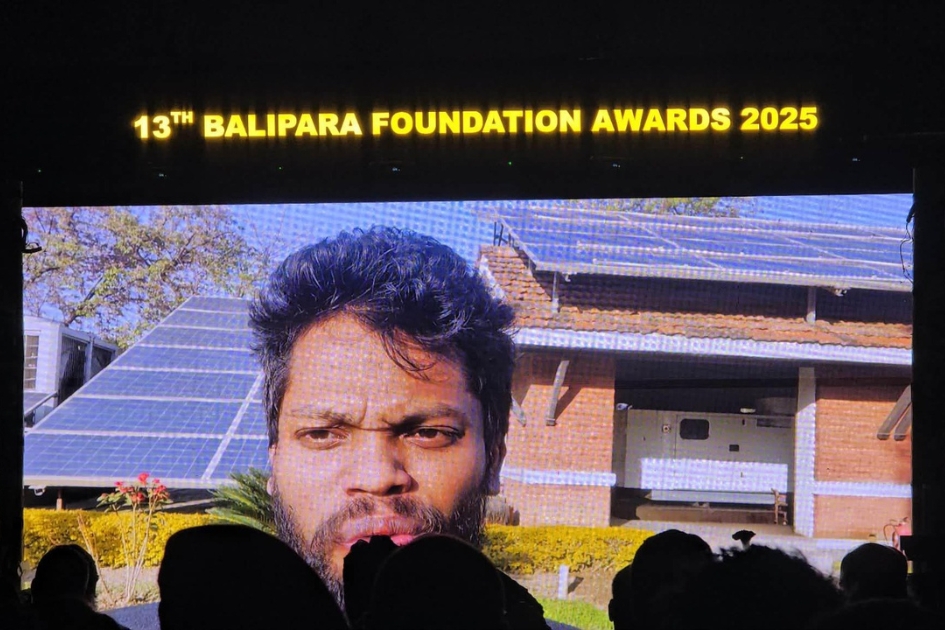



Bangladeshi youth climate advocate Sohanur Rahman won the Green Journalist Award at the 14th Balipara Foundation Awards, recognized for amplifying marginalized voices through climate justice storytelling across South Asia region.
Bangladeshi youth climate advocate and environmental communicator Sohanur Rahman was awarded the Green Journalist Award on Thursday at the 13th Balipara Foundation Awards in Guwahati, India. Recognized for his impactful climate justice storytelling across South Asia, Sohanur has amplified the voices of communities most affected by climate change, including coastal populations, indigenous groups, women, and climate-affected migrants. Due to visa restrictions, he joined the ceremony virtually from Dhaka on Thursday.
“This recognition belongs to the communities whose voices I amplify. Their stories drive action, inspire solutions, and remind us that climate justice must reach the most affected,” said Sohanur Rahman, who serves as Executive Coordinator at YouthNet Global and Co-Founder of the Climate Communicators Community in Bangladesh.
By honoring Sohanur and other environmental leaders, the Balipara Foundation Awards highlighted the power of storytelling, youth leadership, and community action in driving meaningful climate and ecological outcomes. The event underscored that cross-sector collaboration, community engagement, and empowering young leaders are essential for building resilient ecosystems and sustainable futures across Northeast India and South Asia.
The awards were part of the 13th Eastern Himalayan Naturenomics Forum 2025, which emphasized the urgent need for cooperation among governments, civil society, the private sector, and local communities to create regenerative and resilient futures in the Eastern Himalaya and the wider Third Pole region. Policymakers, corporate leaders, academics, conservationists, and youth activists participated in to discuss sustainable development, ecosystem restoration, and ecological preservation. Experts highlighted the critical role of mountain ecosystems in maintaining biodiversity, freshwater resources, local climates, and the livelihoods of millions of people.
Fifteen environmental leaders from Northeast India and neighboring regions were recognized for their outstanding contributions. Dr Kushal Konwar Sarma was lauded for decades of wildlife conservation, particularly elephant protection, strengthening human-nature relationships across Assam and beyond. Zoram Entu Pawl of Mizoram received recognition for championing grassroots conservation initiatives and empowering local communities to restore landscapes. Numaligarh Refinery Limited was honored for integrating sustainable practices into industrial operations and supporting conservation programs that benefit both ecosystems and communities.
Frontline conservationists were also celebrated. Hukai H Zhimo from Nagaland and a team from King Cobra Camp in Assam, including Lokhimoni Dutta, Jitamoni Kakoti, Pompy Bora, and Priyanka Pegu, received the Forest Ranger and Guards Award for their tireless efforts to protect forests and preserve ecological balance. Communities in Tripura, including Kuki Basti and Changlong Para, earned the Food for the Future Award for adopting sustainable agricultural practices and strengthening community resilience. Youth leadership in conservation was recognized through the Young Naturalist Award, presented to Sonam Wangchuk Lepcha from Sikkim and Bijiyashanti Tongbram from Manipur for their dedication to ecological stewardship and inspiring younger generations.
The 13th Balipara Foundation Awards and the Eastern Himalayan Naturenomics Forum together underscored how storytelling, youth leadership, corporate responsibility, and community collaboration can drive tangible ecological outcomes. The event highlighted the urgent need for collective action to protect biodiversity, restore ecosystems, and build resilient communities in Northeast India and across South Asia.
The forum highlighted the importance of mountain ecosystems for sustaining biodiversity, regulating water supplies, and supporting local climates. Discussions explored the environmental, social, and economic consequences of ongoing ecological degradation and emphasized collaborative solutions that involve governments, civil society, private organizations, and local communities.
Corporate innovation was showcased as a key driver of sustainable development. Representatives from Google, Coca-Cola, Tata Consumer Products, and Tata Semiconductor Assembly and Test presented initiatives that integrate business growth with ecological stewardship, protect forests and rivers, and enhance community resilience. Panelists emphasized that private sector engagement is essential to achieving sustainable development while supporting local livelihoods and ecosystems.
Youth engagement featured prominently during the forum, with the launch of the Youth Volunteer Network, Guardians of the Eastern Himalaya, led by Huma Abia Kanta. The network trains young people in ecological monitoring, habitat restoration, and awareness campaigns, highlighting the central role of youth in conservation efforts.
Sessions also explored the shift from extractive to regenerative development. Experts presented strategies for ecosystem restoration, climate-resilient livelihoods, and policies that balance environmental protection with human development. The forum emphasized the importance of traditional ecological knowledge with modern, sustainable and inclusive growth.




