

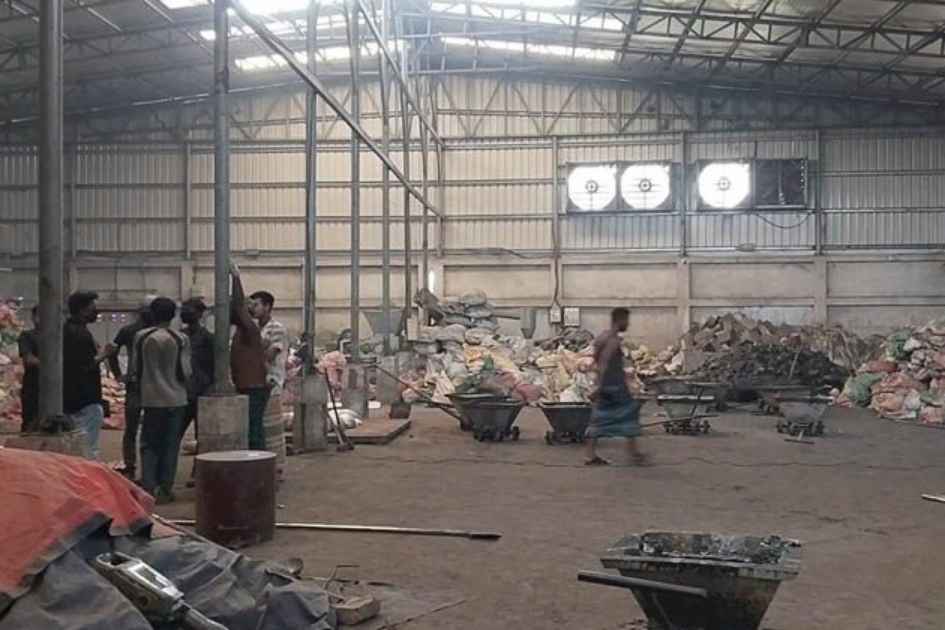



Residents of Singair in Manikganj allege a factory burning discarded batteries for lead is emitting toxic smoke, harming health, damaging crops and trees, and prompting urgent calls for government action.
Residents of Singair upazila in Manikganj district have raised concerns over a factory allegedly burning discarded batteries to produce lead in a densely populated area, causing toxic air pollution and serious public health risks.
The facility, operating under the name “Tanvir Enterprise,” is located near Alam Mora Bridge in Charigram Union. Local residents said the factory has been burning old and abandoned batteries for a long time to extract lead, releasing toxic smoke and chemical fumes into nearby communities.
Residents said that when the batteries are broken and burned, a strong acidic odor and thick black smoke spread across the surrounding areas, making daily life increasingly difficult. Many people in nearby households have complained of breathing problems, eye irritation and persistent headaches.
Local farmers also reported negative impacts on agriculture. They said crop yields in nearby fields have declined in recent months while fruit and forest trees are gradually drying up, raising fears that the soil’s fertility may be deteriorating due to chemical contamination.
Rahim Dewan, a local resident, said the community has repeatedly submitted written complaints to local authorities but has yet to see any effective action.
“We have been living with this toxic smoke for nearly two years. We have informed the authorities several times but no effective steps have been taken. We want the factory shut down immediately,” he said.
Another resident, Ismail Hossain, said the pollution is threatening the livelihoods of farmers in the area.
“Our crops are producing less and trees are dying. We depend on agriculture to survive. If our land continues to be damaged like this, it will become impossible for us to sustain our livelihoods,” he said.
Environmental experts warn that burning used batteries to extract lead releases highly dangerous substances, including lead particles and sulfuric acid, which can contaminate the air, soil and water.
Sohanur Rahman, executive coordinator of YouthNet Global, said the incident reflects broader environmental governance challenges.
“Unregulated lead recycling from used batteries releases highly toxic substances into the environment. Prolonged exposure to lead pollution can severely affect human health, particularly children. Authorities must urgently investigate the factory and enforce environmental laws to protect local communities,” he said.
However, the factory management denied the allegations. Manager Md Habib said the factory is operating in accordance with government regulations and claimed that the pollution complaints are unfounded.
Singair Upazila Nirbahi Officer Khayrunnahar confirmed that the administration has received a written complaint regarding the issue.
“Lead processing industries cannot operate in densely populated residential areas. We will investigate the matter and take necessary action based on the findings,” she said.




