




On Bangladesh’s coast, disasters, poverty and gaps in public services are narrowing children’s lives. What disappears is more than an education: a sense of safety, a place among friends, the freedom to imagine a future. A school notebook offers an intimate record of what climate policy calls non-economic loss and damage.
In Neelima’s school notebook are the words of songs she heard on the radio. The handwriting is neat and careful. At thirteen, she had completed class five but had been unable to enroll in class six. After she stopped going to school, the notebook stayed with her.
Her home is in Majher Char, beside the Bishkhali River, in Betagi, an upazila, or subdistrict, of Barguna in southern Bangladesh. She did not come out to speak with us. We did not press her to do so. Her mother spoke instead. Neelima is a pseudonym.
For several days after her schooling ended, her mother said, she barely ate. She spoke less. She does housework and sews. From time to time, she returns to her mother with the same question.
“Ma, my studies have stopped. I won’t be able to go to school anymore. What will happen to me now?” her mother recalled her saying. Then, she said, the crying would begin again.
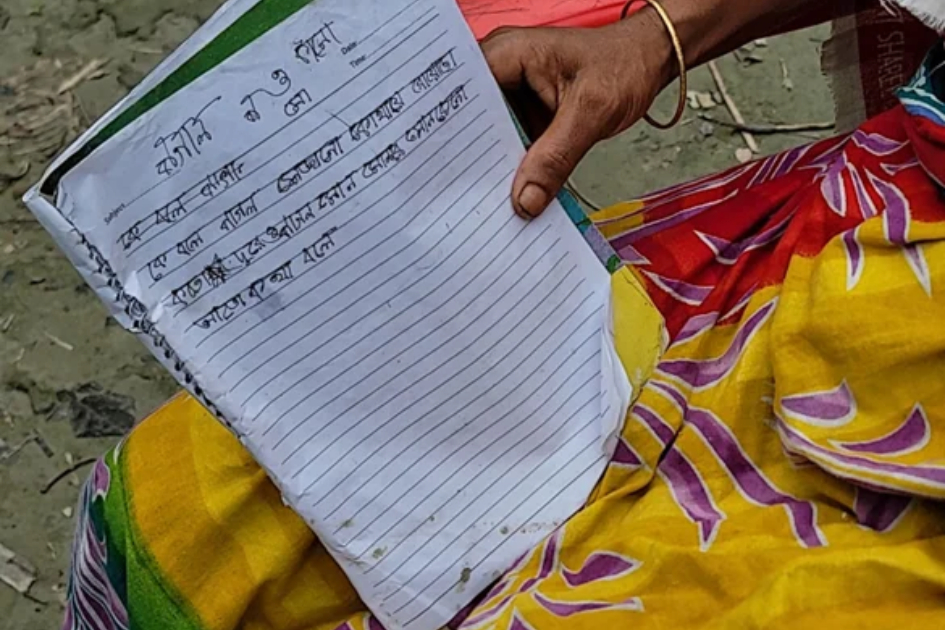
The family’s immediate crisis followed her father’s accident. His treatment cost money; there was no longer enough to keep his daughter in school. No connection between the accident and climate change has been established. But when her mother described the family’s savings and its ability to recover, she kept returning to floods, storms, and water from the river. When the water rises, she said, they leave home for a shelter. Crops and livestock are lost. As the household struggles to get by, education becomes an expense beyond its reach.
When keeping everyone alive is already a struggle, she asked, “How can we pay for our children’s education?”
She had hoped that her daughter would study and eventually help support the family. Asked what she now imagined for the girl, she paused and wiped her eyes with the end of her sari.
“I’ll marry her off in a few years. What else can I do?”
The girl’s aunt, nearby, said it could happen sooner if a suitable proposal came. She worried about the safety of an adolescent girl staying at home. At an age when Neelima might have expected a new set of schoolbooks, the family was beginning to discuss the timing of her marriage.
The cost of schooling can be written down. What is lost when that cost cannot be met is harder to account for. There is the company of classmates, the identity of being a student, the space to decide what sort of person to become. Future earnings cannot describe all of it.
In climate discussions, a category of harm known as non-economic loss and damage, or NELD, provides a way to consider such losses. The United Nations climate change framework includes losses involving life and health, identity, culture, connections to home, and social ties. Their value cannot be fully captured by a market price.
In Neelima’s life, the boundaries between these losses, poverty, and inadequate services are difficult to separate. Medical bills were the immediate reason she left school. Her family’s account suggests that repeated disasters had weakened its capacity to absorb that expense. There is no basis here for calculating the share attributable to each cause. The interaction matters: climate risks reach households already short of money, safe transport and choices for their daughters.
The next grade is across the river
From Neelima’s home, we went to Gulishakhali Majherchar Government Primary School, where she had studied. Cows were tethered in the open space on the ground floor. The building also serves as a disaster shelter. The same place has to accommodate children’s lessons and the need for refuge.
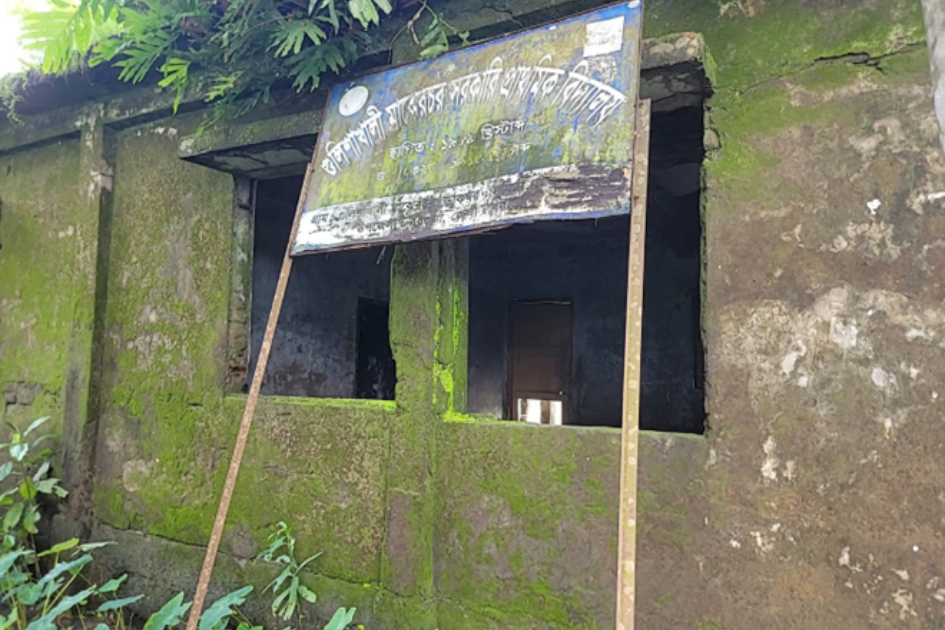
At the time of the interview, Abdur Rahim, a teacher, said that only two teachers were working there, responsible for more than a hundred pupils across five grades. Some children attended irregularly; others stopped coming. When teachers checked, they found children helping at home, fishing or doing other work to earn money. Rahim spoke of a lack of encouragement from some parents, but also acknowledged the poverty of the households.
After the last year of primary school, distance takes on a different meaning. According to Parveen Akter, a resident whose daughter is in class six, there is no secondary school on Majher Char. To continue her education, the girl must cross the Bishkhali.
Parveen was thirty-three when we met. Her husband fishes in the deep sea and is away for long stretches. She puts aside small amounts of money to keep their daughter in school. The girl wants to become a lawyer.
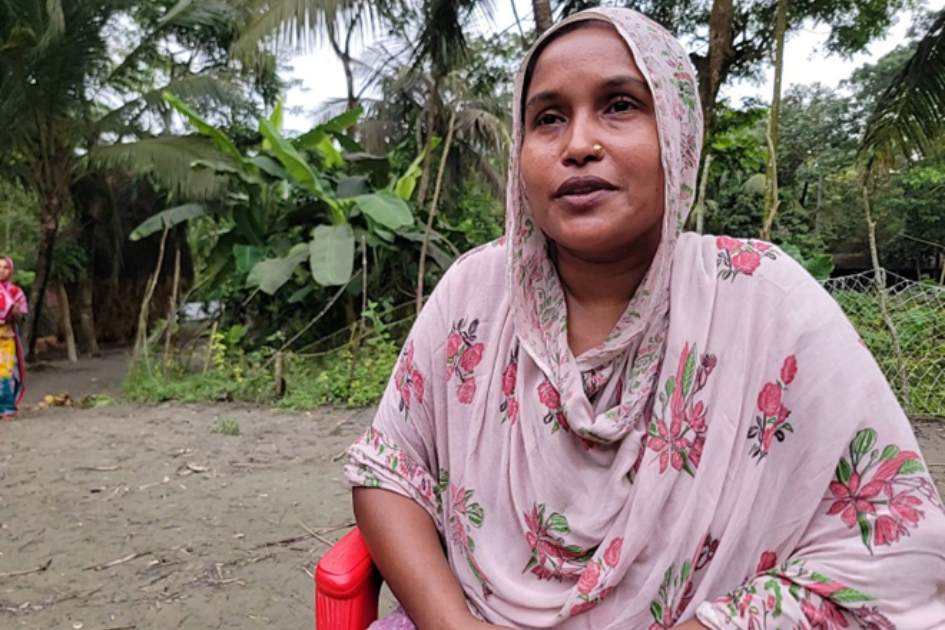
Then Parveen described a boat journey. About two weeks before the interview, she said, her daughter and several other pupils were in the middle of the river when a storm struck. The boat nearly capsized. The children returned alive. Since then, they have been reluctant to cross the river to school.
“After that incident, fear took hold of them,” she said.
This account came from Parveen; we had no separate scientific analysis of that day’s storm. The Intergovernmental Panel on Climate Change has assessed that human-induced warming increases heavy precipitation associated with tropical cyclones. That finding does not establish the cause of every local storm or boat incident.
Even within those limits, Parveen’s difficulty is plain. She can save money for her daughter’s education. She cannot make the memory of danger in midriver disappear. Keeping the girl’s ambition alive requires safe passage as well as savings.
Across Bangladesh, the scale of disrupted education is considerable. A UNICEF analysis published on January 24, 2025 found that extreme weather, including heatwaves, cyclones and floods, disrupted the schooling of about thirty-five million children in 2024. Some pupils in Sylhet lost up to eight weeks of classroom learning. These are figures for interrupted education, not the number of children who permanently left school.
When schools reopen, lessons resume. For a child such as Neelima to return, there must also be money, family support and a way into the next grade. For Parveen’s daughter, there is the fear of crossing the river. A school’s reopening and a child’s return to education need not happen together.
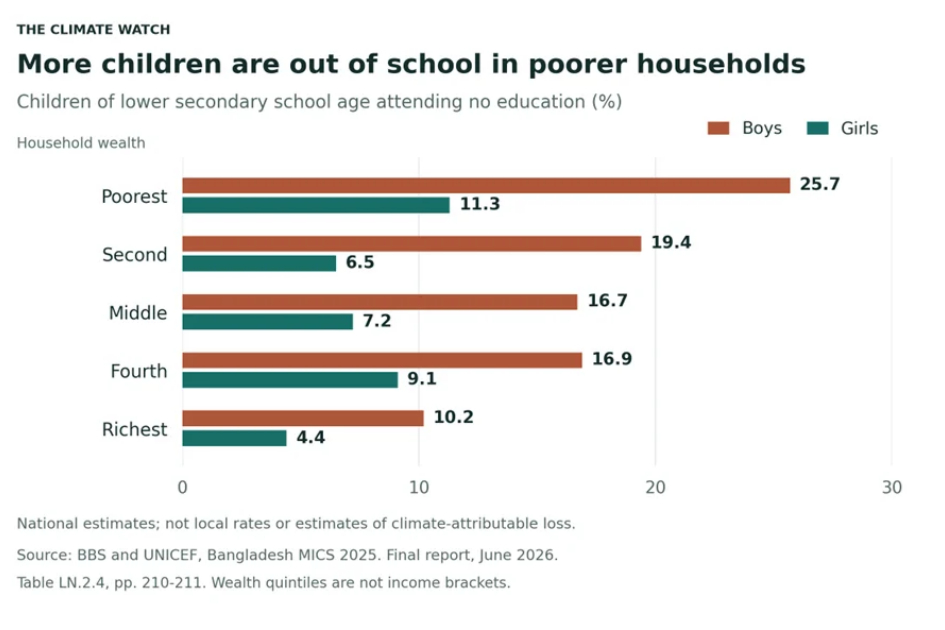
National data reveal another distinction. The Bangladesh Bureau of Statistics and UNICEF’s Multiple Indicator Cluster Survey, MICS 2025, shows that boys of lower secondary school age are more likely than girls to be out of education. Attention to the pressure on girls to marry must also leave room to understand the barriers facing boys.
The children Rahim described, drawn away from lessons by household work and earnings, do not all face the same circumstances. Gender, age, household resources, a parent’s presence and the side of the river on which a child lives combine to shape the route to school. Parveen’s savings are an effort to make that route possible. Families begin with very different means.
The man who did not return
By the time we crossed the Bishkhali and traveled through Kalmegha, in Patharghata, to the fishing community of Ruhita, it was afternoon. There, a mother described how two of her daughters had left school. Her husband was at sea. After meeting the household’s needs, his earnings had become insufficient to cover their education.
Her older daughter had studied through class ten. The family could not afford the fees and other costs of taking the Secondary School Certificate examination, the mother said. Later, the girl married. Another daughter stopped studying in class eight. Both had wanted to become teachers.
The younger of the two had told her mother that she did not want to marry yet. She wanted to keep studying. Her mother nevertheless saw marriage as the path available to her. In her account, inability and regret sat side by side.
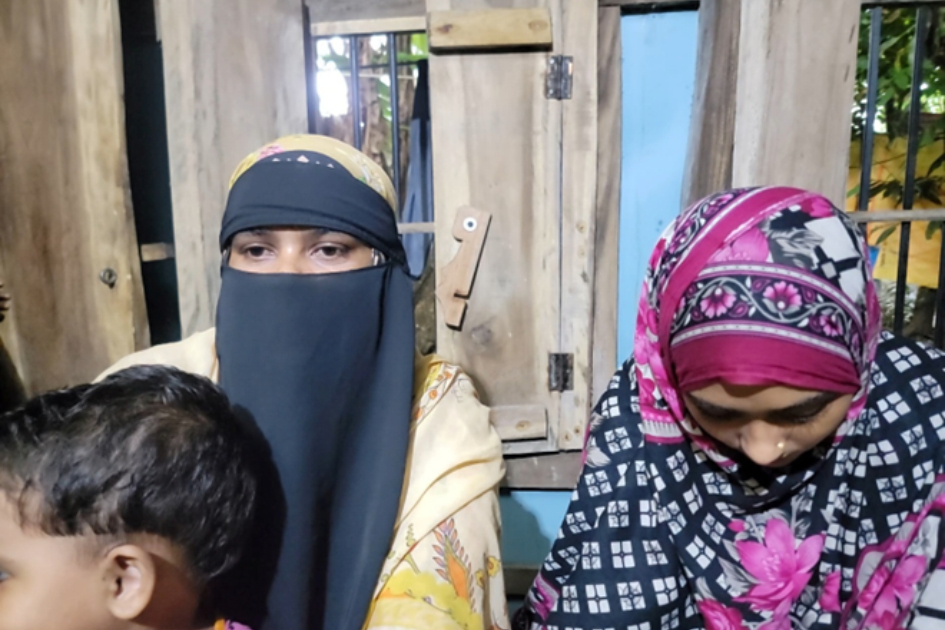
The distance between what the mother considered possible and what the daughter wanted reveals another loss: a diminishing say in the timing of one’s own life. How long to study, when to marry, and what work to pursue become decisions in which the girl has less room to express a preference. Financial pressure combines with concerns about safety and social expectations to narrow that room.
Nationally, MICS 2025 found that 47.2 percent of women aged twenty to twenty-four had first married before eighteen. Among women in the poorest household wealth group, the share was 62.5 percent; in the richest, 31.5 percent.
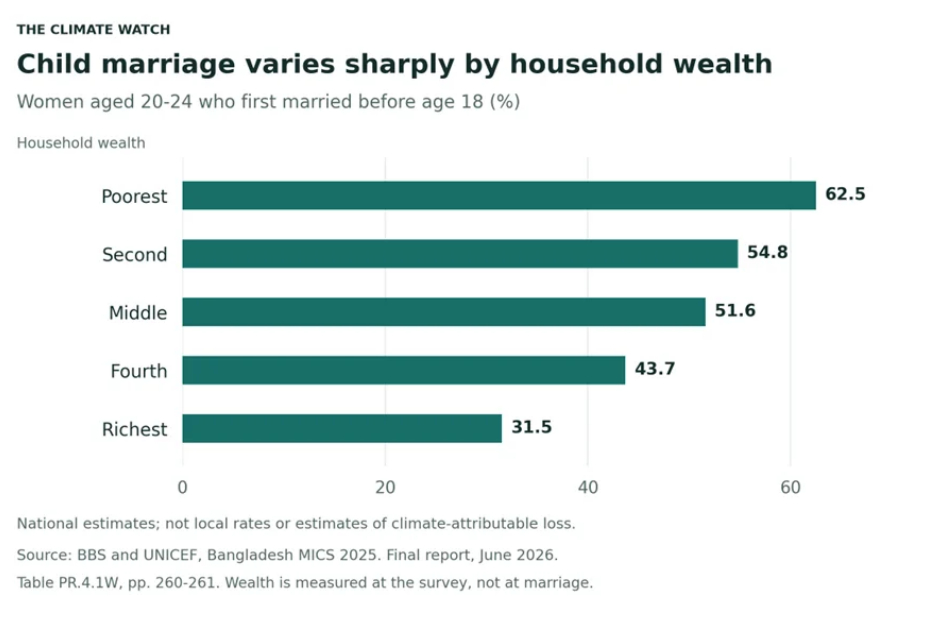
That difference cannot identify a single cause of any family’s decision. It does place the mothers’ worries about what they can afford within a wider pattern of inequality. Reporting only that a mother intends to marry off her daughter would leave the girl’s objection unheard. It would also leave unasked what help might allow the family to keep her in school.
In the same community, we spoke with another girl, aged twelve. Her father had gone missing while fishing at sea, about two years before the interview, according to her mother. He had not returned. The girl had finished class five but could not afford to enroll in class six.
“My classmates are going to school, and I cannot enroll in class six because we have no money. It hurts so much,” she said.
Her father’s absence had become entangled with the end of her education. “I thought I would study and ease my mother’s suffering,” she told us.
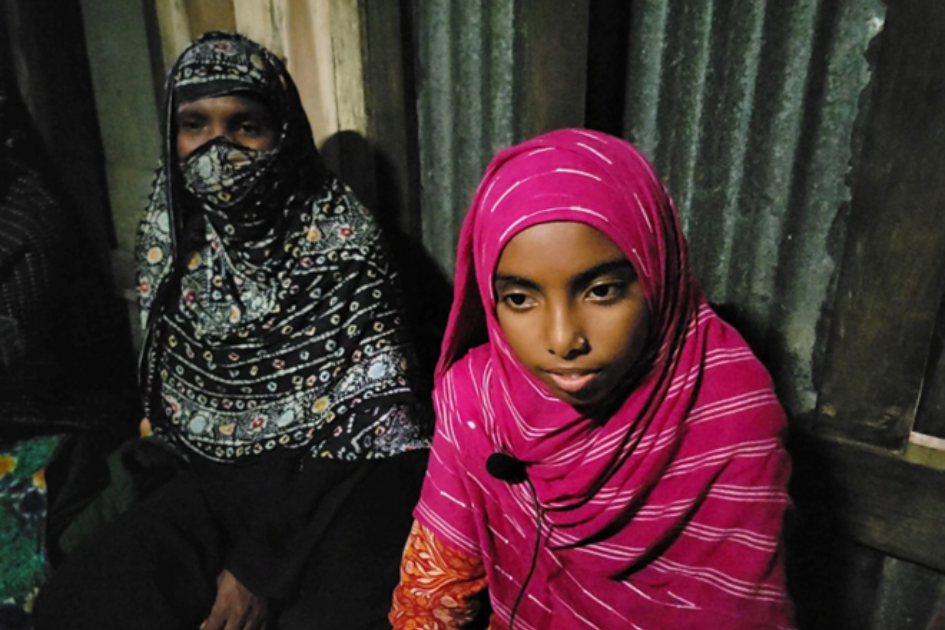
Her older brother now supports the household. Like their father, he goes fishing in the deep sea. Their mother said that he wants to pay for his sister’s education but cannot stretch his earnings far enough. Since her husband disappeared, she fears that her son, too, may not return from the sea.
Missing cannot be treated as confirmation of death. We had no records establishing the circumstances of the fisherman’s disappearance, nor evidence that it was a direct consequence of climate change. Yet the family’s experience raises a question essential to understanding losses on the coast: what support exists for the waiting, uncertainty and insecurity that gather around an absent breadwinner?
The girl sees her classmates continuing to school. For her mother, the sea carries the possibility of losing another person she loves. It also provides the family’s income. These relationships shape their daily lives alongside the cost of schooling and the earnings from fish.
Shafiqul Islam Khokon, a social and environmental activist who works with families of missing fishermen, had brought us to the community. He described efforts to record the names of the missing and keep their memory present. Interrupted education, women’s vulnerability and prolonged emotional strain recurred in his account. He called for government action and long-term research into the educational, social and psychological difficulties facing coastal women and children.
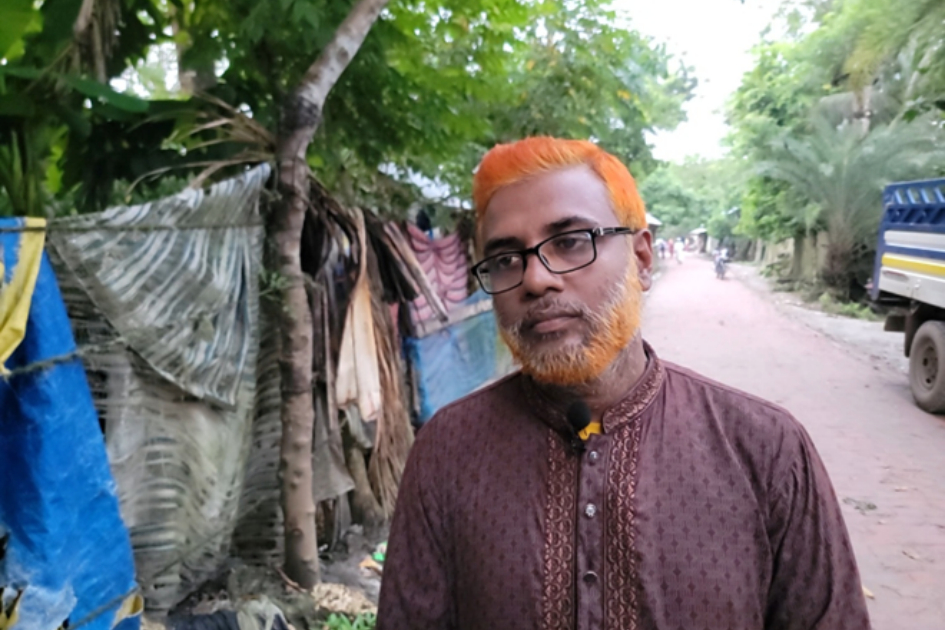
Accounts of grief, fear, or withdrawal cannot diagnose a child’s mental health condition. The children in this story had not undergone a clinical assessment for this reporting. Their distress deserves attention without waiting for a diagnostic label. It is possible to listen to what has changed in their daily lives.
A study published in 2025, involving adolescents affected by disasters in Bangladesh, offers relevant context. Of 1,220 selected participants, 515 had migrated, and 705 had not. Using the PHQ-9 questionnaire, researchers identified depressive symptoms in 84 percent of the first group and 54.77 percent of the second.
The sample was purposively selected, and the study was cross-sectional, observing participants at one point in time. Its findings are not national prevalence estimates and do not prove that migration alone caused the symptoms. The screening results, reported in the published abstract, are not diagnoses of the children interviewed in Barguna. They do, however, underline why mental well-being belongs in questions about how life continues after disaster.
What it would take to return
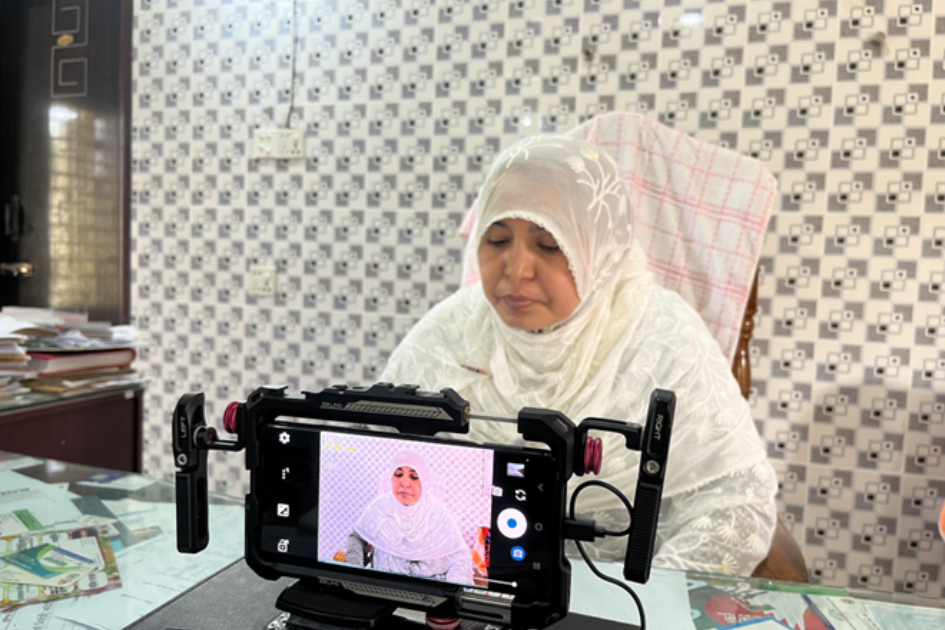
When families explained why children had left school, they spoke of costs, transport and safety. Helping a child return also depends on the people available at school. Zinat Jahan, interviewed as the primary education officer for Patharghata upazila, said teachers had instructions to visit the homes of pupils who attended irregularly and speak with their parents. Staffing shortages also limited the monitoring of that work, she said.
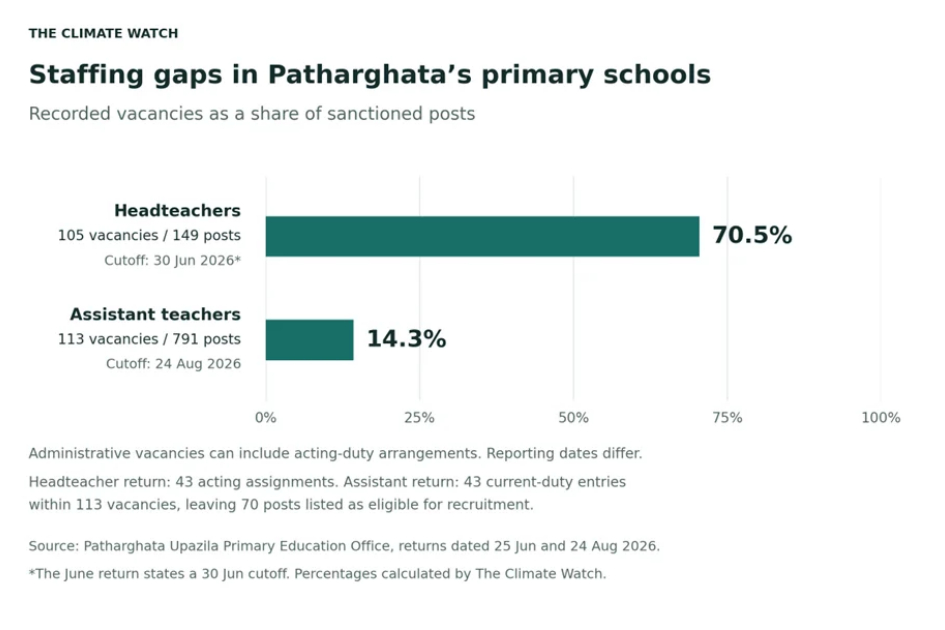
Official staffing returns put a scale on that shortage. In its June 2026 headteacher return, Patharghata’s primary education office listed 105 vacancies among 149 sanctioned posts: 70.5 percent, or about seven in ten. It recorded 44 headteachers in post and, in a separate column, 43 teachers carrying out headteacher duties in an acting capacity.
An assistant-teacher return dated August 24 recorded 678 serving posts against 791 sanctioned posts. Its 113 recorded vacancies amount to 14.3 percent. That vacancy count includes 43 current-duty assignments; the document lists 70 posts as eligible for recruitment.
These are administrative vacancy counts. Acting arrangements can provide cover even when a post is formally vacant. The returns give a measure of the staffing problem Jahan described, but do not identify the affected schools or show how vacancies changed attendance. They do not establish that climate change caused the vacancies.
Parents had described limited experience of teachers visiting in person. Asked about this, Jahan said action was taken when complaints were received. Her interview and these staffing returns concern Patharghata, where the fishing families were interviewed. They do not describe staffing or supervision at Neelima’s school in neighboring Betagi.
What happens after a child’s absence is noticed matters. A telephone call cannot make a frightening river crossing safe. If medical costs have ended a child’s schooling, instructions to attend regularly need financial support alongside them. When a marriage is being discussed, a girl needs a safe opportunity to say what she wants.
Abdul Halim, a Majher Char resident, described another gap. According to him, the char has no clinic even for basic care; residents must cross the river when they are ill. The river lies on the route to treatment as well as to school. One person’s illness can impose costs that reshape another family member’s life, as Neelima’s father’s treatment had done.
NELD encompasses more than emotional suffering. It concerns the practical opportunity to continue an education, to move about safely, to speak within a family and to sustain relationships with familiar people. Reducing these losses costs money, even when money cannot express their full value.
Research published in 2024, conducted in Shyamnagar and Durgapur, examined the ways people respond to non-economic loss and damage themselves. Without sufficient resources and support, some responses can further erode their capacity to cope in the future. The study emphasized financial security and support for local people’s own initiatives.
Parveen’s savings are one such initiative. Within the household, she is making room for her daughter’s wish to become a lawyer. Anyone planning assistance has questions to ask her: what transport would feel safe for her daughter, which educational expense is hardest to meet, who could speak with the girl about her frightening experience? Neelima’s family might answer the same questions differently.
The World Health Organization’s recommendations on climate change and mental health call for mental health and psychosocial support to be integrated into climate action, with community involvement and greater funding. Such support belongs in recovery planning from the beginning.
The mandate of the International Fund for responding to Loss and Damage includes both economic and non-economic losses. Recognition in that mandate is not evidence that assistance has reached any of these households. Connecting local needs to plans and funding remains a separate task.
The families’ accounts suggest concrete ways to judge that task. Alongside the number of homes repaired after a disaster, it is possible to ask how many children reached the next grade. Did they gain safe transport? Could a family find someone to talk to about grief or persistent fear? Did girls have a say in their education and marriage? Even when earnings recover, these questions remain.
By the time we left Kalmegha, evening had darkened the river. The sound of the trawler’s engine did not end the day’s conversations. There was the girl watching her classmates go to school. And there was the notebook Neelima had kept on Majher Char.
Her handwriting remained. A way back to school had yet to be found.
This story was produced as part of the Earth Journalism Network (EJN) fellowship on non-economic loss and damage (NELD).




