

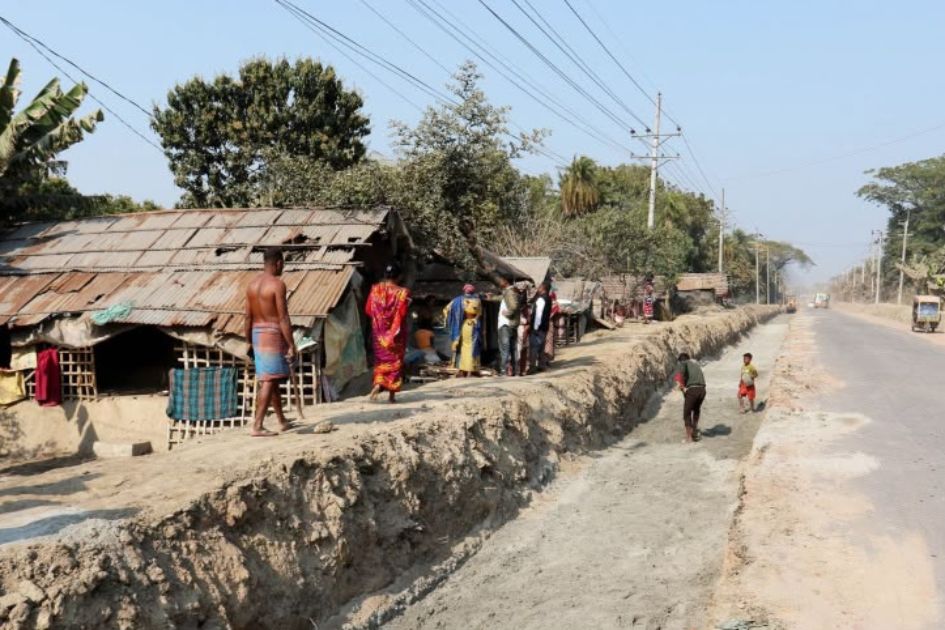

Forty-five Kayputra families in Satkhira face eviction for a highway expansion, exposing the intersection of climate vulnerability, poverty and the lack of a fair rehabilitation and relocation plan.
For 45 families of the marginalised Kayputra community in Dakshin Alipur of Satkhira Sadar upazila in southwestern Bangladesh’s Satkhira district, an approaching deadline of July 9 has turned everyday life into deep uncertainty and fear as authorities move forward with a road expansion project along the Satkhira-Shyamnagar highway.
The families, around 250 people in total, have lived for generations on government land beside the highway. Now, with the Roads and Highways Department (RHD) proceeding with a project to widen the road into a four-lane highway, they face imminent eviction. Public announcements have instructed residents to vacate voluntarily, warning that eviction drives will follow if they do not comply.
According to officials, the land in question was acquired between 1962 and 1964 for road development purposes and approximately 120 feet of space, including embankment slopes, is required for the expansion. While construction has been underway since early February, five families have already been displaced and are now living in makeshift shelters made of polythene and tin, exposed to extreme heat, flooding rains and worsening climate stress.
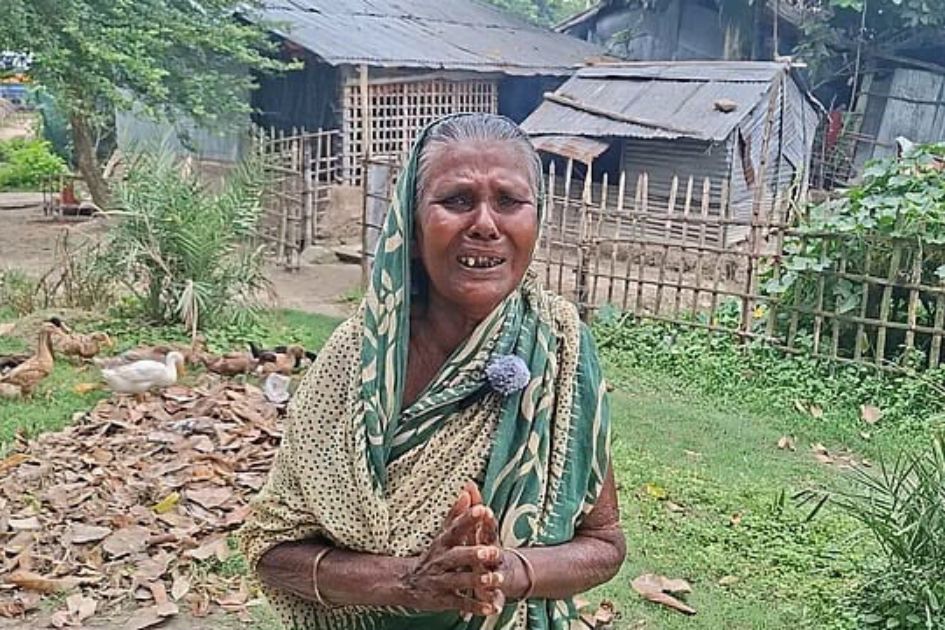
“Where are we supposed to go with our children?” asked 75-year-old Sandhya Mondal, her voice breaking. “Our ancestors have lived here for generations. We have nowhere else to call home.”
A community at the intersection of poverty and climate stress
The Kayputras, traditionally engaged in swine rearing and informal daily wage labour, are among the most economically vulnerable groups in the region. Many households depend on irregular labour, roadside work and survival-level incomes, with some forced into begging during times of crisis.
Their vulnerability is deepened by the realities of climate change in coastal Satkhira, where salinity intrusion, waterlogging, cyclonic storms and river erosion are steadily undermining livelihoods. For low-income and informal workers, these environmental pressures reduce income opportunities and increase dependence on fragile settlements.
Despite their long presence on this land, predating Bangladesh’s independence, most families remain outside formal housing systems and social protection coverage. Their settlements along the highway consist of tin, plastic and palm leaf structures with limited access to sanitation, safe drinking water and basic public services.
For many residents, displacement does not only mean losing shelter. It also means losing proximity to roadside informal work that sustains daily survival in an already climate-stressed local economy marked by unstable agricultural cycles and rising livelihood insecurity.
Development, displacement and a just transition gap
While the Roads and Highways Department maintains that the expansion is necessary to improve connectivity and transport efficiency, it has stated that rehabilitation responsibilities lie with the district administration. Local officials, however, have not yet publicly outlined a clear relocation plan, creating what observers describe as an administrative gap between infrastructure delivery and social protection.
The RHD, tasked with upgrading the highway into a four-lane thoroughfare, states that approximately 120 feet of land is required for the project, including slopes.
“To maintain the momentum of development, the road must be widened. The community currently residing near the Alipur checkpoint will unfortunately need to be relocated,” said Md Anwar Parvez, executive engineer of the Satkhira RHD.
The situation highlights a broader question increasingly raised in climate-affected regions: how infrastructure and development projects can align with the principles of a just transition, ensuring that economic progress does not deepen spatial inequality or push already vulnerable communities further into insecurity.
For communities like the Kayputras, who face both economic marginalisation and climate vulnerability, the absence of structured relocation, livelihood restoration and social protection support risks turning infrastructure development into another cycle of displacement rather than a pathway to resilience.
Youth climate activist and Executive Coordinator of YouthNet Global, Sohanur Rahman, said the situation reflects a deeper structural gap in climate-affected development planning.
“Development cannot be measured only in roads and infrastructure,” he said. “In climate-vulnerable regions like Satkhira, every infrastructure decision must also be a just transition decision, ensuring that low-income and informal workers are not displaced twice, first by climate impacts and again by policy gaps in relocation and protection.”
A question of protection, climate resilience and inclusion
Civil society actors and local observers have called for a temporary suspension of the eviction until a clear, climate-sensitive and socially inclusive rehabilitation plan is in place. They argue that relocation planning must go beyond housing alone and address livelihood continuity, particularly for informal workers dependent on roadside and seasonal economies.
They also emphasise that in climate-affected districts like Satkhira, displacement decisions must be grounded in an understanding of overlapping risks where poverty, environmental stress and infrastructure expansion intersect and reinforce one another.
Without such safeguards, experts warn, already vulnerable communities risk being pushed into deeper cycles of insecurity, undermining both social protection commitments and climate adaptation goals.
As bulldozers move closer and the July 9 deadline approaches, the Kayputras of Dakshin Alipur remain in limbo, caught between a changing climate, an expanding highway and an uncertain promise of relocation. The question now facing authorities is not only how to build infrastructure but also how to ensure that development does not come at the cost of those who have the least capacity to absorb its impact.




