

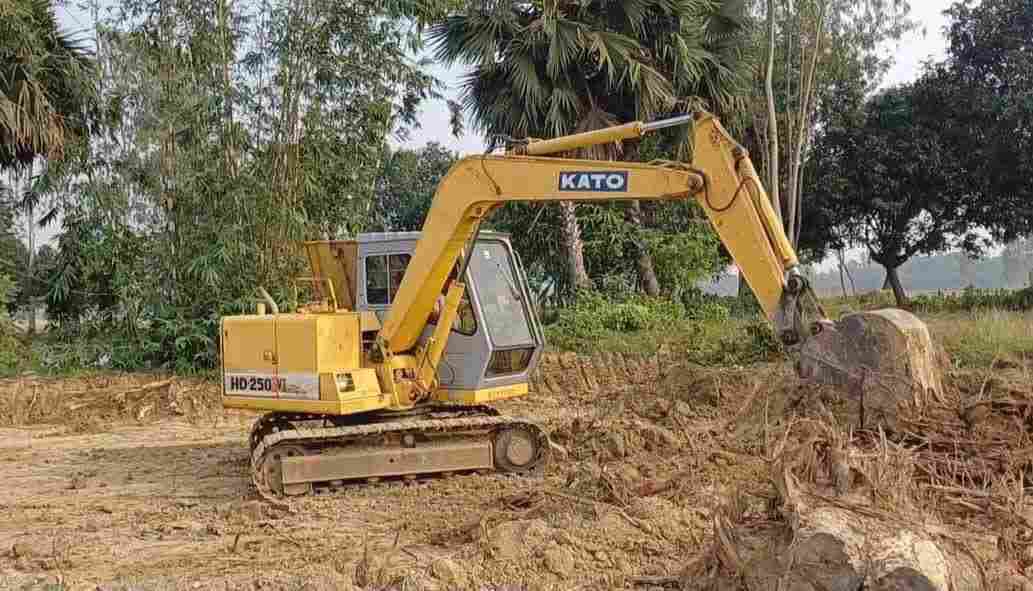



Across Rajshahi, brick kilns are cutting fertile topsoil from croplands, leaving farmers trapped in long-term losses as soil fertility declines and food security risks grow.
The fertile agricultural heartland of Rajshahi is facing a deepening environmental and food security crisis as vast stretches of farmland are stripped of their nutrient-rich topsoil to supply brick kilns, exposing farmers to long-term losses and threatening sustainable development.
Bangladesh’s booming construction sector relies heavily on traditional fired bricks, produced by more than 7,000 brick kilns nationwide, many of which operate in violation of environmental and land-use regulations. In Rajshahi district alone, at least 200 brick kilns are reported to be using agricultural topsoil as their primary raw material, according to the Department of Environment.
Across upazilas including Paba, Mohanpur, Tanore, Godagari, Durgapur, Puthia, Charghat, Bagha, Bagmara and Taherpur, fertile topsoil from croplands is being illegally excavated and transported to kilns. Agricultural experts warn that once this upper layer is removed, land productivity can remain severely compromised for more than a decade.
Local kiln workers confirm the scale of soil consumption. Kamal Uddin, a technician at a brick kiln in Parila Union under Paba upazila, said each brick requires nearly five kilograms of soil. “A single kiln produces four to five million bricks annually. For brick-making, topsoil is considered the most suitable,” he said.
Brick kiln owners maintain that farmers sell soil voluntarily. Babu Hossain, a kiln owner from Ramchandrapur, claimed attractive prices encourage cooperation. “If we do not buy soil, brick kilns will shut down and development work will be disrupted,” he said.
However, farmers describe a pattern of coercion rather than choice. When large plots are excavated, neighbouring fields become uneven and prone to waterlogging, making cultivation difficult. “Once nearby land is cut, our fields sink lower and irrigation becomes impossible. We are then forced to sell our soil as well,” said 65-year-old farmer Altab Uddin of Matikata Union in Godagari upazila.
Farmers in Bagmara report receiving between Tk18,000 and Tk20,000 per bigha for topsoil. While the immediate cash appears beneficial, the long-term costs are severe. “After selling soil, crop yields remain poor for several years. What looks like profit becomes a loss,” said farmer Abul Sorkar.
Soil scientists warn that the environmental damage is both profound and long-lasting. Dr Md Nurul Islam, senior scientific officer at the Rajshahi Soil Resource Development Institute, said topsoil contains the highest concentration of organic matter and microorganisms essential for plant growth. “Once this layer is removed, it takes more than ten years for soil fertility to recover naturally,” he explained.
The Department of Agricultural Extension has echoed similar concerns. Md Abdul Wadud, additional director in Rajshahi, said indiscriminate soil cutting is already reducing crop productivity, threatening rural livelihoods and regional food security.
The practice also undermines Bangladesh’s climate resilience. Degraded soils retain less water, increase vulnerability to drought and erosion and weaken the adaptive capacity of farming communities already exposed to climate stress.
Although Bangladesh has laws prohibiting the use of agricultural topsoil for brick manufacturing, enforcement remains weak. The Brick Manufacturing and Brick Kilns Establishment (Control) Act restricts the extraction of fertile soil, yet violations are widespread.
Rajshahi Department of Environment Assistant Director Kabir Hossain said the issue has been reported to local administrations and enforcement drives are ongoing. “Mobile courts have fined and demolished several illegal kilns, particularly in Bagmara, but the practice continues,” he admitted.
Deputy Commissioner Afia Akhtar said authorities act on complaints and field inspections, while Rajshahi Divisional Commissioner Dr A N M Bazlur Rashid confirmed that upazila administrations have been instructed to take strict measures to stop topsoil extraction from agricultural land.
Environmentalists argue that without stronger enforcement and a transition to alternative construction materials such as concrete blocks and eco-friendly bricks, fertile land will continue to disappear into kilns.
“If topsoil loss continues unchecked, Rajshahi risks long-term agricultural decline,” Sohanur Rahman, executive coordinator of YouthNet Global, warned, adding that protecting farmland is essential not only for food security but also for sustainable development in climate-vulnerable Bangladesh.




