

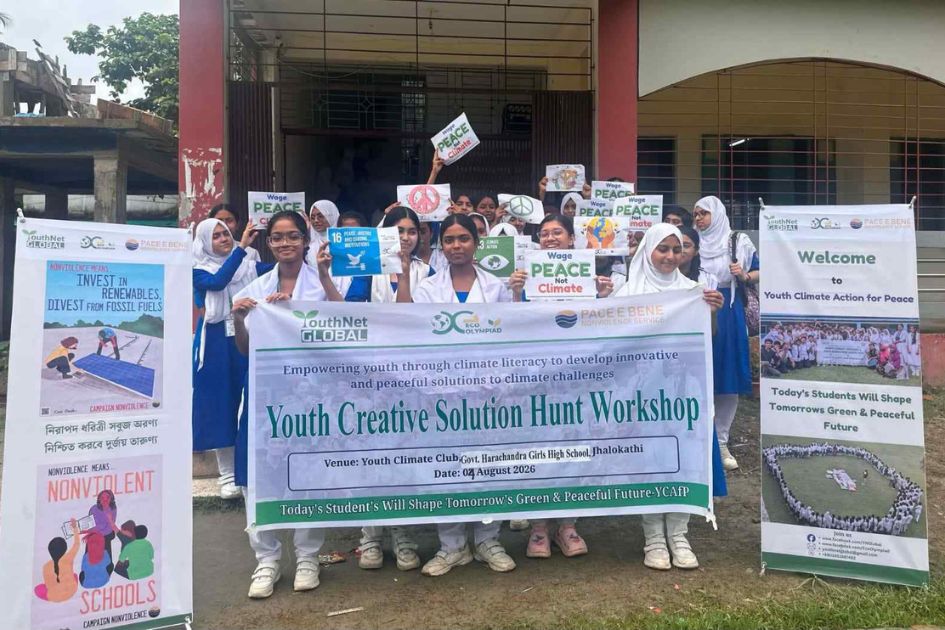



By combining climate education with peacebuilding and creative problem-solving, the initiative seeks to prepare students, particularly girls, to lead resilience efforts in vulnerable coastal communities.
Thirty students from a climate-vulnerable coastal district in southern Bangladesh have completed a capacity-building workshop aimed at developing youth leadership, creativity, peacebuilding and problem-solving skills to address local climate challenges.
The “Youth Creative Solutions Search Workshop” was organised at Government Harachandra Girls’ Secondary School in Jhalakathi by environmental organisation YouthNet Global under its “Youth Climate Action and Peace” initiative, with support from Pace e Bene Nonviolence Service.
The initiative comes at a critical time for Bangladesh’s coastal communities, which are among those facing some of the country’s most severe climate impacts. Bangladesh is widely recognised as one of the world’s most climate-vulnerable countries, with coastal districts experiencing increasing threats from sea-level rise, river erosion, cyclones, tidal surges and waterlogging. These challenges are affecting local livelihoods, education and social wellbeing.
Turning climate awareness into action
Moving beyond traditional climate awareness discussions, the workshop focused on equipping students with practical skills related to climate justice, conflict resolution, creative thinking and sustainable problem-solving.
Through interactive group activities, participants identified environmental challenges in their communities, analysed their causes and developed peaceful, locally relevant solutions. Organisers said the approach was designed to help students become active contributors to climate resilience rather than only observers of climate impacts.
School Headteacher Md Abu Saeed welcomed the initiative, saying it would help students develop environmental awareness and leadership skills.
“Through the Youth Climate Club, our students are gaining crucial knowledge about environmental protection and climate change. Their engagement will strengthen awareness, leadership and a sense of civic responsibility, helping them become responsible citizens in the future,” he said.
Youth at the centre of climate justice
YouthNet Global General Secretary Arifur Rahman Suvo said young people are among those most affected by the climate crisis despite contributing the least to its causes.
“Climate change is not only an environmental challenge; it can increase social pressures, inequality and the risk of conflict. Peaceful cooperation, tolerance and community participation are essential for building resilience, and young people must be equipped to lead these efforts,” Suvo said.
He said climate education must move beyond awareness and create opportunities for young people to apply their creativity and leadership to real challenges.
“Students need the space to identify problems in their own communities and develop innovative, peaceful and sustainable solutions. Youth participation is essential for achieving climate justice,” he added.
Suvo said YouthNet Global plans to expand the programme to more schools across Jhalakathi to develop a network of young climate leaders and community climate champions.
Divisional Coordinator Sazid Mahamud said empowering students, particularly girls in climate-vulnerable communities, is vital for building future leadership.
“Developing their problem-solving skills, creativity, peaceful coexistence and sense of responsibility is essential for sustainable change. When young women are empowered to participate in climate action, communities become stronger and more resilient,” he said.
A new perspective for students
For participating students, the workshop offered a new understanding of their role in addressing climate challenges.
Nusrat Jahan Noha, a student participant, said the programme changed her perception of climate action.
“Previously, I thought climate change was only a matter for adults. Now I realise that students like us can also contribute to protecting the environment, promoting peace and creating positive change through small initiatives,” she said.
The organisers said the “Youth Climate Action and Peace” initiative will continue implementing school-based programmes focused on climate awareness, youth leadership, nonviolence, tolerance and cooperation.
By linking climate adaptation with creativity, peacebuilding and community participation, the initiative aims to place young people at the centre of climate resilience efforts and prepare a new generation of responsible leaders capable of responding to local environmental challenges while contributing to global climate action.




