

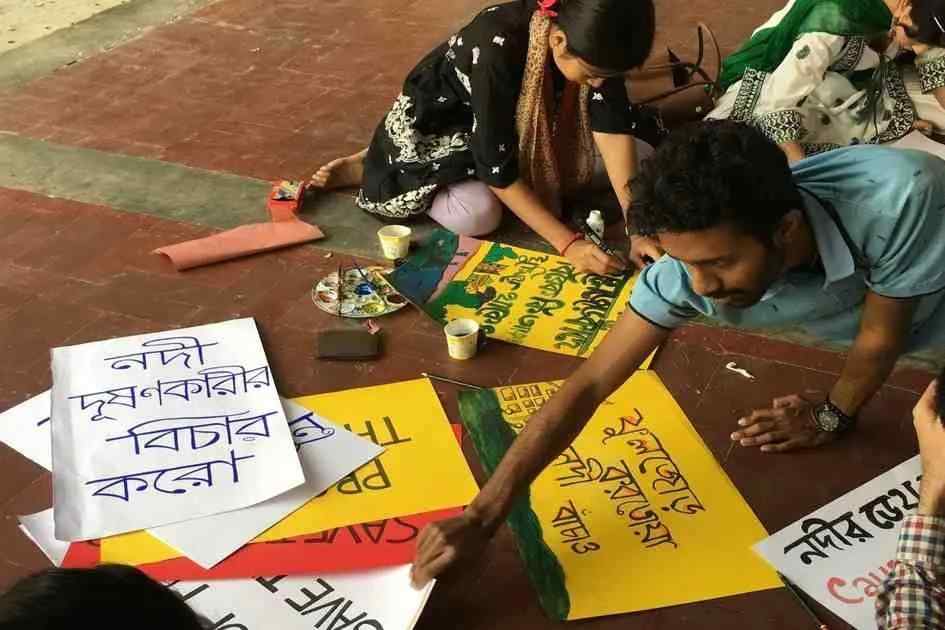



The High Court has sought explanations over unchecked industrial pollution in three Bogura rivers, amid allegations of ecological damage, regulatory failure and growing public protests demanding accountability and enforcement of environmental laws.
The High Court has issued a rule asking why the authorities’ failure to prevent pollution of the Fuljhor, Karatoya and Bangali rivers by two industrial establishments in Bogura district of northern Bangladesh should not be declared illegal, unconstitutional and against public interest.
A division bench comprising Justices Bhishmadev Chakrabortty and Abdur Rahman passed the order on Sunday following a preliminary hearing of a writ petition filed by the Bangladesh Environmental Lawyers Association (BELA).
The court sought explanations as to why authorities allegedly failed to take effective steps to stop unauthorised and polluting industrial activities by SR Chemical Industries and Majumdar Products Limited in Rajapur and Chanka villages under Sherpur upazila of Bogura.
It also asked why directives should not be issued under Section 4A of the Environment Conservation Act, 1995 to prevent hazardous operations and protect the three rivers from further degradation.
The bench directed that the rule be heard together with earlier related writ petitions involving the two companies filed in 2024.
Allegations of environmental damage
According to the petition, untreated industrial waste is allegedly being discharged into the rivers, causing severe pollution and threatening biodiversity and local livelihoods.
It reported deaths of fish and aquatic species, including snakes, frogs, crabs and snails in affected areas.
The petition further stated that river water in parts of Raiganj upazila in Sirajganj has changed colour and developed a foul odour, making it unfit for domestic and agricultural use.
Despite repeated fines by the Department of Environment, effective measures were not implemented. A technical committee had earlier recommended 11 measures to reduce pollution in a 25-kilometre stretch of the Fuljhor River, but those recommendations were not enforced.
The respondents include secretaries of the ministries of water resources and environment, forest and climate change, the chairman of the National River Conservation Commission, the director general of the Department of Environment, deputy commissioners and superintendents of police of Bogura and Sirajganj, and the managing directors of the two companies.
Advocates Minhajul Haque Chowdhury and S Hasanul Banna represented BELA during the hearing, assisted by Rumana Sharmin.
The issue has also triggered public discussion in the region, including references in local discourse to possible political connections linked to industrial operations.
These discussions have included references to local Member of Parliament GM Siraj. However, he has publicly denied any involvement or connection to the allegations, and no such claims have been established or proven in court.
Background: from local alarm to expanding crisis
The case originated in late February when residents in Raiganj and surrounding areas reported a sudden deterioration in the Phuljhor–Karatoya river system, including discoloured water, foul odour and mass fish deaths.
Communities dependent on the rivers for fishing, irrigation and daily water use first raised concerns, which soon evolved into organised human chains and protests demanding investigation and urgent environmental protection measures.
By early March, the issue expanded to university campuses and civic platforms and developed into a coordinated movement under the Karatoya–Phuljhor River Protection Movement, involving farmers, fishers, students and local activists calling for stronger enforcement of environmental laws and restoration of the river ecosystem.
Youth-led mobilisation and national attention
Youth activists and environmental campaigners later brought the issue to Dhaka through demonstrations, press briefings and civic engagements, calling for stronger enforcement of environmental regulations, protection for environmental defenders, independent investigation into pollution allegations and restoration of damaged river systems.
The movement expanded beyond local geography into a broader national conversation on environmental governance and enforcement gaps in Bangladesh.
In a reaction, Sohanur Rahman, executive coordinator of YouthNet Global, said: “Rivers cannot be treated as sacrifice zones for industrial expansion.” He added, “Youth are stakeholders in demanding accountability, transparency and stronger environmental enforcement. This is not only about pollution, it is about governance and justice.”
Next steps
The High Court is expected to hear the matter alongside earlier related petitions in due course, as judicial scrutiny of regulatory action continues.
The outcome of the case is being closely watched, as it may have wider implications for environmental enforcement, industrial regulation and river protection mechanisms in Bangladesh.




