


Bangladesh is expanding rooftop solar nationwide, turning unused urban rooftops into clean energy hubs while reducing emissions, generating revenue, and advancing its ambitious renewable energy and power capacity targets.
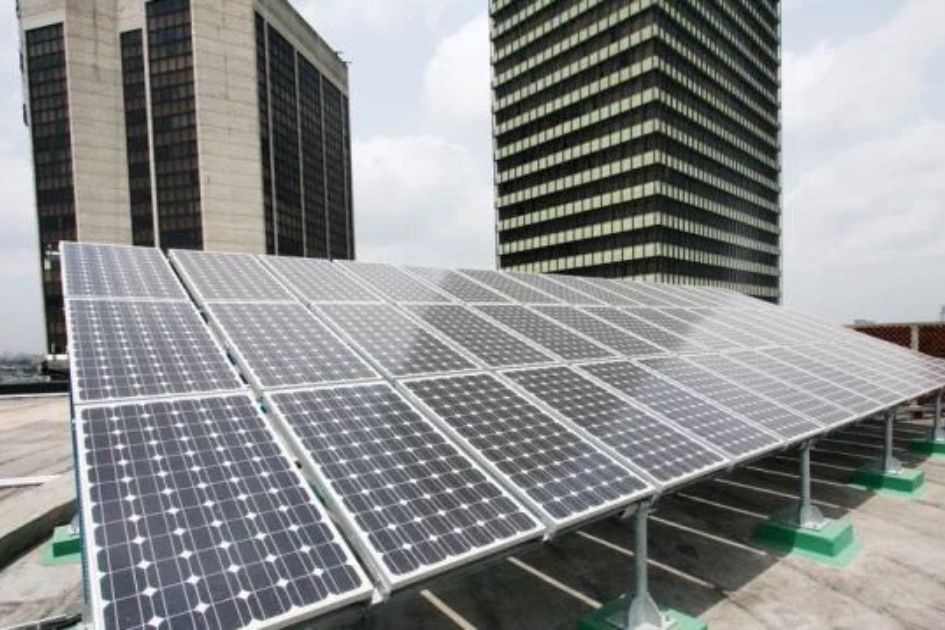
Bangladesh is steadily transforming idle urban rooftops into distributed power stations as part of its expanding renewable energy push, with a flagship 150 kWp solar installation at Biniyog Bhaban in Agargaon emerging as a model of public-utility collaboration.
The project, implemented under the National Rooftop Solar Programme, is hosted by the Bangladesh Investment Development Authority (BIDA) and operated in partnership with the Dhaka Electric Supply Company Limited (DESCO), combining public infrastructure with utility-led investment and operational management.
According to the Climate Budget Report 2026-27, the system generates between 500 and 600 units of electricity daily, or around 15,000 units per month, while reducing carbon dioxide emissions by an estimated 150 to 180 tonnes annually.
The model is based on a cost-sharing and revenue-sharing arrangement in which BIDA provides rooftop space and receives 10 percent of the electricity for institutional use, while DESCO retains 90 percent along with future carbon credit benefits. The structure removes the need for upfront public capital investment while ensuring long-term operational efficiency through utility management.
Built at an initial cost of around Tk 50 lakh, the system is expected to recover its investment within three and a half years, generating an estimated Tk 14-15 lakh annually. Officials say this underscores the financial viability of rooftop solar as a scalable urban energy solution.
Policy observers say the initiative reflects Bangladesh’s broader effort to integrate climate action into national development planning and public infrastructure design. Finance Minister Amir Khosru Mahmud Chowdhury has emphasized that Bangladesh stands at a critical juncture where climate vulnerability intersects with the pursuit of sustainable and inclusive development.
“In this context, climate finance is not merely a source of support; it is a key enabler of resilience, innovation and sustainable development,” the finance minister said in his budget remarks.
Bangladesh has set a target of generating 20 percent of its electricity from renewable sources by 2030, alongside expanding total power generation capacity to 35,000 MW and extending transmission infrastructure to 25,000 circuit kilometres. Longer-term projections aim for 30 to 50 percent renewable energy generation by 2050.
To meet these goals, the government is prioritizing rooftop and utility-scale solar expansion, coastal wind assessments, waste-to-energy pilot projects, domestic renewable energy manufacturing and grid modernization through a National Energy Storage Roadmap. Fiscal incentives, including a zero percent tax rate for the solar sector until 2035 and a 5 percent rebate on consumer solar electricity bills, are also part of the policy framework.
Analysts note that installations such as the one at Biniyog Bhaban demonstrate how underused urban space can be converted into productive energy infrastructure, reducing emissions while generating revenue and improving energy resilience without requiring significant additional land.
Sohanur Rahman, executive coordinator of YouthNet Global, said: “Rooftop solar shows how Bangladesh can turn unused urban spaces into practical clean energy systems that reduce emissions, cut costs and support its path toward a 35,000 MW power future.”
As Bangladesh accelerates its renewable energy transition, rooftop solar is increasingly viewed as a practical and scalable pillar of its urban energy strategy, gradually reshaping the capital’s skyline into a network of decentralized clean power generation.




