

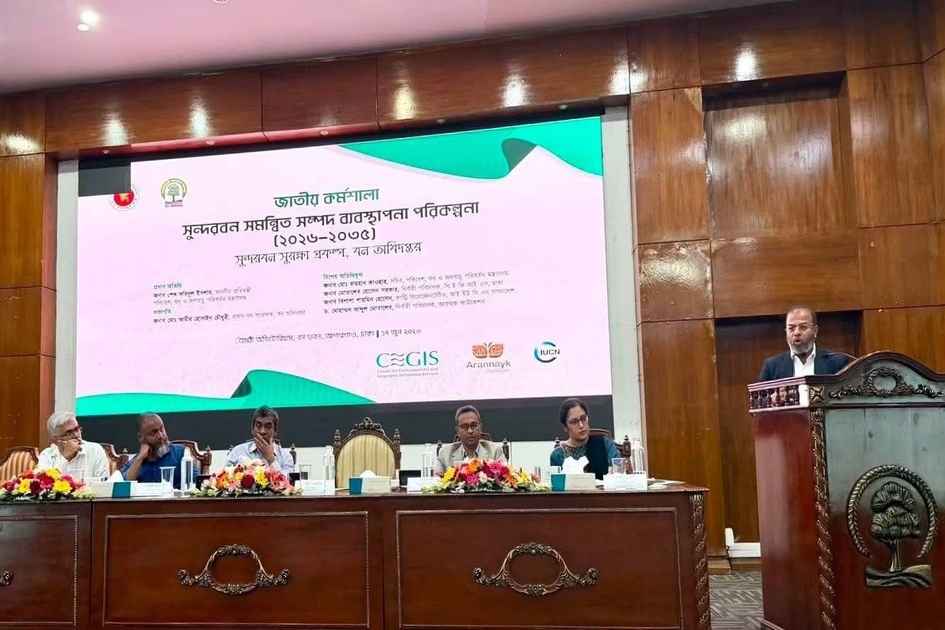



Environment State Minister Shaikh Faridul Islam has criticised costly Sundarbans research proposals, urging realistic budgets as officials discussed a new 2026-2035 management plan for the mangrove forest.
Speaking as chief guest at a national workshop on the “Sundarbans Integrated Resource Management Plan (2026-2035)” at the Forest Department’s Haimanti Auditorium in Agargaon, the minister said some researchers and institutions were seeking excessive funding in the name of scientific work.
“We have professors who, I have noticed, carry a kind of commercial mindset in the name of research. For a single paper, someone may ask for Tk10 lakh, Tk15 lakh, or Tk20 lakh. But universities often submit proposals of Tk2 crore, Tk4 crore, or even Tk5 crore. Why should research cost so much?” he said.
Faridul said inflated budget proposals often create obstacles for research projects and lead to delays or rejection of funding requests.
He stressed the importance of keeping research expenditures within reasonable limits to ensure that studies can be carried out more efficiently.
The workshop was attended by forestry officials and experts who discussed the draft management plan for the Sundarbans covering the period from 2026 to 2035.
Amir Hossain Chowdhury, Chief Conservator of Forests and chair of the event, urged greater government investment in conserving the world’s largest mangrove forest and reducing dependence on donor-funded initiatives.
“When we talk about blue carbon, forest conservation or protection, we often hear whether these activities can be done with donor agencies,” he said.
Highlighting financial constraints, Chowdhury said government support for Sundarbans-related conservation efforts had remained limited over the decades.
“In the last 55 years, government financial support has been received only for the Tiger Conservation Project,” he said.
According to officials, the proposed Sundarbans Integrated Resource Management Plan includes 11 major programmes aimed at strengthening the long-term protection and sustainable management of the forest.
The initiatives cover sustainable forest management, wildlife and habitat conservation, climate change mitigation and adaptation, eco-tourism development, pollution control and co-management activities, among other priorities.
This version follows a wire-service style with a concise headline, strong lead paragraph, clear attribution and smooth narrative flow while preserving every fact and quote from the original report.




