

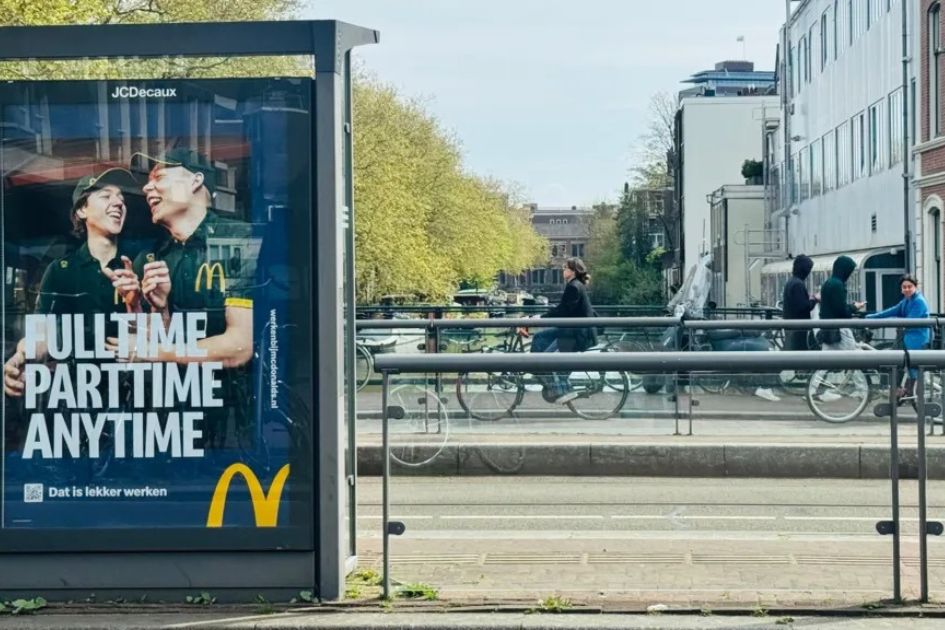

Amsterdam has become the first capital to ban public advertisements for flights, SUVs, fossil fuels and meat, aiming to align municipal spaces with ambitious climate and public health objectives.
Amsterdam, the capital of the Netherlands, has become the world’s first capital city to ban public advertisements for high-carbon products, including flights, cruise holidays, petrol and diesel cars, sport utility vehicles (SUVs) and fast-food meat products, in a landmark move aimed at supporting its climate and public health goals.
The restrictions, which took effect on May 1 following approval by the Amsterdam City Council, apply to advertising spaces owned or controlled by the municipality, including billboards, tram shelters, metro stations and other public properties. They do not prohibit the sale of the products or advertisements on privately owned advertising spaces or digital platforms.
The changes are already visible across the Dutch capital. At many tram stops and metro stations, advertisements once promoting burgers, SUVs and low-cost flights have been replaced by posters for museums, concerts and other cultural events, reflecting the city’s effort to align public spaces with its environmental ambitions.
Amsterdam has pledged to become carbon neutral by 2050 while cutting local meat consumption by half over the same period. City leaders say allowing advertisements that encourage carbon-intensive consumption would undermine those objectives.
“The climate crisis is very urgent,” city councillor Anneke Veenhoff said while defending the policy. “If you want to be a leader in climate policy and you rent out your walls to promote exactly the opposite, then what are you doing?”
She added that many residents question why the municipality should generate revenue by promoting products that conflict with its own environmental policies.
Anke Bakker of the Party for the Animals, who initiated the proposal, rejected criticism that the measure represents government interference in personal choices. She said the policy is intended to reduce the constant marketing pressure from large corporations rather than restrict individual freedom, allowing people to make purchasing decisions without persistent advertising encouraging high-carbon consumption.
The ban covers advertisements for airline travel, cruise holidays, fossil fuel companies, petrol and diesel vehicles, SUVs and fast-food meat products. Supporters say placing meat advertising alongside fossil fuel promotions reflects growing recognition of the livestock sector’s contribution to greenhouse gas emissions, deforestation and biodiversity loss.
Campaigners also argue that fossil fuel companies spend billions of dollars globally each year on advertising, marketing and public relations to promote carbon-intensive products and maintain public support.
The measure has drawn criticism from industry groups. The Dutch Meat Association described the restrictions as “an undesirable way to influence consumer behaviour,” arguing that meat remains an important source of essential nutrients. Meanwhile, the Dutch Association of Travel Agents and Tour Operators said restricting advertisements for holidays involving air travel places unnecessary limits on companies’ commercial freedom.
The Intergovernmental Panel on Climate Change (IPCC) says changes in consumption habits, transport choices and lifestyles could deliver up to 70 percent of the emissions reductions needed globally by 2050 alongside cleaner technologies and renewable energy.
Researchers say removing repeated advertising cues from public spaces may gradually influence consumer behaviour by changing social norms around what is considered desirable or aspirational. Studies have shown that London’s 2019 ban on junk food advertising across its public transport network was associated with reductions in obesity-related health risks and significant healthcare savings. Research in Switzerland also found that restrictions on tobacco billboard advertising contributed to lower smoking rates over time.
Amsterdam is part of a broader movement in the Netherlands to limit advertising for products linked to climate change. Haarlem became the first city in the world to announce a broad ban on most meat advertising in public spaces, with the restrictions taking effect in 2024. Utrecht and Nijmegen have since introduced similar measures, with Nijmegen also restricting dairy advertising on municipal billboards.
Internationally, more than 50 cities have introduced or are considering restrictions on fossil fuel advertising. Stockholm, Edinburgh, Florence and Sydney have adopted similar policies, while France has introduced a nationwide ban on advertising for many fossil fuel products.
Although the new rules do not apply to online advertising, where consumers will continue to encounter promotions for flights, meat products and other carbon-intensive goods, researchers describe Amsterdam’s policy as an important real-world experiment in using public advertising to support climate action.
Whether the restrictions lead to measurable changes in consumer behaviour remains to be seen. However, supporters believe Amsterdam’s approach could provide a model for cities worldwide seeking to align public advertising with climate, environmental and public health objectives while reducing the public visibility of high-carbon products.




