

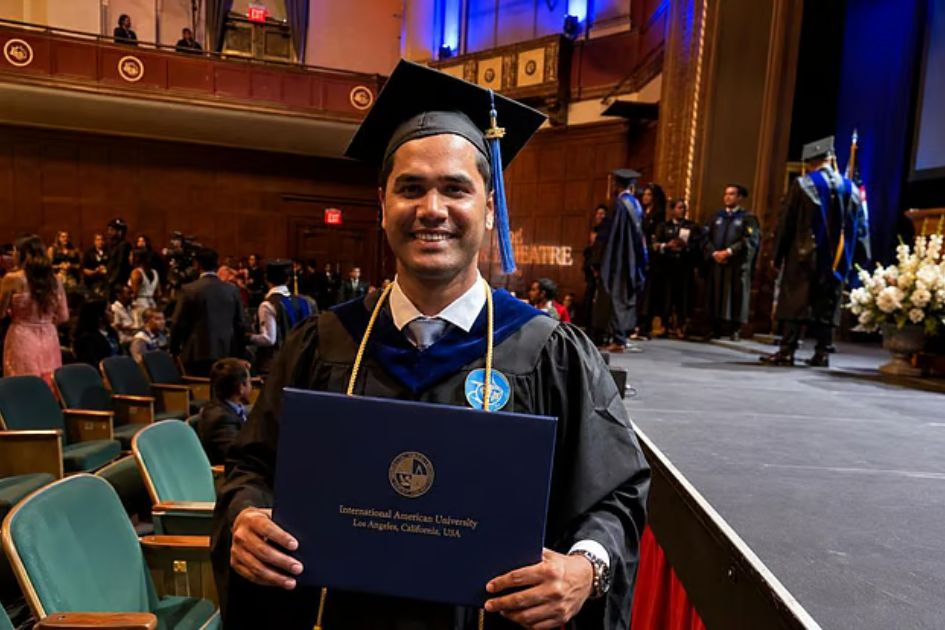



Bangladeshi researcher Azam Khan has won the Global Recognition Award 2026 for pioneering AI energy research, earning international recognition for innovations that improve renewable energy systems, infrastructure reliability and efficiency.
A Bangladeshi researcher whose work focuses on artificial intelligence and energy systems has received international recognition for his research contributions, highlighting the growing role of AI in making power infrastructure smarter, more efficient and more reliable.
Azam Khan was named a recipient of the Global Recognition Award 2026 (Research Category) for his contributions to scientific research. The highly competitive award selects only 5.8 percent of applicants from around 15,000 submissions worldwide each year.
Bangladesh’s energy sector has long measured progress through increases in power generation capacity, transmission infrastructure and the number of power plants. Installed electricity generation capacity has grown from less than 5,000 megawatts in 2009 to more than 30,000 megawatts by 2025 while access to electricity has expanded to more than 99 percent of the population.
However, the country’s future energy challenges require technologies capable of forecasting electricity demand, reducing waste and identifying infrastructure faults before major failures occur. In that changing landscape, Khan has drawn international attention for his research on artificial intelligence, predictive analytics and energy infrastructure reliability.
The impact of his research is reflected in his Google Scholar profile, where his publications have received 307 citations. He has an h-index of 12 and an i10-index of 15. Khan has also published more than 15 peer-reviewed research papers, holds membership in IEEE and owns a patent related to AI integrated data processing and supply chain technology.
A significant part of his research focuses on improving renewable energy systems and modern power management.
One of his notable studies, published in the IEEE Open Journal of the Computer Society, introduced a physics-guided Bayesian neural network for detecting sensor faults in wind turbines. The research combines physics-based models with Bayesian neural networks to create an advanced AI method for identifying sensor failures.
Using real-world data, the model achieved an accuracy of 97.6 percent and a recall rate of 91.8 percent. Through explainable AI techniques, it can also identify the causes of potential failures by analyzing critical indicators including gearbox temperature, blade vibration and generator torque. The system can alert engineers before serious damage occurs.

Bangladesh’s Renewable Energy Policy 2025 aims to generate 20 percent of the country’s electricity from renewable sources by 2030 and 30 percent by 2040.
Khan’s research could play an important role in helping solar and wind power facilities become more data driven and reliable to support those targets.
Another of his studies, titled Optimizing Energy Consumption Patterns in Southern California: An AI Driven Approach for Sustainable Resource Management, presents artificial intelligence-based strategies for energy management. The model could be particularly useful in Bangladesh’s major industrial zones including Gazipur, Narayanganj, Chattogram and Savar by reducing energy waste and improving the international competitiveness of the country’s manufacturing sector.
Beyond academic research, Khan has also applied his expertise in the global manufacturing industry.
He currently works as an Operations Data Analyst at Hyundai Motor Manufacturing in Alabama in the United States, where he is involved in projects related to machine learning, data analytics and energy efficiency.
His future research plans include integrated data systems, predictive maintenance, carbon-conscious AI and improving the energy efficiency of power-intensive digital infrastructure such as data centers.
Speaking to Prothom Alo via WhatsApp, Khan said, “The future of energy systems is not only about generating more electricity. Artificial intelligence can now make more accurate decisions on how much electricity will be needed at a particular time, where faults may occur and where energy is being wasted. At the same time, AI technology itself must become stronger and more efficient.”
He said Bangladesh’s energy sector had once focused primarily on increasing electricity generation but the next major challenge would be making every unit of electricity smarter, more efficient and more sustainable.
Khan was born and raised in Bangladesh. After studying at educational institutions in Barishal and Dhaka, he moved to the United States for higher education. He completed a master’s degree in Management Information Systems at the International American University in Los Angeles.
Before moving into international research, he worked in data analytics in Bangladesh’s ready-made garment and hospitality sectors.
He is currently an active member of IEEE and ORCID. His contributions to the United States economy and sustainable technological leadership have also enhanced Bangladesh’s international image.
Khan’s long-term goal is to strengthen critical infrastructure through artificial intelligence while making it more environmentally sustainable.
This post is republished from Daily Prothom Alo.




